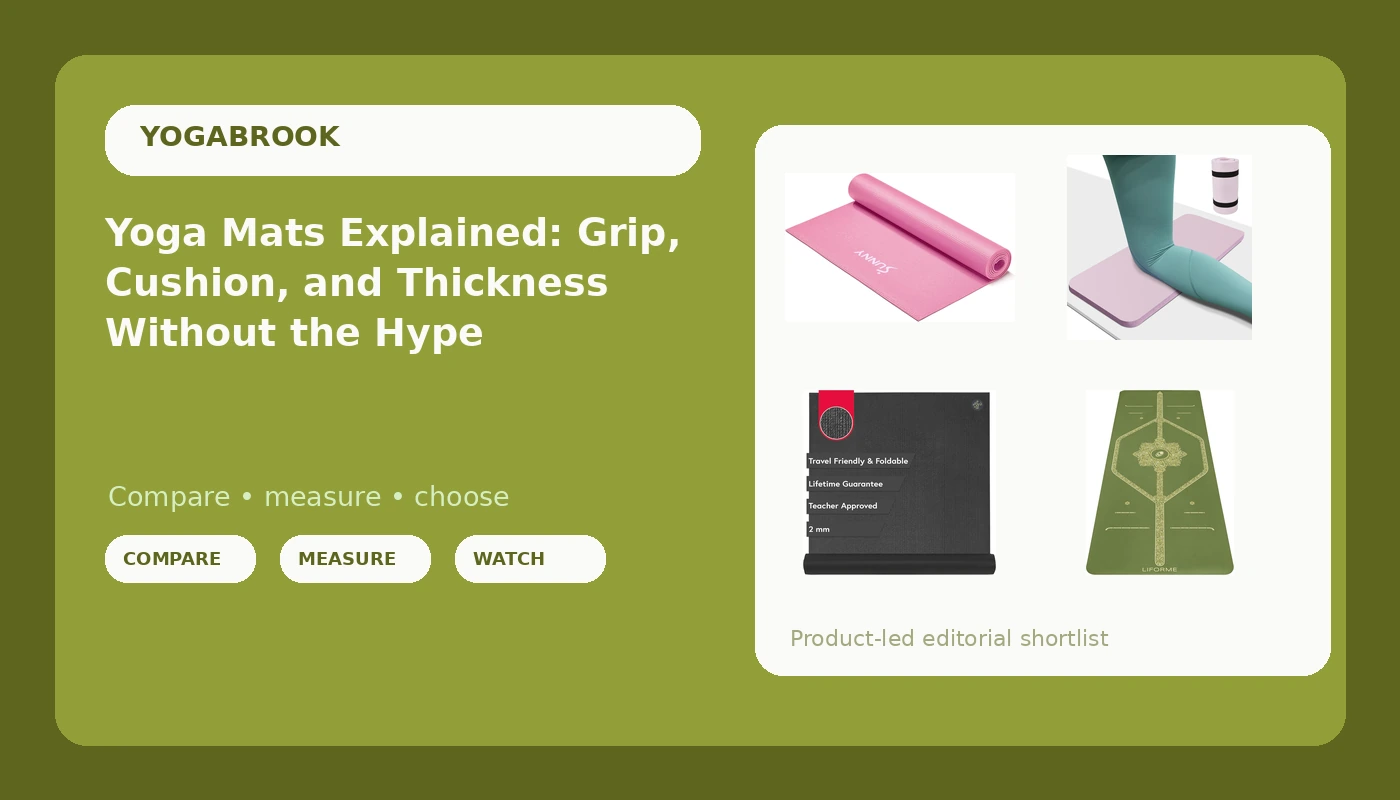
Yoga mats are one of the few pieces of gear where the marketing and the physics disagree most of the time. The box says non-slip. It rarely says when. The box says 6mm. Your palms in downward dog usually disagree. If you are shopping for yoga mats for home practice, the useful question is not which one is nicest, it is which one fits the floor you actually practice on, the joints you actually have, and the way you actually get to class. What follows is a breakdown of four options by what each is built to do, plus the material facts that separate a mat you keep from a mat you replace every eighteen months.
Related: How to Clean a Yoga Mat Without Killing the Grip →
Quick answer
No single mat covers every situation, so choose by constraint rather than by hype. If you practice at home on a hard floor and want to spend as little as possible, the Sunny Health & Fitness mat is the entry point. If kneeling, planks, or a sensitive knee is the limiting factor, the Yoga Knee Pad Cushion adds cushion exactly where a full mat cannot. If you need something that folds into a bag and goes with you, the Manduka PRO Travel is the thin, packable option. If holding position in a sweaty class is the whole problem, the Liforme Printed mat sits at the premium end of the range.
Four useful options
| Model | Best fit | What stands out |
|---|---|---|
| Sunny Health & Fitness Exercise Yoga Mats | Home and gym practice on a budget | An inexpensive all-purpose mat described as non-slip for general use |
| Yoga Knee Pad Cushion, 24 x 9.8 x 0.8 in | Kneeling, planks, and sensitive knees | NBR foam pad with a listed 0.8 in thickness and a storage strap |
| Manduka PRO Travel Yoga Mat | Travel, small rooms, and packing | 2mm foldable construction with a manufacturer lifetime durability claim |
| Liforme Printed Yoga Mat | Sweaty practice and alignment | Patented alignment design and a grip-first top layer |
The budget starter: Sunny Health & Fitness Exercise Yoga Mats
The honest case for a mat at this end of the range is not that it performs like a premium one. It is that most people quit or commit within the first year, and a mat that gets used daily beats a better mat that stays rolled in a closet. What you give up is longevity and consistent wet grip. Foam and PVC topsheets can break down, and inexpensive mats are the ones most likely to go slick in a hot room or start flaking at the edges after a couple of years of rolling and unrolling. If your practice is at home, unheated, and mostly on carpet or a rug, that trade is a reasonable one.
The joint support piece: Yoga Knee Pad Cushion, 24 x 9.8 x 0.8 in
Here is the distinction that matters most in this whole category: cushion and grip are different properties, and one does not buy the other. A pad this thick under your knee solves pressure. It does nothing about the fact that your palms are still on a slick surface in warrior two. Thick foam also compresses, so a pad that feels wonderful in a kneeling lunge can feel unstable under a standing balance if you try to use it as your whole mat. Use it as a supplement, placed under knees, forearms, or a hip in pigeon, and it earns its place in the bag.
The travel mat: Manduka PRO Travel Yoga Mat
Two millimeters is not a cushion, it is a barrier, and that is the point. On a studio floor or a hotel carpet it gives you a consistent surface and a clean one, which is the real reason travel mats exist. What it will not do is protect knees in camel pose or soften a hardwood floor for a long restorative practice. Density matters more than thickness here: a dense 2mm mat supports your palms better in downward dog than a spongy 6mm mat that lets your hands sink. If you have knee or wrist history, plan on pairing a mat like this with the knee pad rather than choosing between them.
The premium option: Liforme Printed Yoga Mat
Alignment markings are the underrated feature here. If you have ever finished a flow and discovered you have crept a foot and a half toward the front of your mat, the printed lines give you a reference point that a plain mat cannot. The trade-offs are real, though. A premium price buys a top layer that needs care, and grip-first surfaces tend to show wear and scuffing sooner than a plain PVC mat does. If you practice hot, that is a fair exchange. If you practice twenty minutes of gentle stretching twice a week, you are paying for capability you will not use.
Prices and availability may change. Product images, names, and retailer links must be matched by verified ASIN. Do not state a current price, rating, stock status, or measured result without current evidence.
Why "non-slip" on the box is an incomplete claim
Grip is a chemistry problem more than a texture problem. The bumps and ridges stamped into a mat are mostly there to sell the mat in a photograph. What actually decides whether your hand slides is the material of the top layer and what happens to it when moisture arrives.
Dry grip is relatively easy. Almost any mat with a rubbery surface holds when your palms are dry and the room is cool. Wet grip is where the category splits. PVC and standard foam topsheets tend to get slick once sweat pools on them, which is why the same mat can feel fine in a Tuesday evening class and treacherous in a heated room at minute forty. Polyurethane and natural rubber topsheets handle moisture far better, which is why the mats marketed on grip tend to be the ones with a specific top-layer material named in the description.
So the practical move is to read for the material, not the adjective. "Non-slip" without a "when dry" qualifier is marketing. If a listing names its top layer and its construction, you can reason about it. If it only says non-slip and shows a photo of a mat in a white studio with no one on it, you have learned nothing.
What thickness numbers actually tell you
Thickness is cushion. It is not stability, and it is not grip. Those are three separate things that buyers routinely bundle into one number.
A 2mm mat is a barrier between you and the floor. It is stable, it packs small, and it transmits the floor directly into your wrists and knees. A 6mm mat is comfortable to kneel on and noticeably less stable for standing balances, because foam compresses under your hands and feet. The thicker the mat, the more you sink, and the more your ankles and wrists work to find a stable position. Extra thickness is not extra quality. It is a different set of compromises.
There is also a caliper gap to watch for. Listed thickness is often measured at the mat's thickest point, while the edges and the areas that get compressed in storage end up thinner. When a listing quotes a measurement, treat it as the ceiling rather than the floor. For a pad sold as 0.8 inches, the useful question is not whether it is thick enough to kneel on, it is whether it stays put under you while you do it.
How to choose in five steps
- Name the floor you practice on most. Carpet, hardwood, studio laminate, and hotel carpet all ask different things of a mat.
- Name the pose that hurts. Knees, wrists, and hips each point at a different product, and only one of them is solved by a thicker mat.
- Name your sweatiest class. If you practice hot, prioritize the top layer material over thickness, every time.
- Name how the mat travels. If it goes in a bag, folding matters more than cushion. If it lives on a floor, the reverse is true.
- Name the budget you will still feel fine about in two years, not the one that looks good today.
Practical guidance
- A mat you roll out daily beats a better mat you use twice a month. Buy for the practice you have now.
- Give any new mat a few sessions to settle. Some surfaces change with body heat and use, and first impressions are not always final.
- Clean with a diluted gentle soap and water, then dry it fully before rolling. Trapped moisture is what makes mats smell.
- Store rolled, not folded, unless the mat is designed to fold. Creases become weak points over time.
- If a mat starts sliding on the floor beneath it, fix that before you blame your hands. A rug pad or a damp towel under the mat solves more slipping than any topsheet upgrade.
Which option should you choose?
Choose the Sunny Health & Fitness Exercise Yoga Mats when you are starting at home, practicing unheated, and want to spend as little as possible while you find out whether the habit sticks. Choose the Yoga Knee Pad Cushion, 24 x 9.8 x 0.8 in when kneeling and floor contact are the actual problem, and you want cushion you can move around independently of your mat. Choose the Manduka PRO Travel Yoga Mat when portability is the constraint and you need something that folds flat into a bag without giving up a consistent surface. Choose the Liforme Printed Yoga Mat when you practice hot, your hands are the thing that fails, and alignment markings would genuinely change how you move.
One caveat before you buy: these four are not competitors in the same race. Two are full mats with opposite priorities, one is a pad, and one is a compromise between cushion and price. Comparing them on price alone will lead you to the wrong answer, because the cheapest option here cannot do what the most expensive one does, and the most expensive one cannot do what the pad does either.
The bottom line
Buy for the constraint, not the spec sheet. If your floor is hard and your practice is unheated, a low-cost all-purpose mat plus a small foam pad under your knees will cover more real situations than a single premium mat. If you practice hot, spend on the top layer, because that is the only thing standing between you and your hands. If you practice in a different city every week, accept that 2mm is thin on purpose and plan your cushioning separately. Whichever you pick, the mat that gets unrolled on a Tuesday is the one doing the work.