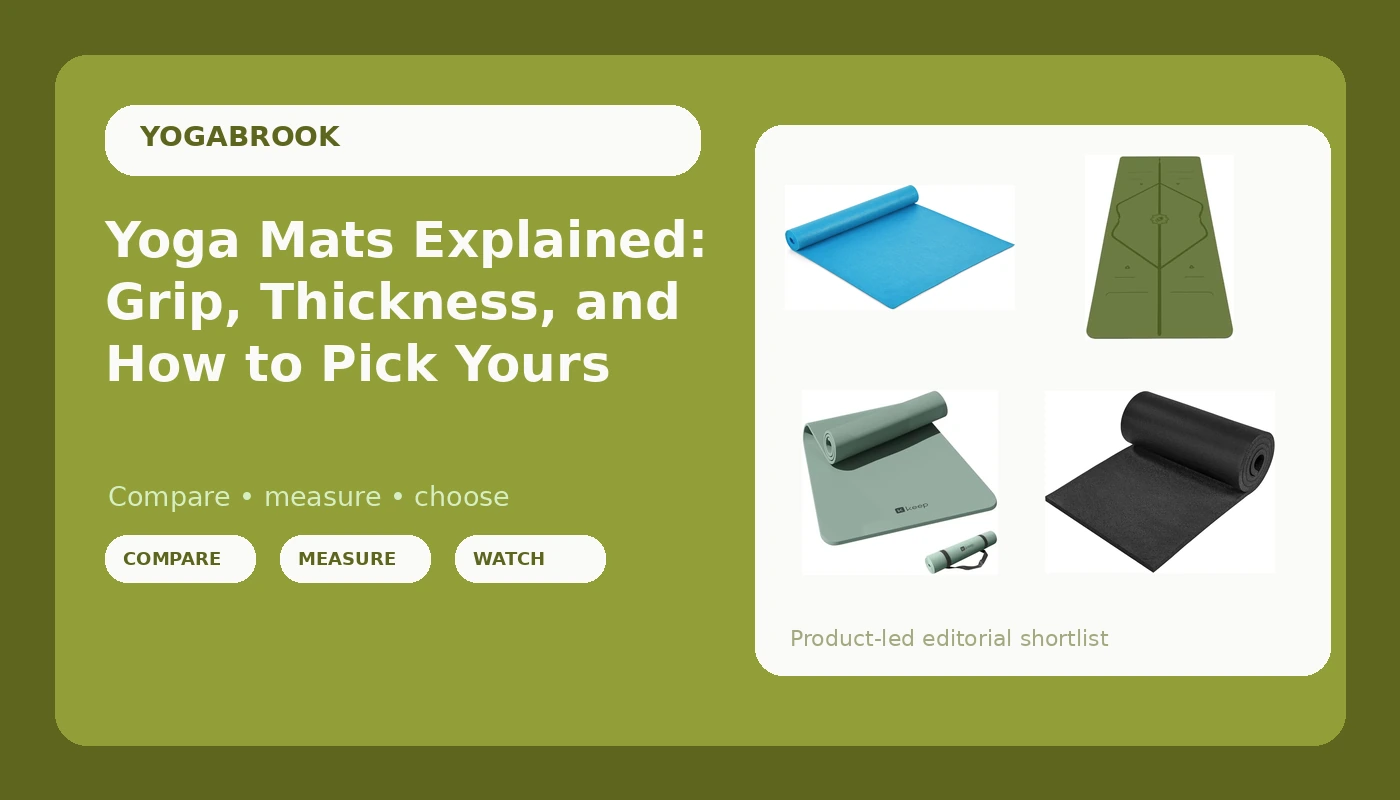
Walk into any studio and you will see the same scene: a wall of mats in every color, and a handful of students quietly adjusting their hands because one of them is sliding. Yoga mat grip and thickness are the two specs that decide whether you spend a class thinking about your breath or about your wrists, and they are also the two specs most often reduced to a sticker on the packaging. Grip is largely chemistry, meaning what the top layer is made of. Thickness is largely arithmetic, with a real trade-off hiding inside it. Get both roughly right and almost any mat will serve you for years. Get them wrong and you will be shopping again in six months. Below are four options that sit at different points on that scale, from a light roll-up mat to a premium alignment mat to a wide and heavily cushioned mat to plain closed-cell foam padding, along with a way to tell which one your practice actually needs.
Related: How Thick Should a Yoga Mat Be? →
Quick answer
There is no single best yoga mat, because the right answer depends on your floor, your room temperature, and your joints. If you want the short version: choose a mat that holds your hands when they are damp, that is thick enough for your knees but thin enough that you can still feel the floor in a standing balance, and that you will actually carry to class. The CAP Non-Slip Yoga Mat is a lightweight roll-up option for home practice and Pilates. The Liforme Classic Yoga Mat is built around alignment markings and a grip-focused top surface. The KEEP Extra Wide Yoga Mat trades portability for width and cushion. The neoprene padding is not a mat at all; it is a cushion for knees, seats, and hard floors. Do not treat a thicker mat as an automatic upgrade. Treat it as a different tool.
Four useful options
| Model | Best fit | What stands out |
|---|---|---|
| CAP Non-Slip Yoga Mat for Home Workout & Pilates | Light home practice, Pilates, travel | Lightweight, rolls up small, textured grip surface |
| Liforme Classic Yoga Mat | Alignment-focused flow and hot rooms | Patented alignment design and a grip-focused top layer |
| KEEP Extra Wide Yoga Mat, 7mm Thick 72" x 32" | Tall practitioners and wide stances | Extra wide footprint with 7mm of cushioning |
| 1/2" Thick × 13" Wide × 60" Long Closed-Cell Foam Neoprene Padding | Knees, hips, seats, and hard floors | Thick closed-cell neoprene cut as a narrow pad |
Lightweight starter: CAP Non-Slip Yoga Mat for Home Workout & Pilates
The case for a mat like this is simple: it lowers the cost of starting, and starting is the hard part. A light mat is also the one that actually leaves the house, which matters more than most buyers expect. The trade-off is durability and wet grip. Thin, lightweight mats compress under your palms and knees, and a textured surface is not the same thing as a surface that holds when your hands are damp. If you practice in a cool room at home, this is a sensible first mat. If you practice in a heated room or you sweat heavily, read the grip section below before you commit.
Alignment and grip: Liforme Classic Yoga Mat
Alignment markings sound like a gimmick until you have taught a room of people who all drift two inches to the right over a ninety minute class. A printed center line and hand and foot markers give you something external to check against, which is useful when you are learning and surprisingly useful when you are tired. The trade-off is price and surface care. Premium grip layers tend to be softer, and soft top layers scuff, stain, and mark. That does not make them worse mats, but it does mean you should expect visible wear if you practice often. If you are choosing between this and a cheaper mat, be honest about whether the markings and the grip tier are worth it to you. If you teach, or you practice hot, the answer is often yes. If you roll out a mat twice a week in a cool room, probably not.
Wide and cushioned: KEEP Extra Wide Yoga Mat, 7mm Thick 72" x 32"
Extra width is the most underrated spec in the category. A standard mat is roughly 24 inches wide, and anyone with broad shoulders or a wide stance spends half of every standing sequence with one hand on the floor instead of the mat. The trade-off is stability and portability. A 7mm mat compresses more under your hands than a thin one, and on a thick, soft surface you have to work harder to hold a steady line in balances. It is also heavier and bulkier to carry. The honest framing: this is an excellent mat for a home practice on a hard floor, and a less good choice for a hot class or a lot of standing balance work on one leg. Buy the width if width is your problem. Do not buy the thickness as a substitute for strength.
Padding, not a mat: 1/2" Thick × 13" Wide × 60" Long Closed-Cell Foam Neoprene Padding
Every studio I have taught in has a stack of pads like this somewhere, and they get used more than anyone admits. Half an inch of closed-cell foam under a knee changes a long floor sequence completely, and because it is closed-cell it does not soak up sweat the way a sponge-like open-cell foam would. The catch is that at 13 inches wide it is far too narrow to practice on, and at half an inch thick it is far too soft to stand on. Use it as a supplement, not a replacement: put it under the knee in lunges, under the hips in seated forward folds, under the seat in meditation, or under a thin mat on a concrete floor. If you have a knee or hip history, this is often a better purchase than a thicker mat, because you get the cushion exactly where you need it without destabilizing the whole surface.
Prices and availability may change. Product images, names, and retailer links are matched to the verified product records. Do not state a current price, rating, stock status, or measured result without current evidence.
Why grip is a chemistry question, not a texture question
A mat can feel wonderfully tacky in the shop and turn into a slip-and-slide forty minutes into a warm class, and the reason is that texture and traction are two different things. Texture is what your fingertips register when the surface is dry. Traction is what happens when a thin film of sweat sits between your palm and the mat. Almost every mat material grips well when dry. They separate when they get wet, and that is where the marketing language gets vague.
The materials break down roughly like this. PVC and other vinyl foams are closed-cell, cheap, durable, and wipe clean easily; they also tend to be the slickest when wet and they are the least eco-friendly option on the shelf, whatever the packaging says. Natural rubber grips well dry and lightly damp, but it is porous, so it absorbs sweat and eventually odor. Polyurethane top layers are the wet-grip champions of the category and the most expensive to make. Cork grips better when damp than when bone dry, but it stains and it holds a smell. None of these is a moral choice. A mat you keep for five years is better for the planet than a compostable one you replace every season.
Two practical consequences follow. First, the word "non-slip" on a box almost never appears alongside the words "when dry," and that omission tells you a lot. Read a non-slip claim as a claim about a dry hand unless the listing says otherwise. Second, break-in is real. Denser closed-cell mats can ship with a residue from manufacturing that needs to wear off before the surface behaves the way you want, and until it does you are effectively practicing on a release agent. If a new mat feels slick for the first few weeks, that is often normal rather than a defect, but if it is still slick at month three, it is not going to change.
Thickness, cushion, and the trade-off nobody mentions
Thickness printed on a box is a claim, not a measurement. Two mats both labeled 6mm can feel completely different under your palms, because what you actually feel is how far the surface compresses under your body weight, not the number at the edge. Cushion protects knees, wrists, and hips in floor work, which is genuinely valuable. Cushion also puts a layer of squish between you and the floor in standing poses, which is exactly what you do not want when you are trying to hold a straight line on one leg.
A rough map of the range: thin mats around 3 to 4mm are for travel and for people who want maximum connection with the floor; the middle band around 5 to 6mm is the all-round compromise most people end up in; 7mm and up is comfort-first and best on hard floors; and half-inch foam padding is not a mat at all but a targeted cushion. The thing to watch for is sink. If your palms visibly compress the mat in downward dog and your wrists feel like they are reaching for a floor that keeps moving away, the mat is too soft for you, regardless of what the number says.
Five steps to decide, in order:
- Measure your space and your body. If you are tall or you like a wide stance, check the width and length before anything else. The KEEP mat is 72 by 32 inches; a standard mat is closer to 68 by 24.
- Name the room. A cool living room and a heated studio make completely different demands on the same mat.
- Decide what your joints need. Knee and hip padding is a different problem from standing stability, and they are sometimes solved by two different products.
- Look at what is under the mat. Carpet, hardwood, sprung studio floor, and concrete all change how a given thickness feels.
- Set a carrying budget. Weight and rolled size decide whether the mat ever leaves your house, and a mat at home beats a better mat in the closet.
Practical guidance before you buy
- Test grip with damp hands, not dry ones. If you can visit a shop, breathe on your palms first.
- Wipe, do not soak. Closed-cell mats tolerate a damp cloth; porous rubber and cork do not want to be drenched.
- Store rolled, not folded. Fold creases become permanent weak points and they collect grit.
- Give a new mat a fair break-in window before you decide it is defective, but set a deadline for that judgment.
- Buy padding for padding and a mat for practice. Half-inch neoprene under your knee is a tool; half-inch neoprene under your whole body is a wobble.
- If your knees or hips hurt consistently in floor poses, see a professional. A mat can cushion a joint; it cannot diagnose one.
Which option should you choose?
Choose the CAP Non-Slip Yoga Mat for Home Workout & Pilates when you want a light, inexpensive mat for home workouts, Pilates, and cool-room practice, and you need something that rolls up small enough to travel. Choose the Liforme Classic Yoga Mat when alignment markings matter to your practice and you want the grip-focused top layer, and you are prepared for a premium price and a surface that shows wear. Choose the KEEP Extra Wide Yoga Mat when length and width are your real problem, when your hands keep landing on the floor in wide stances, or when you practice on a hard floor and want cushioning. Choose the 1/2" Thick × 13" Wide × 60" Long Closed-Cell Foam Neoprene Padding when your issue is specific joints on hard ground, and you want a cushion to place under knees, hips, or a seat rather than a whole new mat.
One caveat on all of this: listings describe a product, not your experience of it. Thickness, width, and material are the facts you can compare. Grip and comfort depend on your sweat, your floor, and your joints, and no spec sheet knows those. Buy from a seller with a return window you can live with, and give yourself permission to send a mat back if it slides.
The bottom line
Grip and thickness are the two decisions that matter, and they pull against each other. More cushion means less stability; more grip often means a softer top layer that scuffs sooner. Match the mat to the room and the floor you actually practice on, buy the width if your hands keep missing the mat, and buy separate padding if your problem is a knee rather than a whole practice. A cheap mat you use four times a week will teach you more than a premium one you are afraid to unroll. Start somewhere, keep a note of how it behaves at minute forty, and let that note decide your next purchase.