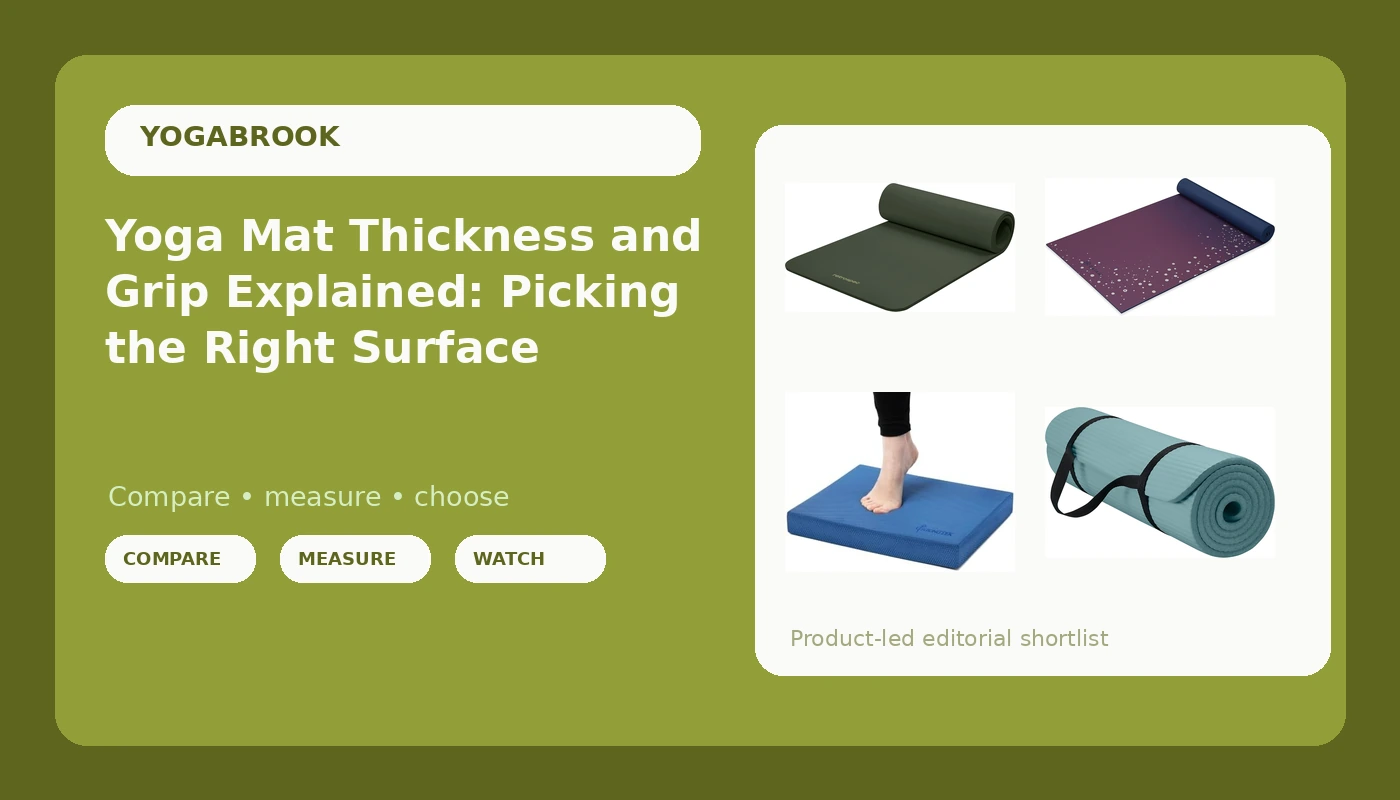
Most mat problems are not flexibility problems. They are surface problems. The student who cannot hold a lunge without wobbling is usually standing on something too soft. The student whose palms slide by minute 40 is usually standing on a top layer that was chosen for its looks. Yoga mat thickness and grip are the two variables that decide whether a practice feels steady, and they pull in opposite directions: every millimeter of foam you add takes away a little of the feedback your feet need. This explainer covers what thickness actually changes under bodyweight, why grip is a chemistry question rather than a texture question, and how the four products below divide the work between cushioning, everyday practice, and balance training.
Related: How to Clean a Yoga Mat Without Ruining the Grip →
Quick answer
For most people, a mat in the 5 to 6 mm range is the sensible middle: enough cushion for knees and wrists, not so much foam that standing balances turn into a wobble. A half-inch mat suits stretching, floor work, Pilates, and anyone whose joints want more padding. A foam balance pad is an accessory for ankle, knee, and single-leg stability work, not a substitute for a mat. Buy for grip first and cushion second, because cushion is a comfort problem and grip is a safety problem.
Four useful options
| Model | Best fit | What stands out |
|---|---|---|
| Retrospec Solana Yoga Mat Thick 1/2in Non-Slip Workout Mat with Nylon Strap | Stretching, Pilates, and joints that want padding | Half-inch thickness, 72 x 24 inch surface, nylon strap included, BPA-free and easy to clean |
| Gaiam Thick Yoga Mat, Exercise & Fitness Mat with Easy-Cinch Carrying Strap | A thick everyday mat for home practice | Thick cushioning paired with an easy-cinch carrying strap |
| Gaiam Premium Yoga Mat, 6mm Thick Print Mat | General practice where balance matters | 6 mm thickness in a printed design |
| StrongTek Foam Balance Pad, High-Density TPE, 15.8 x 13 x 2 in, Non-Slip | Balance and single-leg stability training | High-density TPE foam, 15.8 x 13 x 2 inches, non-slip surface |
Cushion-first pick: Retrospec Solana Yoga Mat Thick 1/2in Non-Slip Workout Mat with Nylon Strap
The trade-off with any half-inch mat is stability. Foam compresses under your palms and feet, and the more it compresses, the more your ankle and knee joints have to work to hold a line. In a slow stretch class or a Pilates session on a wood floor, that cushion is a gift. In a standing sequence with a lot of single-leg work, the same mat asks more of your balance. If your knees hurt in kneeling poses and your wrists complain in tabletop, this is the direction to go. If your practice is mostly standing postures, look at the 6 mm option below instead.
Thick everyday mat: Gaiam Thick Yoga Mat, Exercise & Fitness Mat with Easy-Cinch Carrying Strap
Thick mats in this category tend to be the ones people actually roll out at home, because they are forgiving on a living room rug or a concrete basement floor. The easy-cinch strap matters more than it sounds: a mat that lives rolled loosely in a closet develops corner curl, and corner curl is how people trip during a transition. If you practice at home a few times a week and want one mat that handles stretching, a short flow, and a few crunches, this sits in that lane. The thing to watch is the same as above: thicker foam means less ground feedback, so if you are working on balance, keep your expectations honest.
Middle ground: Gaiam Premium Yoga Mat, 6mm Thick Print Mat
Six millimeters is where a mat stops being a mattress and starts being a floor you can read. It is thick enough to take the edge off kneeling and thin enough that your standing leg gets real information back. The printed surface is a cosmetic choice, but cosmetics are not nothing: a mat you like looking at is a mat you use on a Tuesday. The honest limitation is that no mat in this thickness class is a cushioning solution for genuinely angry knees, and no printed top layer is a guarantee of wet grip in a hot room. Treat it as a general practice mat and it will do its job.
Stability accessory: StrongTek Foam Balance Pad, High-Density TPE, 15.8 x 13 x 2 in, Non-Slip
A balance pad is not a yoga mat and should not be sold to you as one. It is a training tool: you stand on it, and the foam gives just enough that your ankle, knee, and hip have to make constant small corrections. That is useful for rehabilitation and for anyone whose single-leg balance has gotten shaky, and it is genuinely useful for standing balance poses once you are ready for a harder version of them. It is not useful for a vinyasa flow, and you would not want it under your hands in downdog. Buy it as a supplement to a mat, not instead of one.
Prices and availability may change. Product images, names, and retailer links must be matched by verified ASIN. Do not state a current price, rating, stock status, or measured result without current evidence.
What thickness actually changes
Thickness is not a comfort dial. It is a stability dial with a comfort side effect. When you press your palm into a mat in downdog, the foam compresses under your hand. The more it compresses, the more your wrist has to do to hold the angle, and the less your palm can tell you where the floor is. The same thing happens under your standing foot in warrior two: a soft mat lets the foot sink, the ankle rolls slightly, and the knee follows.
There is no universal correct number, only a trade. Roughly, mats fall into three bands. Thin mats, in the 3 to 4 mm range, give the most ground feel and the least padding, and they are common among people who practice often and want stability in standing poses. Middle mats, around 5 to 6 mm, are the compromise most people should start with. Thick mats, from about 8 mm up to a half inch, prioritize joint comfort and floor work, and they ask more of your balance.
Two details matter more than the headline number. The first is where the mat is thick. A mat that tapers at the edges feels different underfoot than one with a uniform slab of foam. The second is how the foam behaves over time. Foam that compresses permanently develops soft spots, and a soft spot under your standing foot is a stability problem, not a comfort feature. That is why the box number and the long-term feel of a mat are not the same thing.
Why grip is a chemistry question, not a texture question
Texture sells mats. Chemistry decides whether you slide. A deeply embossed top surface feels grippy in a shop at room temperature, and that same surface can go slick once sweat and body heat are involved, because what you are actually touching is the material, not the pattern.
Mat top layers fall into a few families, and each behaves differently when damp. PVC is the traditional workhorse: inexpensive, durable, and variable, because two PVC mats can have completely different top layers. Natural rubber has excellent dry grip and is made from tree rubber rather than petroleum, but it absorbs sweat and can hold odor. Polyurethane tops are the ones people describe as sticky when wet, and they are usually paired with an absorbent layer underneath. Cork grips well when damp and stains over time. TPE, the foam family used in the balance pad above, is lightweight and often used for travel and fitness surfaces.
The practical consequence is simple. A "non-slip" claim on a box almost always means non-slip when dry. If you sweat heavily or practice in a heated room, weight the wet behavior of the top layer far more heavily than the pattern, and consider a thin towel over the mat rather than replacing the mat entirely.
- Decide whether cushion or ground feel is the priority for the practice you actually do most weeks.
- Match the thickness band to that answer: 3 to 4 mm for stability, 5 to 6 mm for general practice, 8 mm and up for joint comfort and floor work.
- Check the footprint against your body, since a standard 72 x 24 inch mat is short for taller practitioners in certain poses.
- Ask how the mat behaves when damp, not just when dry, if you sweat or practice hot.
- Confirm what comes in the box, including whether a carrying strap is included or sold separately.
Practical guidance
- Roll your mat with the top surface facing out, so the grip layer is not pressed against itself in storage.
- Store it standing or loosely rolled rather than folded, since folds create permanent creases that never fully relax.
- Wipe the surface after sweaty sessions and let it dry fully before rolling, because trapped moisture is what turns into odor.
- Expect a break-in period on some surfaces. New foam can feel slicker than it will after a few weeks of use.
- Replace a mat when it develops soft spots or edge lift, not on a calendar. A compressed mat is a stability problem you cannot stretch your way out of.
- Keep a balance pad for balance work and a mat for practice. Using one as the other makes both jobs harder.
Which option should you choose?
Choose the Retrospec Solana Yoga Mat Thick 1/2in Non-Slip Workout Mat with Nylon Strap when your priority is padding for stretching, Pilates, and floor work, and your joints want more between you and a hard floor. Choose the Gaiam Thick Yoga Mat, Exercise & Fitness Mat with Easy-Cinch Carrying Strap when you want one cushioned mat for home practice and general fitness, with a strap that stays with it. Choose the Gaiam Premium Yoga Mat, 6mm Thick Print Mat when you want the middle ground for a regular practice where standing balance still matters. Choose the StrongTek Foam Balance Pad, High-Density TPE, 15.8 x 13 x 2 in, Non-Slip when you are training single-leg stability or rebuilding ankle and knee control alongside your mat work.
The caveat is that none of these distinctions come from a lab test in this article. They come from how thickness and top-layer material behave in general, and from the specifications each product lists. Your bodyweight, the floor under your mat, and how much you sweat will shift the answer more than any spec sheet will.
The bottom line
Start with the thickness band that matches the practice you do most often, not the one you intend to do someday. For a general home practice, a 6 mm mat is the safest default and the Gaiam Premium sits in that band. For stretching, Pilates, and joints that need padding, the half-inch Retrospec Solana with its included strap is built for that job. The Gaiam Thick mat covers the same cushioned ground with an easy-cinch strap if you want a thicker everyday option. And if balance is the thing you are actually working on, add the StrongTek foam pad to the routine rather than asking a thicker mat to do a balance pad's work. Grip first, cushion second, and buy the mat you will unroll on a Tuesday.