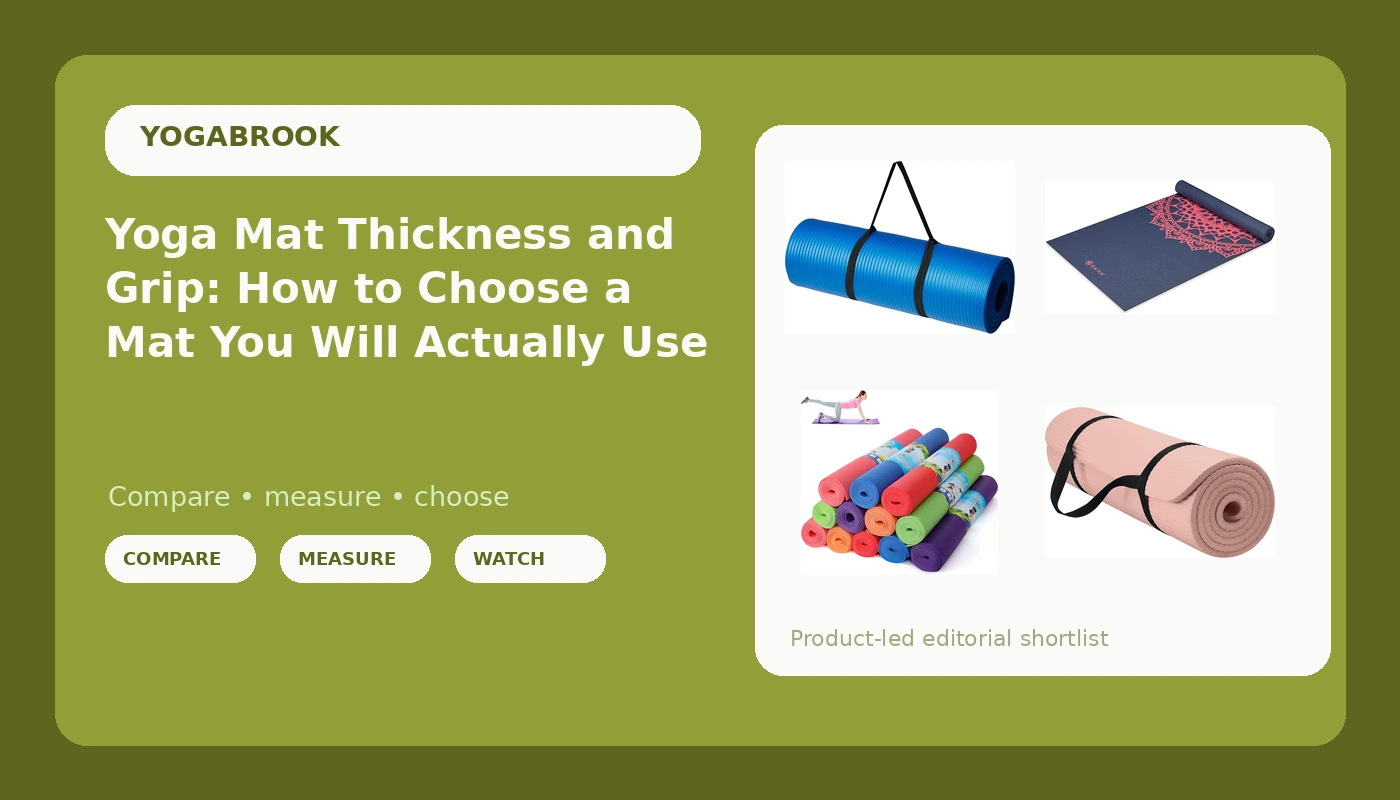
Yoga mat thickness and grip are the two specifications that decide whether a mat works for you, and they are also the two that packaging explains worst. A mat labeled extra thick can feel like soft sand under your palms in downward dog, and a mat labeled non-slip can hold fine while you are cool and turn unreliable the moment you sweat. If you are buying a first mat, replacing one that has gone slick, or outfitting a studio, an office, or a class set, the useful order of operations is to decide what you need the mat to do, then read the numbers with that job in mind.
Disclosure first, because it belongs at the top: this site earns a commission when you buy through the links in this article. The four mats below are included because of what their product records actually describe, not because anyone paid for a placement, and nothing here is a sponsored ranking.
Related: How to Break In a Slick New Yoga Mat →
Quick answer
Match thickness and surface to how you practice, not to how much cushioning sounds comfortable. A mat in the 4mm to 6mm range covers most home and studio practice: enough padding for knees, wrists, and a stiff low back, little enough compression that standing balances stay stable. Go thicker for seated, restorative, and floor-based work, or for sensitive joints over a hard floor. Go thinner when stability matters more than cushioning. And if you need mats for a group rather than one person, buy a bulk pack and treat the mats as consumables.
4 useful options
| Model | Best fit | What stands out |
|---|---|---|
| Amazon Basics Extra Thick Exercise Yoga Mat with Carrying Strap | One person who wants cushioning on a budget | Extra thick cushioning with a carrying strap included |
| Gaiam Yoga Mat Classic Print, 4mm Non-Slip Mat | Everyday home and studio practice | A 4mm profile with a printed top surface |
| Amylove 12 Pieces Yoga Mats Bulk, 68x24x0.12 Inch | Studios, offices, and group sets | Twelve mats per pack, each 68 by 24 by 0.12 inch |
| Gaiam Thick Yoga Mat, Exercise & Fitness Mat with Easy-Cinch Carrying Strap | Cushioned home practice with easy transport | Thick cushioning plus an easy-cinch strap |
The cushioned budget pick: Amazon Basics Extra Thick Exercise Yoga Mat with Carrying Strap
The trade-off with any extra thick mat is stability. Foam that compresses under your palms in downward dog also compresses under your feet in warrior two and tree pose, and the more it compresses, the harder your ankle has to work to hold the line. If your practice is mostly standing poses and balance work, this mat is a comfort-first choice, and you should know that going in. If your practice is mostly seated stretching, restorative holds, or floor work at home, the extra give is exactly what you want. The included strap matters more than it sounds: a thick mat is bulky to carry, and a strap keeps it rolled tightly instead of unspooling across a lobby floor.
The everyday standard: Gaiam Yoga Mat Classic Print, 4mm Non-Slip Mat
The honest caveat on any non-slip claim is that grip depends on the chemistry of the top layer, the amount you sweat, and the floor underneath. A 4mm mat with a smooth or lightly textured surface tends to hold well dry and can get slick in a heated room once your hands and feet are wet. That does not make it a bad mat. It makes it a good mat for unheated vinyasa, hatha, and general fitness, and a less certain choice for hot practice. The thinner profile also means the mat packs down smaller and weighs less than a thick mat, which is the practical reason so many regular practitioners land here.
The group and studio option: Amylove 12 Pieces Yoga Mats Bulk
The case for a bulk pack is arithmetic, not romance. If you run a workplace wellness session, a school program, a church hall class, or a rental studio that supplies mats, buying twelve thin mats usually costs less than buying three thick ones, and a thin mat laid over a carpeted or sprung floor can be perfectly adequate. The case against it is comfort: 0.12 inch is not much between your knee and a hard floor, and anyone in your group with knee or hip sensitivity will want something thicker or a folded blanket under the joint. Buy this for logistics, and be honest with yourself that it is a logistics purchase.
The cushioned mat with a quick strap: Gaiam Thick Yoga Mat with Easy-Cinch Carrying Strap
The same trade-off applies here as with any thick mat: cushion and stability pull in opposite directions. More foam means softer landings for knees and elbows, and it also means more compression under your hands and feet in standing poses. For a home practice that leans toward stretching, yin, restorative, or general fitness, that is a reasonable bargain. For a practice built on one-legged balance and long holds in warrior three, a thinner mat will usually feel steadier. The strap is the detail that separates this from a bare thick mat, and if you have ever chased a half-unrolled mat across a parking lot, you already know why it is worth having.
Prices and availability may change. Product images, names, and retailer links must be matched by verified ASIN. Do not state a current price, rating, stock status, or measured result without current evidence.
What thickness actually changes
Thickness is a cushioning spec, not a quality spec, and the number on the box is usually a nominal figure for the mat at its thickest point. What matters in practice is how much the surface compresses under body weight. A mat that gives two or three millimeters under your palm in downward dog is doing its job. A mat that sinks visibly under your hands changes the angle of your wrist and pushes more work into your forearms and shoulders, which is why very thick foam mats are a poor fit for long weight-bearing sequences.
As a rough map of the category: mats around 3mm to 4mm prioritize stability and packability, and they are the usual choice for people who practice regularly and travel with a mat. Mats around 5mm to 6mm are the common middle ground, adding joint comfort without much wobble. Mats at 8mm and above, including the extra thick and thick options above, are comfort-first. They suit seated work, restorative practice, floor stretching, and anyone whose knees complain on a hard floor, and they are the wrong tool for standing balance work.
What decides grip
Grip is a surface and moisture question more than a texture question. A deeply embossed pattern feels grippy in the store, but what holds your hand in place during a sweaty flow is the material at the very top of the mat and how it behaves when it is wet. Most entry-level mats use a PVC-based top layer. PVC is durable, inexpensive, and easy to clean, and its friction drops noticeably once your palms are damp. That is not a defect, it is a property, and it is why the same mat can feel secure in a hatha class and slippery in a heated one.
Three practical implications follow. First, if you sweat heavily or practice in a warm room, plan on a towel over the mat or a mat with a more absorbent top surface. Second, grip changes as a mat ages: body oils, sunscreen, and cleaning products all build up on the surface, and a mat that felt tacky when new can feel slicker at month eighteen for reasons that have nothing to do with the manufacturer. Third, the floor under the mat matters. A mat on a smooth wood or laminate studio floor can slide as a unit even when your hands are not slipping on it, which is why corner curl and edge lift are worth checking before you commit to a mat for a class setting.
How to choose in five steps
- Write down where you will use it most: a heated studio, an unheated studio, a carpeted living room, a gym with rubber flooring, or a hard floor at home.
- Decide whether you need cushioning or stability more. Knees and hips complaining points toward thicker; balance poses and wrist comfort point toward thinner.
- Estimate your sweat level during a typical class. Heavy sweater means plan for a towel or an absorbent top layer, not just a "non-slip" label.
- Check the length and width against your height. A standard 68 by 24 inch mat leaves taller practitioners with hands or feet near the edge, which is uncomfortable in wide-legged poses.
- Decide whether you are buying for one person or a group. One person buys a mat, a group buys a pack, and the two decisions should not be mixed.
Practical guidance before you buy
- Roll a new mat out flat for a day or two before class. Most curling at the ends is packaging memory, not a permanent defect.
- Wipe a new mat with a damp cloth and mild soap, then let it dry fully before the first session. Many mats arrive with a film from manufacturing.
- Skip oil-based cleaners and heavy sprays. They leave residue that reduces friction, which is the opposite of what you want.
- Store the mat rolled, not folded, and keep it out of direct sun. Heat and UV both age foam faster than use does.
- If you practice hot, budget for a towel from the start rather than replacing the mat when grip fades at minute forty.
- Set a realistic lifespan expectation. A daily practice on a thin budget mat is a different wear rate than twice a week on a cushioned one.
Which option should you choose?
Choose the Amazon Basics Extra Thick Exercise Yoga Mat with Carrying Strap when you want the most cushioning for the least money and your practice is mostly home, seated, restorative, or floor-based. Choose the Gaiam Yoga Mat Classic Print, 4mm Non-Slip Mat when you want a thinner, steadier everyday mat for unheated studio classes and general fitness. Choose the Amylove 12 Pieces Yoga Mats Bulk when you are equipping a group, an office, a school, or a rental studio and need twelve mats rather than one. Choose the Gaiam Thick Yoga Mat with Easy-Cinch Carrying Strap when you want cushioning plus a strap that makes carrying and storing the mat simple.
Thickness and grip claims vary by listing and by production run, and friction depends on your sweat, your body weight, and the floor beneath you, so a mat that holds well for one person can feel slick to another. Treat these specs as a starting filter, buy from a seller with a workable return policy, and let the first few classes tell you what the packaging could not.
The bottom line
Thickness buys comfort and costs stability, and no mat escapes that trade. If your joints need the cushion, the extra thick options here make sense, and the Amylove pack makes sense when the mat is for a group rather than a person. If your practice is built on standing poses and you want one mat that does most things well, the 4mm Gaiam Classic Print is the middle ground to beat, provided you keep a towel nearby in a warm room. Whichever you pick, the mat that works is the one you unroll on an ordinary Tuesday, so weight your decision toward the practice you actually do rather than the one you plan to start.