Two people unroll mats in the same studio, on the same floor, and by minute 20 one of them is quietly fighting her mat while the other has forgotten hers exists. The difference is rarely willpower. It is yoga mat thickness and grip, two specs that pull against each other and that almost no box explains honestly.
The problem starts with how mats get sold. Thickness is marketed as comfort, so the number on the label climbs and buyers assume more is better. Grip is marketed as texture, so mats arrive covered in bumps and ridges and buyers assume they will hold. In practice, a mat that is too thick compresses under your palms, which makes standing balances feel like balancing on a sponge, and a textured surface can still turn slick the moment your hands get wet. If you have ever blamed your balance for what was really a mat problem, the fix is usually a spec decision, not a willpower decision.
Related: How to Stop Your Yoga Mat From Sliding Mid-Flow →
Quick answer
There is no single best yoga mat, and a guide that hands you one is selling something. The practical answer is to match thickness to your joints and your floor, and match the top layer to how much you sweat. A 1/4 inch TPE mat covers most beginners practicing at home on carpet or wood. A multi-thickness mat with a carrying strap covers mixed use, travel, and shared households. A premium mat built around an alignment design makes sense when wet grip and consistent hand placement matter more than the money. And a small knee pad solves one specific problem, cushioning knees, wrists, and elbows, without forcing a thicker mat on the rest of your practice.
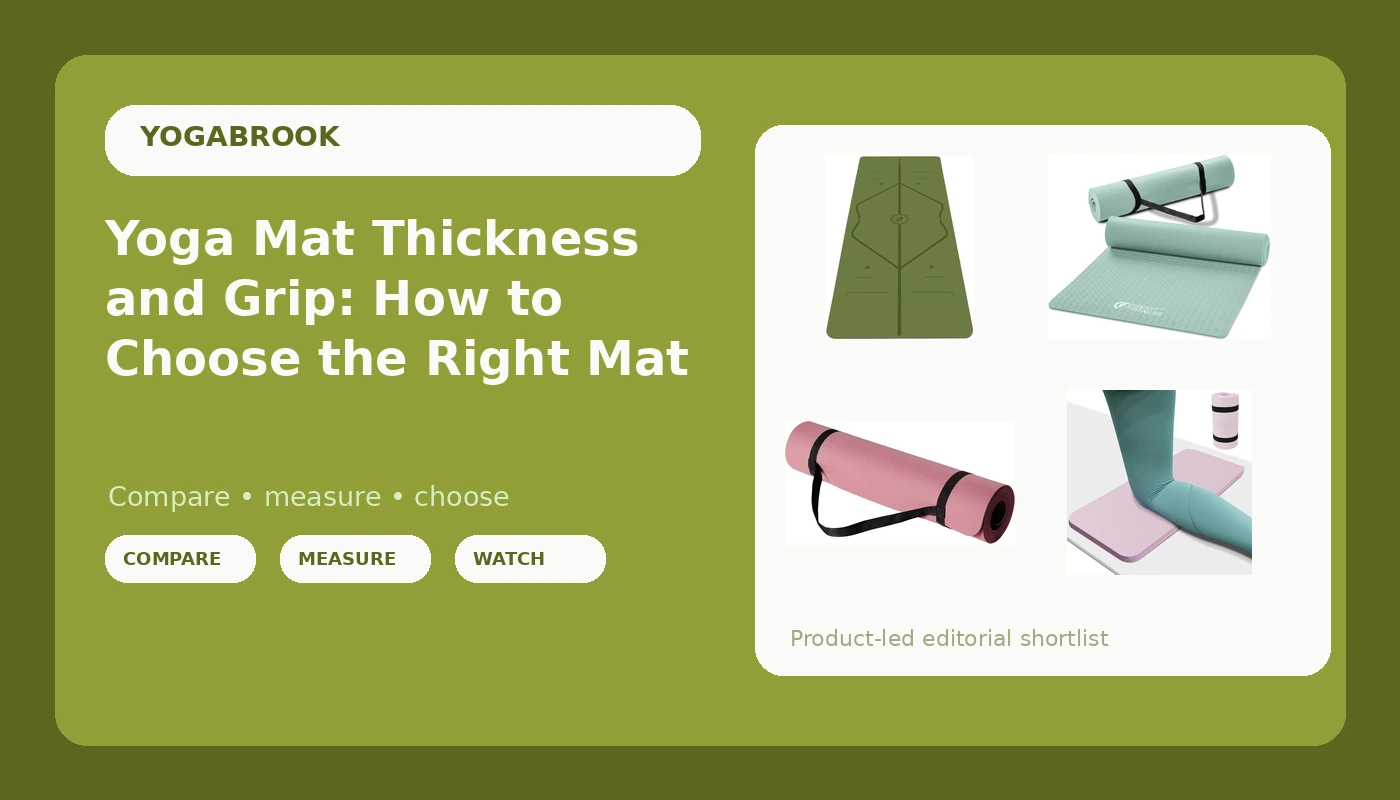
Four useful options
| Model | Best fit | What stands out |
|---|---|---|
| Liforme Classic Yoga Mat - Patented Alignment Design, Ultimate Grip | Hot rooms and alignment-focused practice | Patented alignment design and a top layer the listing describes as ultimate grip |
| Amazon Basics 1/4 Inch Thick TPE Exercise Yoga Mat with Carrying Strap | Beginners and everyday home practice | 1/4 inch TPE cushioning with a carrying strap |
| Circuit Fitness by Marcy Non-Slip Multi-Purpose Exercise Yoga Mats with Carrying Strap Multi-Thickness, Multi-Color Options | Budget buyers who want a choice of thickness | Multiple thickness and color options, a non-slip surface, and a carrying strap |
| Yoga Knee Pad Cushion, 24 x 9.8 x 0.8 in Thick Mini Yoga Mat, Odor-Free NBR Workout Mat with Storage Strap, Small Exercise Mat for Yoga, Pilates, Kneeling, Planks & Home Gym | Knees, wrists, and elbows on hard floors | A 24 x 9.8 x 0.8 inch NBR pad with its own storage strap |
The grip-first option: Liforme Classic Yoga Mat - Patented Alignment Design, Ultimate Grip
Alignment markings sound like a gimmick until you teach a room of beginners. The most common problem I see in a first class is drift: students creep forward through a flow until their hands are half off the front edge by the third sun salutation. A mat that shows hand and foot placement gives you a reference point that survives sweat and fatigue, and it is the reason teachers keep recommending this mat to students who have already bought one cheap mat and one slick mat.
The trade-offs are real. This is the premium option in this group, and a grip-focused top layer usually asks for more care than a basic foam mat: wipe it down, do not leave it baking in a hot car, and expect surface scuffs if you drag it across pavement. It is also not a cushioning mat. If your knees hurt in kneeling poses, the answer is a pad, not a thicker version of this.
The everyday option: Amazon Basics 1/4 Inch Thick TPE Exercise Yoga Mat with Carrying Strap
A quarter inch is roughly 6mm, which is the thickness band most beginners are happiest in. It is enough cushion to take the edge off a hard floor for seated and supine work, and thin enough that your standing leg still gets something solid to push against. That balance is the whole reason this thickness keeps showing up in entry-level mats.
TPE is the reason this mat stays light. It is a foam rather than a rubber, so it is easier to carry and easier to wipe, and it tends to be softer underfoot than a dense rubber mat. The flip side is durability and wet grip. TPE mats generally do not hold up as long as a well-made rubber or PVC mat, and they are not the material I would choose for a hot room. Treat this as a first mat or a home mat for a dry practice, not a decade-long purchase.
The flexible budget option: Circuit Fitness by Marcy Non-Slip Multi-Purpose Exercise Yoga Mats with Carrying Strap Multi-Thickness, Multi-Color Options
Choice of thickness inside one product line is more useful than it sounds. Thickness preference is personal and it correlates with things you already know about yourself: how much your knees complain in child's pose, how much your balance wobbles in tree pose, whether your practice floor is carpet or concrete. Being able to stay inside one line while moving up or down a thickness band means you can correct a mistake without changing brands.
Multi-purpose is the honest framing here. A mat like this is built for yoga, stretching, floor work, and the kind of home-gym use where one surface has to do several jobs. It is not a specialist mat, and it is not marketed as one. The non-slip claim in the listing is the standard dry-surface claim, so read it the way you should read every mat's non-slip claim: it means grip while dry, and it tells you nothing about minute 40 of a heated class.
The joint cushion add-on: Yoga Knee Pad Cushion, 24 x 9.8 x 0.8 in Thick Mini Yoga Mat, Odor-Free NBR Workout Mat with Storage Strap, Small Exercise Mat for Yoga, Pilates, Kneeling, Planks & Home Gym
This is the piece of gear I wish more students bought before they bought their second mat. The usual pattern is that kneeling poses hurt, so the student replaces a thin mat with a thick one, and then every standing balance gets worse. A pad breaks that loop. You keep the firm, grippy mat you already own for standing work, and you slide a cushioned rectangle under your knees for the poses that need it.
The dimensions matter more than the material here. At 24 inches long and just under 10 inches wide, this covers a kneeling position with room to shift, and at 0.8 inches thick it is substantially more cushion than any mat provides. It is also useful under forearms in plank and under wrists in positions where your body weight concentrates on a small area. The limit is obvious: it is a pad, not a mat, so it does not replace anything for standing poses.
Prices and availability may change. Product images, names, and retailer links are matched to verified listings. No current price, rating, stock status, or measured result is stated here without current evidence.
Why the thickness number on the box is not the whole story
Thickness and cushion are not the same thing, and the gap between them is where most buying mistakes live. A mat can be 6mm thick and feel firm, or 4mm thick and feel mushy, because what your palms register is how far the foam compresses under load. Press a hand into a mat in downward dog and watch how far it gives. A millimeter or two of give is fine and kind to your wrists. Six millimeters of sink turns every balance pose into a negotiation with your own mat.
There is also the gap between the number printed on the box and the number you get when you measure the mat at its thinnest edge. Foam compresses in a roll, edges taper, and mats advertised at an inch routinely measure under an inch. That is not a scandal by itself, but it tells you how carefully the rest of the spec sheet was written.
The trade-off runs in two directions. Cushion protects knees, hips, and wrists during floor work and restorative poses. Firmness protects balance, because your standing leg needs a surface that pushes back. Thicker mats also weigh more and roll wider, which matters if you walk or bike to class. For most people the honest answer is a middle thickness for the main mat plus a small pad for the poses that actually hurt.
Grip is a chemistry problem, not a texture problem
Texture sells mats. Chemistry decides whether you slide. The top layer of a mat is a materials question: what it is made of, how it behaves when your skin is dry, and what happens once sweat or water sits on the surface for twenty minutes.
PVC, still the most common mat material, can be formulated to grip well when dry and wipes clean easily, but it is the least environmentally friendly option and cheap formulations can go slick as they age. TPE is a lighter foam, popular at entry level; it tends to be softer and less durable than a good PVC or rubber mat. Natural rubber grips well with minimal moisture, but it absorbs sweat, and an uncleaned rubber mat can develop an odor over months. Polyurethane and similar grip-focused top layers are where the strong wet-grip claims live, usually paired with a heavier backing. Cork is the newer contender: it grips well when damp, but it stains and picks up the smell of whatever it is stored beside.
Two conclusions follow. First, "non-slip" without the words "when dry" anywhere on the packaging is a claim to read with suspicion. Second, if you practice hot, your budget should go toward the top layer, not the thickness.
How to choose in five steps
- Check your practice floor. Carpet forgives a thin mat; concrete and tile do not. If you practice on a hard floor, add cushion rather than assuming a thin mat will be fine.
- Audit your joints before your ego. Knees, wrists, and hips that complain in kneeling or tabletop positions are a pad problem, not a mat-thickness problem.
- Time your sweat. If your hands get wet within the first fifteen minutes of class, wet grip should outrank every other spec on your list.
- Weigh portability honestly. A heavier, denser mat usually grips and lasts better, and it is also the mat you will resent carrying across town.
- Decide whether you need one mat or one mat plus a pad. For a lot of people with cranky knees, the second option is cheaper and better than buying a thicker mat.
Practical guidance
- Buy for the practice you actually do, not the one you plan to start. A home stretching routine does not need a hot-room mat.
- Roll a mat out on the shop floor if you can, press a palm into it, and see how far it sinks before you commit.
- Wipe a new mat down before the first class. Manufacturing residue is a common reason a mat feels slick out of the tube.
- Store mats rolled, not folded, and out of direct sun. Folds become creases and creases become weak points.
- If you already own a mat that grips well and hurts your knees, add a pad before you replace the mat.
Which option should you choose?
Choose the Liforme Classic Yoga Mat - Patented Alignment Design, Ultimate Grip when wet grip and consistent hand placement are the two things you care about most and the premium price is acceptable. Choose the Amazon Basics 1/4 Inch Thick TPE Exercise Yoga Mat with Carrying Strap when you are starting out, practicing at home on a soft floor, and want a light mat you can carry without thinking about it. Choose the Circuit Fitness by Marcy Non-Slip Multi-Purpose Exercise Yoga Mats with Carrying Strap Multi-Thickness, Multi-Color Options when you want to pick your thickness and color at a budget level and your mat has to serve stretching, floor work, and general home exercise. Add the Yoga Knee Pad Cushion, 24 x 9.8 x 0.8 in Thick Mini Yoga Mat, Odor-Free NBR Workout Mat with Storage Strap, Small Exercise Mat for Yoga, Pilates, Kneeling, Planks & Home Gym when your knees, wrists, or elbows need cushioning but you do not want a thick mat under your standing poses.
One caveat: material and thickness descriptions here come from the product listings, not from measurements taken on these specific mats. Grip claims in particular are worth testing in your own conditions, because sweat rate, room temperature, and floor surface change the answer more than any spec sheet does.
The bottom line
Thickness buys comfort for your joints and costs you stability in your balances. Grip comes from the top-layer material and how it behaves once you are wet, not from how bumpy the surface looks. The sensible sequence is to pick the thickness your floor and joints require, then pick the material your sweat rate demands, then add a small pad if a few poses still hurt. A mat you roll out on a Tuesday beats a mat that lives in a closet, and a cheap mat you keep using for years beats a premium mat you are afraid to sweat on.