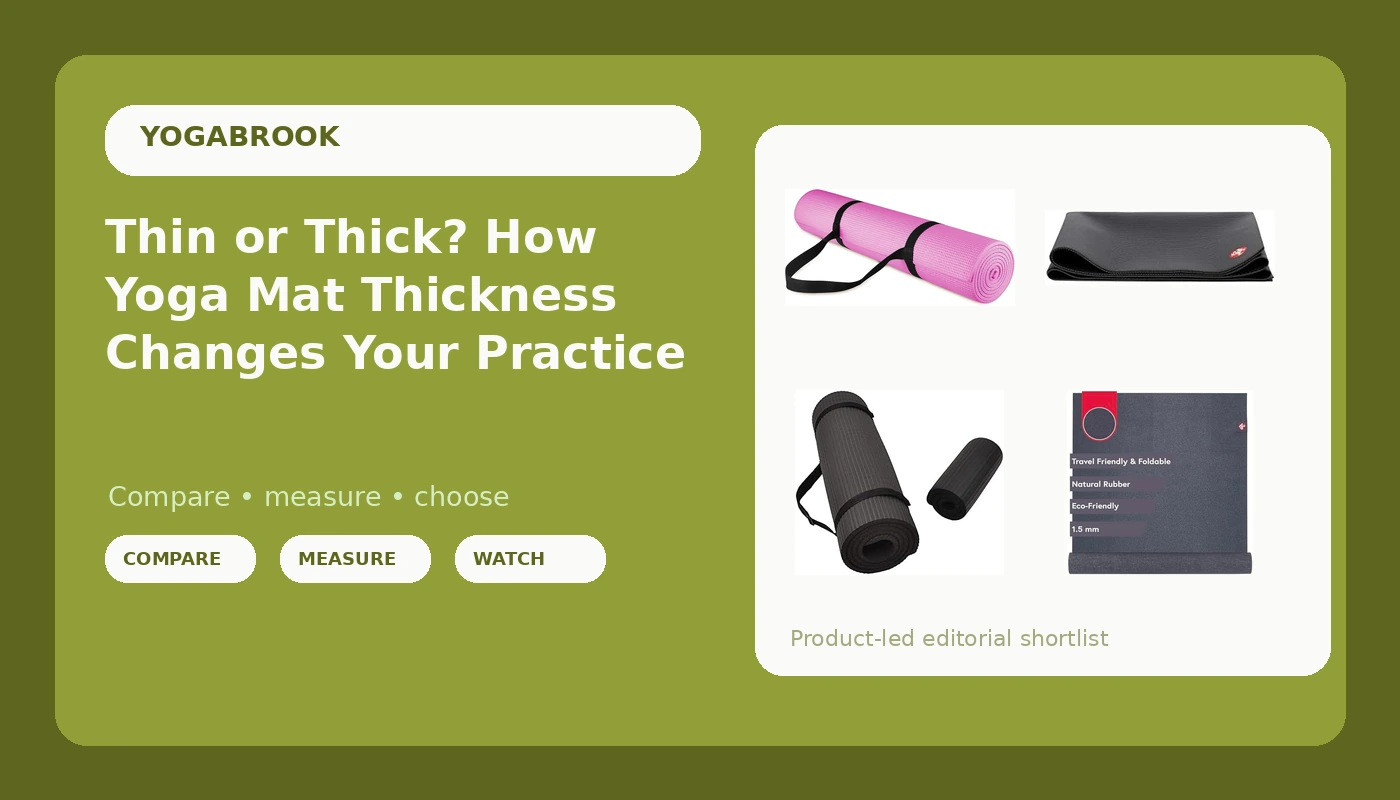
Yoga mat thickness is the number every listing leads with and almost nobody explains. It matters because thickness settles two things at once, and they pull in opposite directions: how much your knees, hips, and wrists are cushioned when you kneel or press into the floor, and how stable you feel when you stand on one leg. This is an explainer rather than a ranking. This site earns a commission from the Amazon links below, and the four mats here were chosen because their listings describe distinct, checkable specs, not because anyone paid for placement. If you have been staring at a wall of mats that all claim to be non-slip and extra thick, the goal here is to give you a way to sort them before you spend anything.
Related: How to Clean a Yoga Mat Without Killing the Grip →
Quick answer
Yoga mat thickness is a trade-off between cushioning and stability. As a rough map: mats around 1.5 to 2 mm fold flat, travel well, and put you close to the floor; mats around 1/4 inch (roughly 6 mm) are the general-purpose middle; mats around 1/2 inch (roughly 12.7 mm) cushion knees and wrists on hard floors but compress under standing balances. Grip is a separate question, decided by what the top layer is made of rather than how it is textured. Choose the thickness your joints need first, then choose the material that stays put when you sweat.
Four useful options
| Model | Best fit | What stands out |
|---|---|---|
| Fitvids All Purpose 1/4-Inch High Density Anti-Tear Exercise Yoga Mat with Carrying Strap with Optional Yoga Blocks, Multiple Colors | A first studio or home mat at a middle thickness | Stated 1/4-inch high-density build, anti-tear surface, included carrying strap, optional blocks, multiple colors |
| Manduka PRO Travel Yoga Mat - 2mm, Foldable and Travel Friendly | Folding a mat into a bag for class, hotels, and travel | Stated 2 mm thickness, foldable design, lifetime durability language, hygienic construction |
| Fitvids All Purpose 1/2-Inch Extra Thick High Density Anti-Tear Exercise Yoga Mat and Knee Pad with Carrying Strap, Multiple Colors | Hard floors and joints that want cushion | Stated 1/2-inch thickness, high-density anti-tear build, knee pad use, carrying strap, multiple colors |
| Manduka eKO SuperLite Yoga Mat - 1.5mm Natural Rubber, Foldable and Travel Friendly | A thin mat with a natural rubber surface | Stated 1.5 mm thickness, natural rubber, soft textured surface, foldable, eco-friendly positioning |
The all-purpose studio mat: Fitvids All Purpose 1/4-Inch High Density Anti-Tear Exercise Yoga Mat with Carrying Strap with Optional Yoga Blocks, Multiple Colors
The appeal of a quarter-inch mat is that it does not ask you to choose a side. It is thick enough for a knee-down lunge on a wooden studio floor and thin enough that your palms do not sink in downdog. The trade-off is that the stated thickness is a spec sheet number, not a measurement taken at the thinnest edge of the mat, and foam density varies from brand to brand at the same thickness. A 6 mm mat that compresses easily behaves like a much thinner one under your hands. If you are buying your first mat for a weekly class, this is the thickness bracket to shop in, and the included strap removes one small reason to leave it at home.
The folding travel mat: Manduka PRO Travel Yoga Mat - 2mm | Foldable & Travel Friendly | Lifetime Durability | Teacher Approved | Hygienic Construction
A 2 mm mat is the opposite trade-off from an extra-thick one. Hotel carpets, borrowed floors, and studio mats that are not yours all become usable when you bring your own thin layer, and folding beats rolling when bag space is the constraint. What you give up is cushioning: kneeling poses on a hard surface will feel like kneeling on a hard surface. Some people solve that by folding the mat double under their knees for the few poses that need it, which works because the mat is thin enough to fold flat. If your knees are sensitive and travel is occasional rather than constant, a thin mat plus a folded towel is usually more comfortable than carrying a heavy one you will not pack.
The extra-thick option: Fitvids All Purpose 1/2-Inch Extra Thick High Density Anti-Tear Exercise Yoga Mat and Knee Pad with Carrying Strap, Multiple Colors
Thickness this generous is a genuine answer to a real problem, and it is also the reason some people hate thick mats. The more a mat compresses under bodyweight, the more your wrists and shoulders work to hold a straight line in downdog, and the less clearly you feel the floor in a standing balance. That does not make a thick mat wrong; it makes it a specialist. If your practice is largely restorative, floor-based, or knee-heavy, and the surface you practice on is hard, the extra foam earns its keep. If your practice is mostly standing vinyasa, the same foam will make every warrior feel slightly less planted than you would like.
The natural rubber travel mat: Manduka eKO SuperLite Yoga Mat - 1.5mm Natural Rubber | Foldable & Travel Friendly | Soft Textured Surface | Eco-friendly
Natural rubber is porous in a way that closed-cell PVC is not, which is why rubber surfaces tend to hold grip as moisture builds instead of going glassy. The costs are real too: porous rubber absorbs sweat and takes on smell over time, it needs to be cleaned and dried rather than rolled up damp, and anyone with a latex allergy should treat a rubber mat as off limits. At 1.5 mm this is the thinnest mat in this group, so it is a travel and hot-room companion rather than a cushion for sore knees. It is also the option here that folds rather than rolls, which is what makes it practical to bring to a class where mats are provided but not always clean.
Prices and availability may change. Product images, names, and retailer links are matched to verified listings. No current price, rating, stock status, or measured result is stated here without current evidence.
What the thickness number on the box actually means
Thickness and density are two different specs, and the box usually tells you only one. A 1/4-inch mat is about 6.35 mm and a 1/2-inch mat is about 12.7 mm, but two mats at the same thickness can feel completely different under a palm because the foam density differs. Dense foam resists compression; cheap foam at the same thickness collapses. That collapse is what people actually mean when they say a mat feels thin.
There is also a gap between the number printed and the number you would find with calipers at the mat's thinnest edge. A stated 1/2 inch is not a promise of 12.7 mm everywhere on the mat. This is not a reason to avoid a product, but it is a reason to treat thickness as a rough bracket rather than a precise measurement, and to judge a mat by how it behaves under your hands at minute forty of a class rather than by the number in the title.
One more thing the number does not tell you: how much the mat sinks. Compression under bodyweight is what wrecks wrists in downdog and makes standing balances vague. A mat that sinks a little is comfortable. A mat that sinks a lot is unstable, regardless of how thin or thick it claims to be.
Grip is a material question, not a texture question
Every listing promises non-slip. Almost none of them tell you the condition that promise assumes. A dry-grip mat is not the same product as a wet-grip mat, and the top layer's chemistry decides which one you have.
PVC, the material most budget mats are made from, is closed-cell and non-porous. It does not absorb sweat, which makes it easy to wipe down, but a slick film of moisture on top of a non-porous surface is exactly the situation that sends a hand sliding in a hot room. Natural rubber, by contrast, is porous, and the surface holds on as dampness builds. Polyurethane and cork-topped mats are the other wet-grip answers, and both come with their own maintenance habits.
There is also a break-in period to plan for. Dense, long-lasting mats sometimes arrive with a surface film from manufacturing and feel slippery for the first stretch of classes before they settle. Thin rubber mats generally do not have that problem, which is part of why teachers like them for travel.
A simple way to decide:
- Start with the floor you actually practice on. Concrete and tile argue for more cushion; a sprung studio floor or a carpet argues for less.
- Decide whether the mat has to travel. If it does, thin and foldable wins, and cushioning moves to a folded towel.
- Read the material, not the marketing word. PVC, natural rubber, polyurethane, and cork each behave differently when wet.
- Match the mat to the temperature of the room. A heated class punishes dry-grip surfaces harder than a gentle morning class does.
- Budget for how long you intend to keep it. A mat you use for five years costs less per class than a cheap one you replace every eighteen months.
Matching a mat to your actual week
- If you practice once or twice a week at a studio that provides props, a middle-thickness mat with a strap covers almost everything.
- If you fly or commute with a mat, choose thin and foldable, and accept that kneeling poses will need a fold or a towel.
- If your knees complain on a hard floor, extra thickness is not vanity, it is the point of the purchase.
- If you sweat heavily or practice hot, prioritize the top-layer material over thickness, because grip is where hot classes are won and lost.
- If you have a latex allergy, skip natural rubber entirely and stay with a PVC or polyurethane surface.
Which option should you choose?
Choose the Fitvids All Purpose 1/4-Inch High Density Anti-Tear Exercise Yoga Mat with Carrying Strap with Optional Yoga Blocks, Multiple Colors when you want one middle-thickness mat for a general studio or home practice and the included strap and optional blocks make the bundle useful. Choose the Manduka PRO Travel Yoga Mat - 2mm | Foldable & Travel Friendly | Lifetime Durability | Teacher Approved | Hygienic Construction when the mat has to fold into a bag and you would rather have stability than cushioning. Choose the Fitvids All Purpose 1/2-Inch Extra Thick High Density Anti-Tear Exercise Yoga Mat and Knee Pad with Carrying Strap, Multiple Colors when the floor is hard and your knees, hips, or wrists want the extra foam. Choose the Manduka eKO SuperLite Yoga Mat - 1.5mm Natural Rubber | Foldable & Travel Friendly | Soft Textured Surface | Eco-friendly when you want a foldable mat with a natural rubber surface and you are willing to dry and clean it properly.
Everything above is drawn from the manufacturers' own listing language and from general material behavior, not from measurements taken on these specific mats. Thickness figures are the stated specs, and stated specs are not the same thing as a caliper reading.
The bottom line
Yoga mat thickness is a decision about your joints and your floor, and grip is a decision about material. Get the order right and the rest gets easy: choose the thickness that matches the surface you practice on and the joints you have, then choose the top layer that holds when you are damp. A quarter-inch mat is the sensible middle for most people, a 2 mm or 1.5 mm mat is the one that actually comes with you, and a half-inch mat is the one that saves your knees on a hard floor. Buy for the practice you have this month, not the one you are imagining, and a single mat can last years.