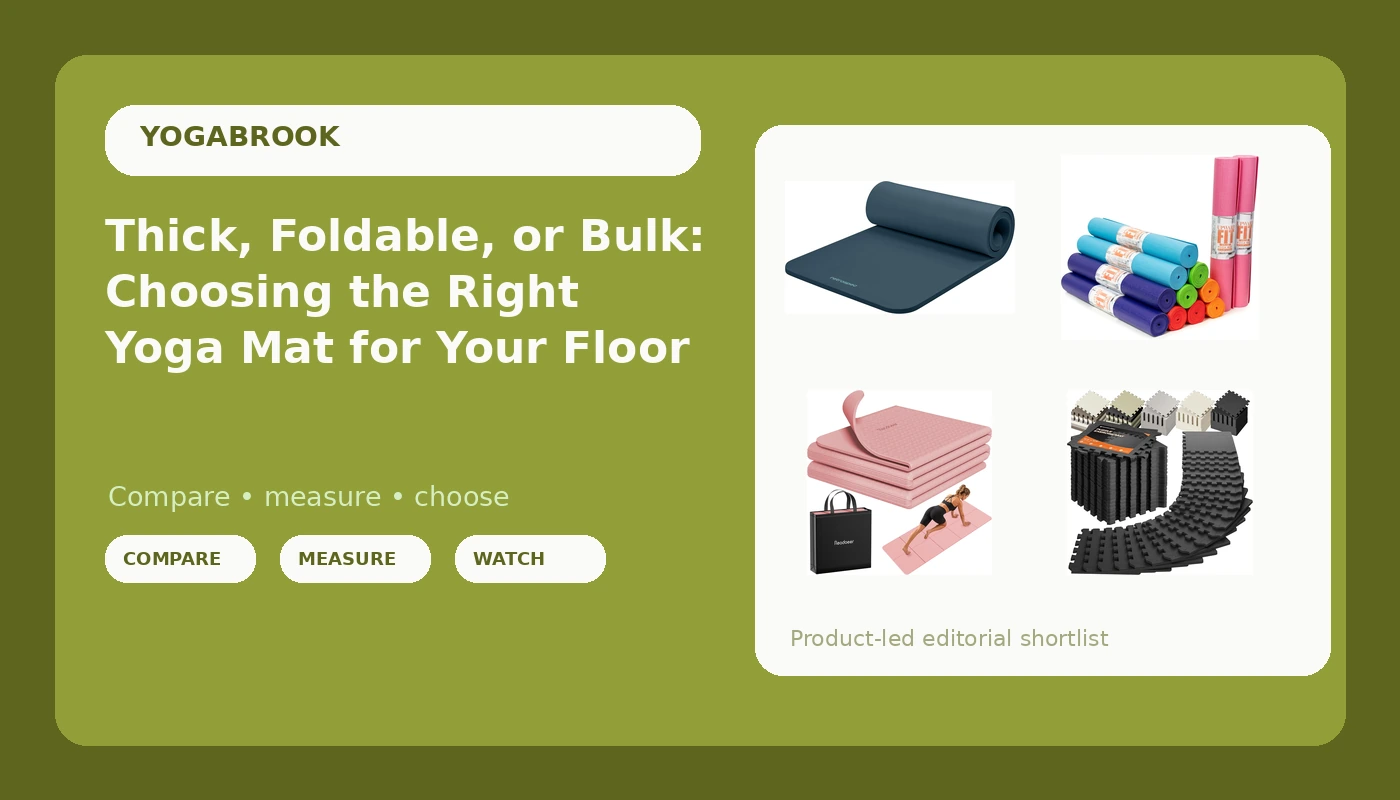
Most people shopping for yoga mats for home practice are solving the wrong problem. They compare thickness numbers on the box, buy the thickest one, and then wonder why standing poses feel like balancing on a marshmallow. I have taught vinyasa in Portland for over a decade, and before that I spent eight years installing sprung dance floors and gym rubber in studios and theaters, so I look at a mat the way a flooring contractor looks at a subfloor: what it does under load matters more than what the label promises. The four mats below are not competitors. They are four different answers to four different floors, bodies, and budgets, and picking the wrong category is the mistake that costs you money.
Related: How Thick Should a Yoga Mat Be? A Measured Answer →
Quick answer
There is no single winner here, because these four products solve four different problems. If you practice at home on a hard floor and your knees complain, a thick cushioned mat is the answer. If you travel or your mat lives in a bag, a folding mat is the answer. If you teach, run a studio, or equip a class, a bulk pack of thin mats is the answer. And if the problem is not the mat at all but the concrete under your living room rug, interlocking foam tiles are the answer. Match the product to the floor and the practice, not to the marketing copy.
4 useful options
| Model | Best fit | What stands out |
|---|---|---|
| Retrospec Solana Yoga Mat 1" Thick w/Nylon Strap for Men & Women - Non Slip Exercise Mat for Home Yoga, Pilates, Stretching, Floor & Fitness Workouts | Home practice on hard floors, sore knees | Listing describes a 1 inch thick cushioned mat with an included nylon carry strap |
| Readaeer Foldable Yoga Mat for Travel Folding Yoga Mat 6mm Thick with Carrying Bag, Non-Slip TPE Exercise Pilates Mat for 72" L x 24" W x 0.24 Inch | Travel, small apartments, mats that live in a bag | Folds instead of rolling, with a carrying bag, in a 6mm TPE build |
| Value 3mm Bulk Yoga Mats, 12 or 16 Pack, 68x24in | Studios, teachers, group classes, community programs | Sold as a multi-pack of thin mats, which changes the per-mat math entirely |
| SUPERJARE Gym Floor Mats, EVA Foam Puzzle Exercise Mats, Foam Floor Tiles | Hard floors that need a padded surface, not a portable mat | Interlocking EVA foam tiles that cover an area rather than travel with you |
Home cushion: Retrospec Solana Yoga Mat
Here is the trade-off nobody puts on the box. Every millimeter of foam between you and the floor buys joint comfort and costs you stability. A thick mat is genuinely kinder to knees, hips, and the bony points of your spine in seated and supine work. The same thickness is what makes a one-legged balance feel vague, because your foot is negotiating with foam instead of reading the floor. My rule for students: if you practice mostly on carpet or a hard floor and your joints are the limiting factor, thick is a reasonable trade. If your practice is standing-heavy and balance is the point, thin wins. The sink factor is real, and you feel it first in your wrists in downward dog.
Travel: Readaeer Foldable Yoga Mat
A rolled mat is a cylinder, and cylinders fight with suitcases, overhead bins, and the corner of a small apartment. Folding solves a logistics problem, not a grip problem. The thing to know about any folding mat is the crease: fold lines are where material fatigues first, and where a mat is most likely to develop soft spots or eventual separation over years of use. That is not a reason to avoid folding mats. It is a reason to store yours flat and unfolded when you are home, and to treat the folds as the part of the mat you inspect. Six millimeters is a sensible middle thickness: enough to soften a hotel floor, thin enough that you can still feel what your feet are doing.
Bulk value: Value 3mm Bulk Yoga Mats
I spent years watching studios buy mats one at a time and then wonder why the loaner pile was a museum of mismatched thicknesses. Bulk packs exist for the community shelf: the class where six people forgot their mat, the corporate wellness session, the church basement yoga program. Three millimeters is thin, which is exactly right for a mat that is stacked, wiped down, and stacked again. Thin mats are also less forgiving on a hard floor, so pair them with the foam tiles below if the room is concrete or tile. Judge a bulk purchase on total mats against total cost, and on whether the pack size matches how many people you actually seat.
Floor base: SUPERJARE Gym Floor Mats
This is the item people skip and then regret. If your practice space is a basement, a garage, or a tile floor over slab, no mat will fully fix it. What fixes it is a padded surface underneath, and interlocking foam tiles are the cheap, removable version of that. Two cautions from my flooring years: EVA foam compresses over time under repeated load, and foam tiles on a slick floor can shift as a unit, so check the seams before you practice and expect to replace tiles eventually. Also, a foam floor is not a mat. You still want a mat on top for grip, because foam gives you cushion, not traction.
Prices and availability may change. Product images, names, and retailer links are matched to verified listings. No current price, rating, stock status, or measured result is stated here without current evidence.
Thickness is a trade-off, not a specification
Every mat purchase is a negotiation between cushion and feedback, and the number on the box is only half the story. A "1 inch" mat and a 3mm mat are not better and worse versions of each other; they are different tools. Cushion protects joints in seated, supine, and restorative work, and it protects you from a hard subfloor during floor-based strength work. Thin mats give you a stable platform for standing balance, arm balances, and any pose where your foot needs to read the ground precisely. If you have bad knees and a tile floor, cushion wins. If you are working on balance and your knees are fine, thin wins.
The second half of the story is honesty in labeling. Manufacturers describe thickness at the nominal point, and foam compresses at the edges. This is the gap I call the caliper gap, and a mat that is noticeably thinner at the perimeter than in the middle will curl at the corners and slide on smooth studio floors. When you unbox any mat, roll it out flat for a day before you judge it, then look at whether the corners lie down. Corner lift is the beginning of every "my mat slides" complaint I have ever heard from a student.
What the top layer is made of decides grip
Texture sells mats. Chemistry decides whether you slide. A deeply embossed surface feels grippy in a dry showroom and can turn slick the moment your palms get damp, because the pattern is not what holds you. What holds you is the material of the top layer and how it behaves when wet.
The main families you will see: PVC, which is durable, inexpensive, and the least environmentally friendly option in the category, and which generally grips well when dry and less well when soaked. TPE, a thermoplastic blend used in the folding mat above, which tends to be lighter and less odorous than PVC but varies widely in wet grip depending on formulation. EVA foam, used in the puzzle tiles, which is a cushioning material rather than a gripping one. And natural rubber, which is the best dry grip in the category but is heavy and absorbs sweat over time. None of these is a moral choice. A mat you keep for five years beats a "biodegradable" mat you replace every two.
If you sweat heavily, plan for it. A towel over the mat is not a compromise; it is what most hot-room practitioners do. And clean your mat according to the maker's instructions, because the wrong cleaner can leave a residue film that makes a perfectly good top layer slippery.
- Measure your practice space and your floor type before you shop, because a hard subfloor changes the answer more than any spec.
- Decide whether the mat travels. If it leaves the house weekly, a folding or lightweight mat beats a heavier cushioned one.
- Decide whether the mat stays put in one room. If it does, cushion and surface coverage matter more than portability.
- Decide how many people need a mat. One practitioner and a class of sixteen are two different products.
- Read the material and care instructions, not just the thickness claim, and treat the listed dimensions as the constraint that matters most for taller practitioners.
Practical guidance before you buy
- Check the listed length against your height. A 68 inch mat and a 72 inch mat are different experiences for anyone over about 5 foot 10.
- Plan for a mat plus a surface if your floor is concrete, tile, or slab. Foam tiles handle the floor; the mat handles the grip.
- Do not stack a thin mat directly on a slick floor without testing it. Corner curl plus a polished floor is how people fall.
- Store folding mats flat when you are home. Creases are the first place any folding mat wears out.
- If you teach or host, buy the bulk pack and the foam tiles together. Loaner mats on a bare floor are a liability, not a convenience.
Which option should you choose?
Choose the Retrospec Solana Yoga Mat 1" Thick w/Nylon Strap for Men & Women - Non Slip Exercise Mat for Home Yoga, Pilates, Stretching, Floor & Fitness Workouts when you practice at home on a hard floor and cushioning for knees, hips, and seated work is the priority. Choose the Readaeer Foldable Yoga Mat for Travel Folding Yoga Mat 6mm Thick with Carrying Bag, Non-Slip TPE Exercise Pilates Mat for 72" L x 24" W x 0.24 Inch when your mat needs to fold into a bag and leave the house with you. Choose the Value 3mm Bulk Yoga Mats, 12 or 16 Pack, 68x24in when you are equipping a class, a studio, or a program rather than one person. Choose the SUPERJARE Gym Floor Mats, EVA Foam Puzzle Exercise Mats, Foam Floor Tiles when the real problem is the floor itself and you need a padded surface under everything else.
One caveat: I am describing what these listings state, not what I have measured on these specific mats, and thickness claims in this category vary in how they are taken. Grip also depends on your sweat, your floor, and how you clean the top layer, which is why the same mat can feel fine to one person and slick to another.
The bottom line
The best mat for home practice is the one that matches your floor and your joints, and those two facts decide more than any marketing claim about thickness or "non-slip" surfaces. Cushion for sore knees on a hard floor, a folding mat for a life that travels, a bulk pack when you are buying for a room full of people, and foam tiles when the floor underneath is the actual problem. Buy for the Tuesday you will actually roll it out, not for the studio photo on the box.