I spent eight years installing sprung dance floors and gym rubber before yoga became my full-time work, and that job taught me something the mat industry would rather you skip: what you roll out on is equipment, and equipment either does a job or it does not. Since 2022 I have kept a class log for every mat I teach on, with a column for grip at minute 40 and a column for corner curl. That is why this comparison of yoga mats and knee pads is organized around jobs instead of adjectives. The three products below do three different jobs. One is a 12-pack of bulk mats meant to equip a room. One is a natural rubber mat built for hot, sweaty classes. One is a pair of kneeling cushions that protects the joints the other two ignore.
Some links on this page are affiliate links, and if you buy through them I earn a commission at no extra cost to you. My rule has not changed: I only link gear I would hand to a student in one of my own classes.
The short answer: for one person in a normal-temperature class, the natural rubber mat is the one worth carrying. For a studio, a school, a retreat, or a family, the 12-pack is the only sensible way to buy volume. And if your knees are the real reason you are shopping, the kneeling pads will change your practice more than any mat on this page.
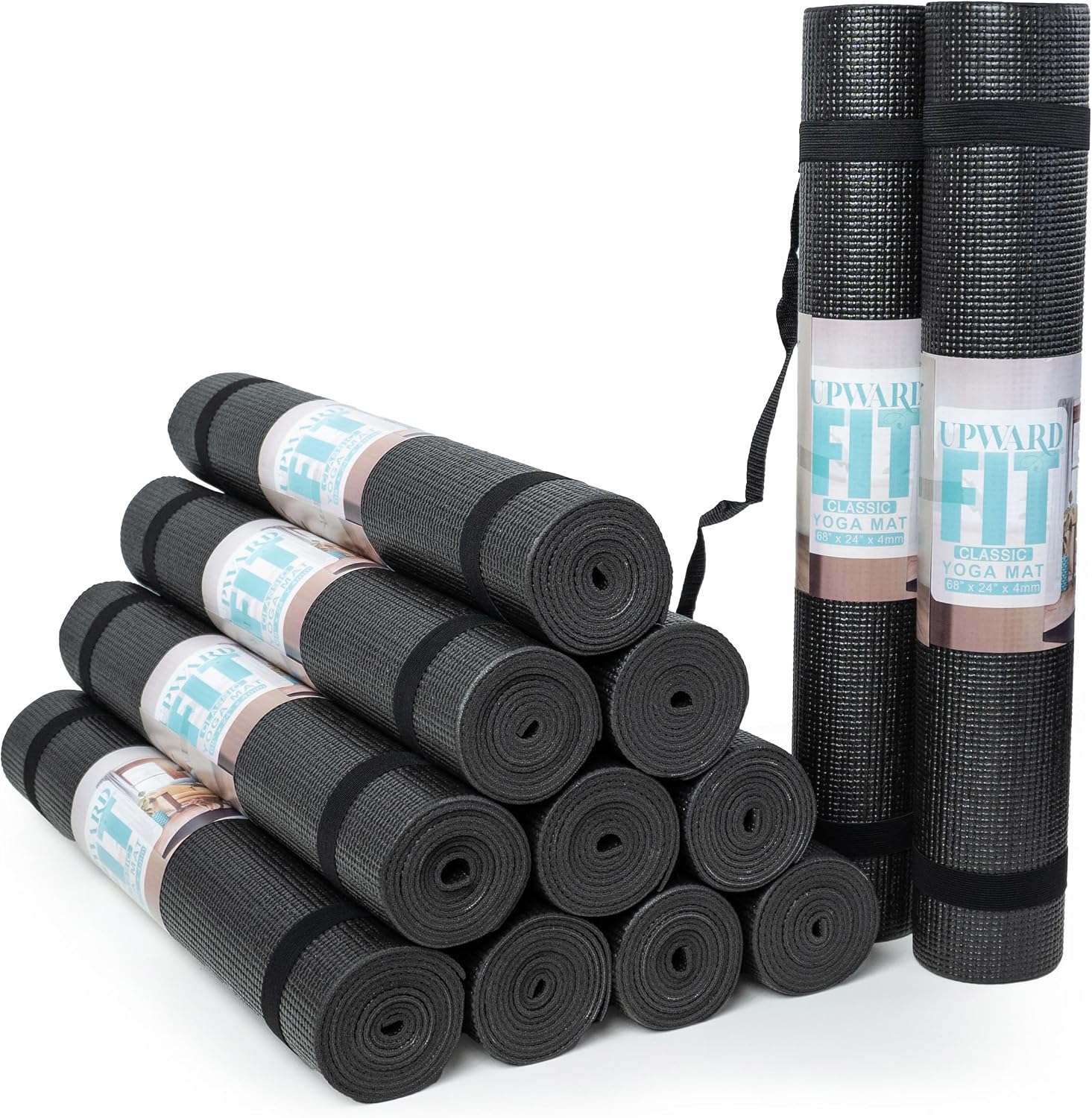
Bulk Yoga Mats, 12 Pack, With Strap, 68x24in, 4mm
Lowest cost per mat of anything here, matching sizes, and a strap so the whole stack travels as one bundle
4mm thick and 24 inches wide is a thin, slightly narrow mat; fine for a beginner on a wood floor, unkind to knees in a long hold
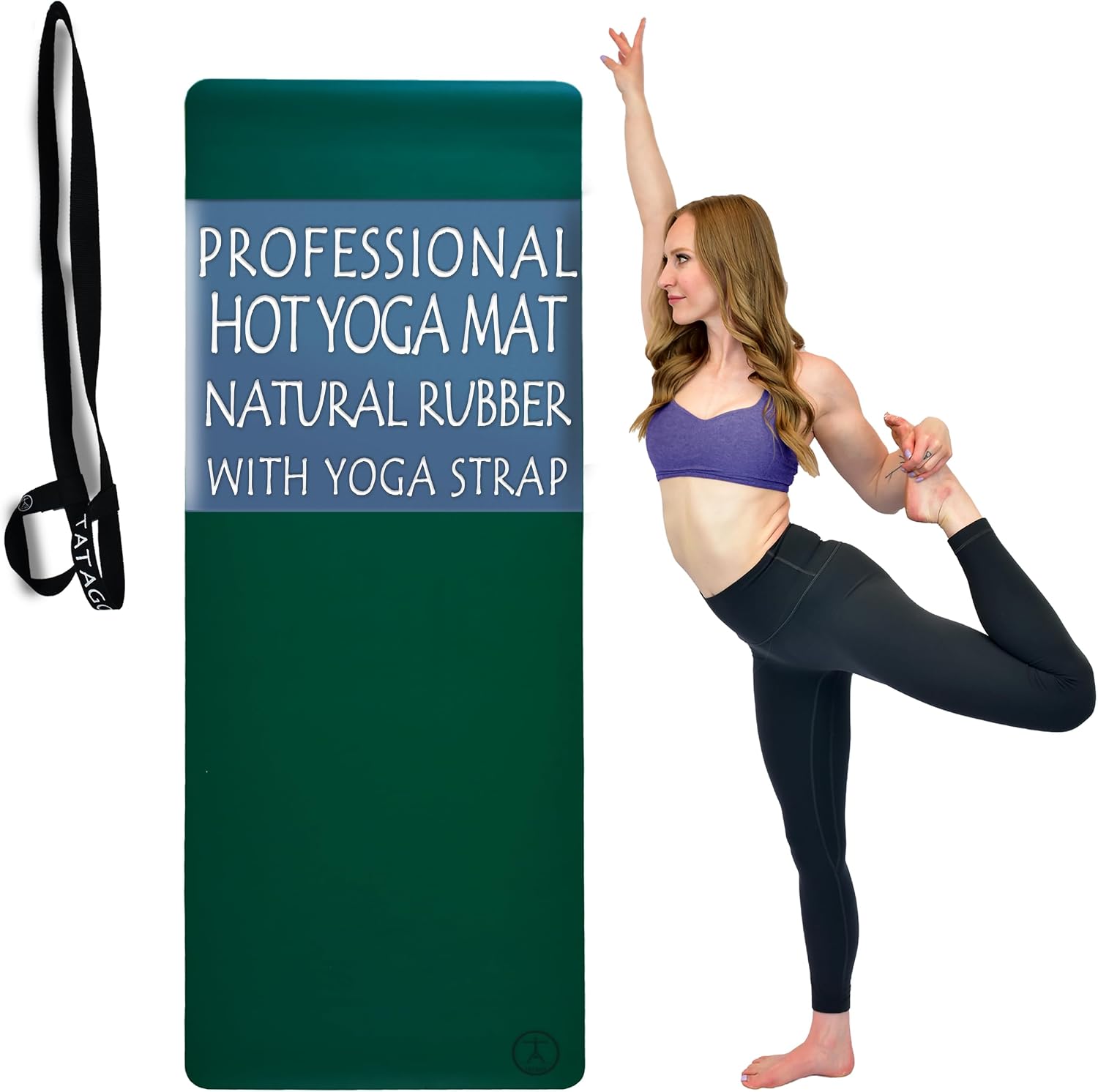
Tatago Hot Yoga Mat Non Slip-Professional Grade Natural Rubber Yoga Mat, Pliates Mat, Stretching Mat or exercise mats for home workout. Nonslip for Hot and Sweaty Classes. Includes Yoga Strap for Carrying and Stretching too.
Natural rubber is the chemistry that still grips when you are wet, the density holds standing balances, and the included strap means it leaves the house
Heavy on the walk to the studio, natural rubber takes on sweat and odor if you neglect it, and it equips exactly one person
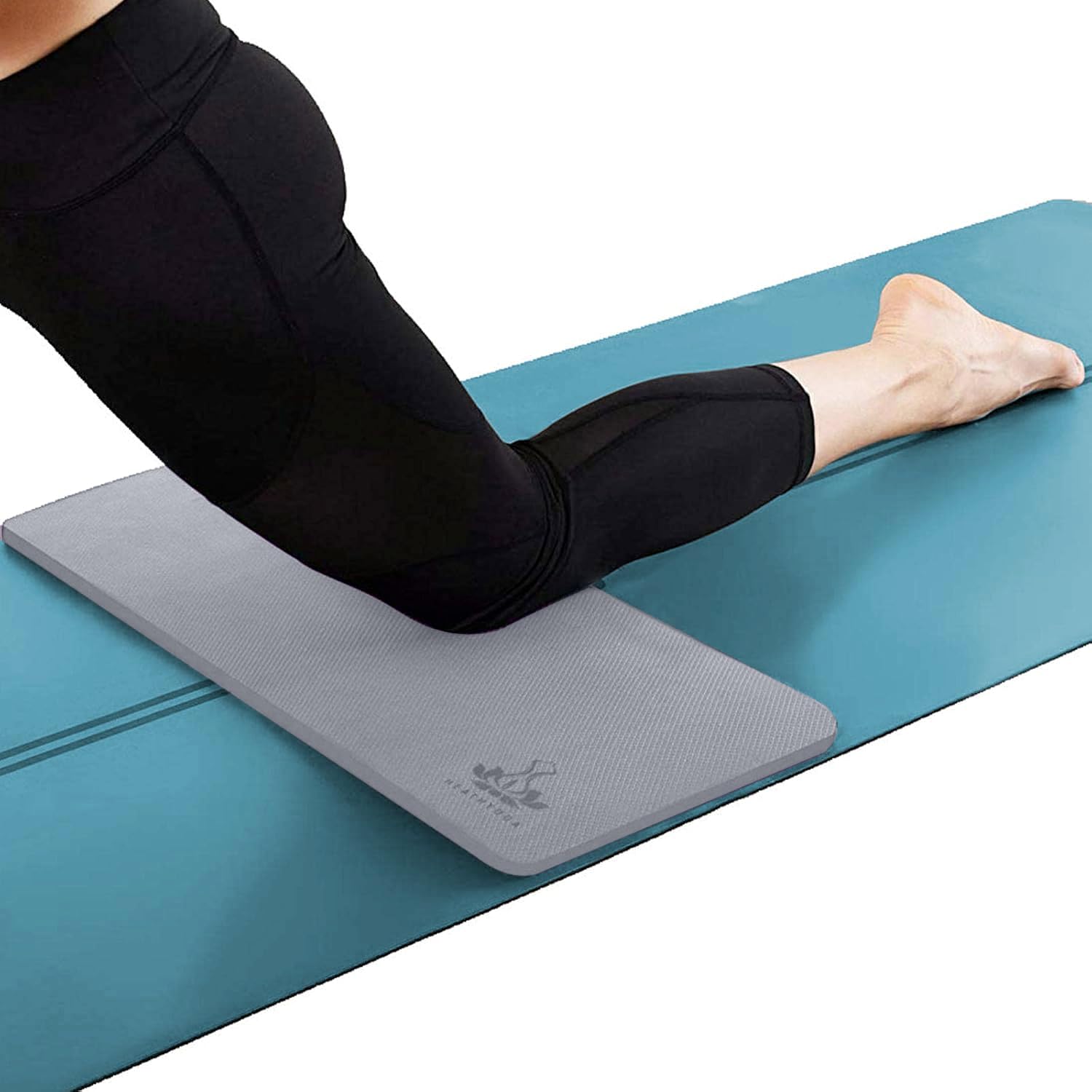
Heathyoga Yoga Knee Pads Cushion Non-Slip Yoga Mat Thick Yoga Accessories for Women Workout Pilates Kneeling Pads for Working out Exercise 26"x10"x0.5"
Adds half an inch exactly where knees and elbows land without making standing poses wobbly, small enough to live in a bag
It is a patch, not a surface; on a slick mat it can creep, and it does nothing for your hands in downward dog
Prices and availability were captured from Amazon Creators API and may change.
How I judge a mat before I write a word about it
Three numbers decide most of it, and none of them appear on the box.
The first is the caliper gap, the distance between the thickness a listing claims and what my calipers read at the thinnest edge of the mat. Anything over a millimeter is a lie told in good font. The second is the slick-sweat threshold, the class minute when grip gives out in a hot room. A mat with a low threshold is a mat that fails exactly when you need it, which is minute 40 of a 26&2 class, not minute two of a photo shoot. The third is the sink factor, how far the surface compresses under my palms at bodyweight. One millimeter of sink is comfortable. Six millimeters of sink turns your wrists into shock absorbers and your standing balances into a negotiation.
Then there is mat drag, the corner curl and edge lift that makes a mat slide across a studio floor when you step into warrior two. On a sprung floor with a good finish, a curling mat is a hazard. I have watched a student sprain a wrist because of exactly that, and it is the reason I take corner curl as seriously as grip.
I am telling you all of this so you understand what I am and am not claiming. I know the materials and the physics here cold. I am not going to pretend I have run 200 classes on every product on this page, and I am not going to invent measurements. What I can do is tell you what each of these three is built to do, where that construction usually holds up, and where it usually does not.
The 12-pack: buying mats by the dozen
Nobody writes poetry about bulk mats, and that is fine, because bulk mats are not for poetry. They are for the Tuesday-night community class where fourteen people show up and six of them forgot a mat.
What you get in a 12-pack at 68 by 24 inches and 4mm is a matched set with a carry strap. Matched matters more than beginners realize: when every mat in the room is the same size and the same surface, you stop thinking about the mat and start thinking about the pose. The strap matters because a dozen rolled mats is an awkward, heavy, floppy object, and a strap turns it into one thing you can carry in one trip.
The honest limitations are thickness and width. Four millimeters is a thin mat. On a wood floor it is perfectly serviceable for standing poses and a little unforgiving in long kneeling holds, which is where a separate cushion earns its place. Twenty-four inches is also on the narrow end; a taller student will hang off the edge in a wide-legged forward fold. And bulk mats are not hot-room mats. Cheap closed-cell surfaces that feel grippy when dry can turn glassy once your hands are wet, so I would not hand one of these to someone heading into a 105-degree class.
Where the 12-pack wins is arithmetic and durability of the boring kind. A dozen mats that live in a closet and get wiped down after class will outlast a single expensive mat used by a rotating cast of strangers, and if one goes missing, you are out one mat instead of a relationship with your credit card.
The natural rubber mat and the wet-grip problem
Grip is a chemistry problem, not a texture problem. Texture sells, because you can photograph it. Chemistry decides whether you slide at minute 40, and you cannot photograph that.
Natural rubber is the material I trust most when a room is genuinely wet. Its surface stays tacky against damp skin in a way that PVC rarely does, which is why the hot-yoga regulars I teach tend to migrate toward rubber over time. This mat leans on exactly that: a natural rubber construction marketed for hot and sweaty classes, plus a strap that does double duty for carrying and for stretching. The density of a rubber mat is the other half of the story. A denser surface holds standing balances, because your foot is not sinking into foam while you try to find a straight line.
The costs are real, and I will not soften them. Rubber is heavy, and heavy is the price of dense. It travels fine in a car and less fine on a twenty-minute walk. Rubber also absorbs sweat, which means it needs to be cleaned after every hot class, not every third one. Neglect it and it will smell like a gym bag, and no amount of sunshine fixes that. Anyone with a latex sensitivity should stay away from natural rubber entirely, and if that is you, a good PVC mat is not a compromise, it is the correct choice.
One more thing about rubber: it can mark a light-colored floor if it sits damp, and it does not love being left in a hot car. Treat it like the equipment it is.
The knee pads: the cheapest fix in the yoga aisle
If you have ever winced in a kneeling lunge, you already understand this product. Two pads, 26 by 10 inches, half an inch thick, non-slip, designed to go under knees, elbows, and wrists.
The genius of a pad like this is that it adds cushion only where cushion is wanted. A thick mat helps your knees and hurts your standing poses at the same time, because every millimeter of foam between your foot and the floor makes balancing harder. A pad is the way out of that trade: keep the thin mat that keeps you stable, and drop half an inch of support under the joints that need it. For students coming back from knee surgery, for anyone over 45 who has discovered that camel pose is now a negotiation, and for the many people who do Pilates and floor work on a hard surface, this is the highest-value item in this entire comparison.
Its limits are equally clear. A pad is a patch, not a surface. It needs a mat under it, and on a slick mat a pad can creep, which is worse than no pad at all because it moves under a joint you are loading. It also does nothing for your hands in downward dog or plank, and it will not rescue a mat that is already failing at grip. Buy it as an addition to a mat, never as a replacement for one.
The trade-offs nobody prints on the box
Durability and portability are opposed, and every mat on this page picks a side. The rubber mat is the durable one and the heavy one. The 12-pack is the portable-per-unit one and the disposable one. The pads are featherweight and they are not a mat.
Cushion and stability are opposed too, and this is the trade-off I watch beginners get wrong most often. They buy the thickest mat they can find to protect their knees, then wonder why their tree pose has become a balancing act on a sponge. The correct answer, nearly every time, is a firm mat plus a targeted pad, which is precisely the combination the third product on this list exists to enable.
Volume and quality are opposed in the same way. Twelve mats for a room is not twelve great mats, and it was never meant to be. It is one decision that solves a room's problem for years.
Which one should you actually buy
Buy the natural rubber mat if you are one person, you practice regularly, you sweat hard, and you are willing to carry something heavier than you would like and clean it more often than you would like. That is the mat that will still be gripping in year three.
Buy the 12-pack if you are equipping a space: a studio's loaner rack, a school program, a retreat, a family of five who all want to stop sharing. It is the only rational way to buy mats in volume, and the strap is a genuinely useful detail rather than a bonus.
Buy the knee pads if kneeling is the thing that hurts, whatever else you own. They pair with either of the other two products, they cost less than a takeout dinner for four, and they are the single change most likely to make a class feel good again.
If you are a teacher building out a room and you have knees in your class, the combination I would actually buy is the 12-pack plus a few sets of pads. That covers the student who forgot a mat and the student who cannot kneel without one.
What I am watching next
The interesting question in 2026 is not thickness, it is top-layer chemistry. Cork, algae foams, and recycled rubber blends are all arriving with eco labels, and at least half of them will be greenwashing, because a leaf icon on a PVC mat is still a lie. Natural rubber remains the benchmark I measure everything else against, which is why it keeps showing up in the recommendations I give students rather than in the ones I give marketers.
Mats are tools. Buy the one that matches the job you are actually doing on a Tuesday night, and then roll it out.