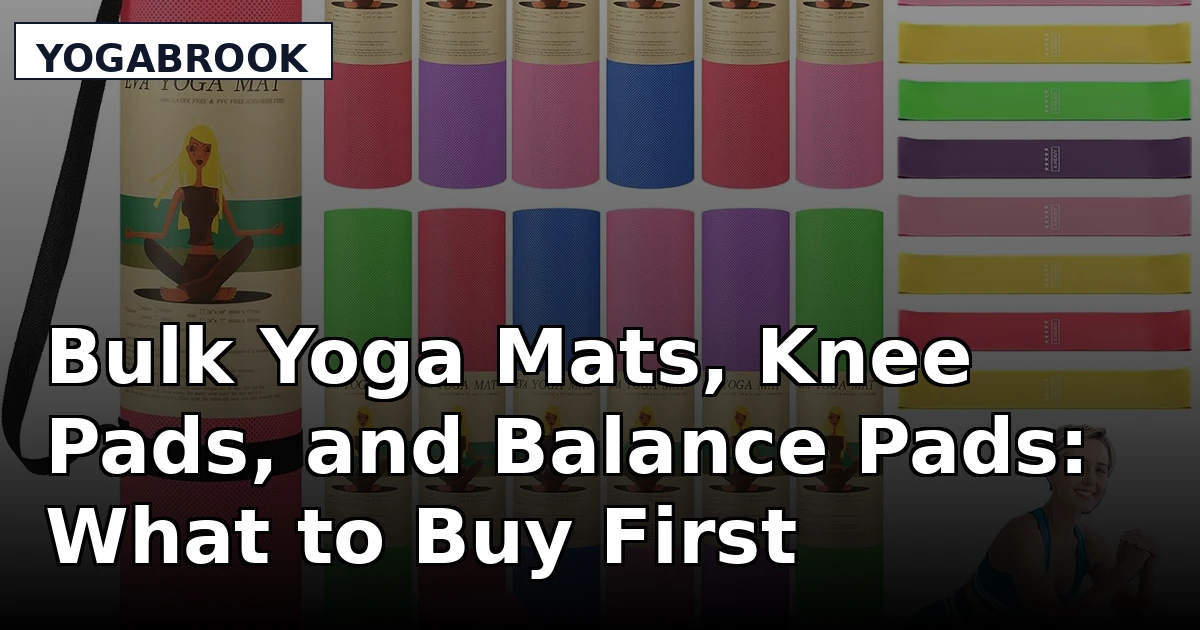
Every autumn I watch the same thing happen in studios around Portland. Someone inherits a room, a roster, and a stack of mats that smell like a gym bag, and they have to buy replacements before the first class of the season. The first two questions are almost always about bulk yoga mats and knee pads, because those are the items a room full of students asks for by name. The rest of the gear conversation comes later, once people have practiced a few times and learned what their own joints want.
This explainer covers four products that answer four different versions of that question: a twelve-mat bulk set that ships with resistance bands and carry straps, a single high-density mat with a strap, a dedicated knee pad cushion, and a foam balance pad. They are not competing with one another. One fills a room. One belongs to one person who practices most days of the week. One is for joints that need a softer landing. One trains balance in a way a flat mat cannot.
Related: How Thick Should a Yoga Mat Be? →
Quick answer
If you are equipping a class, a studio shelf, or a large household, the Hoolerry 36-piece set is the only option here that covers multiple people in a single order, because it bundles twelve mats with matching resistance bands and straps. If you are one person who wants one mat to roll out on, the CAP Barbell high-density mat with strap is the direct answer. If your problem is pressure on knees, wrists, or elbows during kneeling and plank work, the Yoga Knee Pad Cushion addresses that specific issue. If your problem is ankle stability and balance rather than cushioning, the StrongTek Foam Balance Pad is the tool built for it. None of the four substitutes for the others.
4 useful options
| Model | Best fit | What stands out |
|---|---|---|
| Hoolerry 36 Pieces Yoga Mats Sets Includes 12 Pcs Yoga Mats Bulk 68” x 24” x 6mm Thick Exercise Mat Non Slip 12 Resistance Bands 12 Carrying Straps for Women Girls for Gym Pilates | Studios, classrooms, retreats, and group setups | Twelve 68 by 24 inch, 6mm mats, plus twelve resistance bands and twelve carry straps in one order |
| CAP Barbell 1/2-Inch High Density Exercise Yoga Mat with Strap | Multiple Options | One person who practices regularly | Half-inch (about 12.7mm) high-density cushioning, with a carry strap included |
| Yoga Knee Pad Cushion, 24 x 9.8 x 0.8 in Thick Mini Yoga Mat, Odor-Free NBR Workout Mat with Storage Strap, Small Exercise Mat for Yoga, Pilates, Kneeling, Planks & Home Gym | Knees, wrists, and elbows on hard floors | A 24 by 9.8 by 0.8 inch NBR pad sized for kneeling, planks, and floor work, with a storage strap |
| StrongTek Foam Balance Pad, High-Density TPE, 15.8 x 13 x 2 in, Non-Slip | Balance, ankle stability, and controlled instability work | High-density TPE foam in a 15.8 by 13 by 2 inch platform with a non-slip surface |
Bulk set: Hoolerry 36 Pieces Yoga Mats Sets Includes 12 Pcs Yoga Mats Bulk 68” x 24” x 6mm Thick Exercise Mat Non Slip 12 Resistance Bands 12 Carrying Straps for Women Girls for Gym Pilates
Bulk sets live or die on arithmetic, not on materials. Twelve mats at 6mm each is roughly the same total foam as two premium single mats, spread across a dozen people, so the per-person cost is low and the per-person feel is ordinary. That is the honest trade. A 6mm mat sits in the middle of the cushioning range: enough to soften a hardwood floor under a kneeling lunge, not enough to hide a bad subfloor. If your room has twenty students and eight mats, this solves your problem. If your room has one student and you want the best surface you can get, this is the wrong purchase, and the CAP Barbell mat below is the right one. The resistance bands are a genuine bonus for warmups, but they are light-duty accessories, not a substitute for a full set of bands.
Everyday mat: CAP Barbell 1/2-Inch High Density Exercise Yoga Mat with Strap | Multiple Options
This is the mat I would hand to a student with cranky knees who practices on a concrete floor or a thin carpet over slab. Depth is the whole point of it. But depth is not grip, and grip is not depth, and confusing the two is the most expensive mistake in this category. A thicker mat compresses under your palms in downward dog, and every millimeter of sink costs you a little stability in standing balances. If your practice is mostly seated, supine, restorative, or floor-based, the extra cushion is pure gain. If your practice is mostly standing balance work on one leg, the extra cushion is a tax you pay at the ankle. The "Multiple Options" note in the listing matters too: color and size variants can differ, so confirm which option you are selecting before you buy.
Joint cushion: Yoga Knee Pad Cushion, 24 x 9.8 x 0.8 in Thick Mini Yoga Mat, Odor-Free NBR Workout Mat with Storage Strap, Small Exercise Mat for Yoga, Pilates, Kneeling, Planks & Home Gym
At 0.8 inch, this pad is roughly 20mm thick, which is three times the cushion under a typical 6mm mat. That changes the angle at the knee in a kneeling pose, and for a lot of people with a history of knee pain, that change is the difference between staying in the pose and leaving it. The length matters as much as the thickness: at 24 inches it covers both knees at once, and it is long enough to sit under forearms in a plank without sliding out from under you. The one caution I give every student who buys a pad like this is about hands, not knees. Piling 20mm of soft foam under your palm in a plank or a side plank can destabilize the wrist and make the whole position harder to hold, so use it where the pressure actually is and leave the hands on the mat.
Prices and availability may change. Product images, names, and retailer links must be matched by verified ASIN. Do not state a current price, rating, stock status, or measured result without current evidence.
Balance tool: StrongTek Foam Balance Pad, High-Density TPE, 15.8 x 13 x 2 in, Non-Slip
Two inches of foam under a standing foot is a very different experience from two inches of foam under a knee. Under a knee, compression is comfort. Under a foot, compression is information: your ankle joint has to read the wobble and correct for it, hundreds of times a minute, and that is exactly the training stimulus people buy a balance pad for. It shows up in ankle rehabilitation, in single-leg stability drills, and in the standing portion of a class when a teacher wants to wake up the feet. What it is not is a mat substitute. Standing in warrior two on a balance pad is not a harder version of warrior two, it is a different exercise with a different point. If you want a stable surface, buy a mat. If you want an unstable one on purpose, buy this.
Thickness, cushion, and grip are three separate questions
Almost every mat decision goes wrong because three properties get blended into one. Thickness is a measurement, usually given in millimeters, and it describes how much foam sits between you and the floor. Cushion is what that foam does under load, which depends on density as much as depth: a 6mm high-density mat can feel firmer than a 10mm low-density one. Grip is a chemistry question about the top layer, and it is largely independent of the other two. A mat can be thick, cushioned, and slick. It can be thin, firm, and grippy. The box rarely tells you which of those you are buying, which is why the number on the label is the least useful thing on the label.
The units are worth converting once, because it stops a lot of bad comparisons. A half inch is about 12.7mm. The 6mm bulk mats and the 0.8 inch knee pad sit at roughly 6mm and 20mm. When a listing says "1 inch," it usually means something closer to 0.8 inches, and that gap is normal across the category rather than a sign of a dishonest brand. Convert everything to millimeters before you compare, and the product tiers sort themselves out quickly.
What each of these four actually changes
The bulk set changes how many people can practice at once. That is its only real function, and it is a good one. The single high-density mat changes what one person's daily session feels like under the knees and hips. The knee pad changes the pressure at the specific contact points where a mat runs out of cushion. The balance pad changes the difficulty of standing work by making the surface unstable on purpose. Four different jobs, four different purchases. The most common mistake I see is buying a balance pad to fix knee discomfort, or a knee pad to fix wobble in a standing pose. Neither works, because the categories do not overlap.
- Count the people first. If more than three people will use the mats, a bulk set is the only sensible starting point, because twelve mats cost less than three premium ones.
- Decide whether your problem is cushion or grip. Cushion problems show up in seated, kneeling, and supine poses. Grip problems show up in standing poses when you sweat.
- Match the pad to the contact point. Knees, wrists, and elbows each need a different amount of foam, and the joint that hurts is the one to pad.
- Check whether the balance tool is the actual goal. A balance pad is training equipment, not comfort equipment, and it should only be on your list if instability is the point.
- Convert every dimension to millimeters and compare against a mat you already own. Guessing at "thick" and "thin" is how people end up with two mats they do not use.
Practical guidance before you buy
- A set is only a bargain if every mat in it gets used. Twelve mats for a class of six means six mats sitting in a closet losing their shape.
- Store bulk mats rolled and standing, not folded and stacked. Foam that lives creased takes a set within a season.
- Wipe mats down after class and let them dry fully before rolling. Damp foam is where smells start, and no listing claim about odor survives a mat rolled wet.
- Put the knee pad where the pressure is, not where the pose looks symmetrical. Half-kneeling poses load one knee far more than the other.
- Use a balance pad barefoot. Socks on foam remove most of the feedback the pad exists to provide.
- Give any new mat a few sessions before you judge its surface. Factory residue on a fresh top layer reads as slickness, and it wears off.
Which option should you choose?
Choose the Hoolerry 36 Pieces Yoga Mats Sets when you are buying for a group and need mats, bands, and straps to arrive together in one order. Choose the CAP Barbell 1/2-Inch High Density Exercise Yoga Mat with Strap when one person needs one mat with real depth under knees and hips for floor-heavy practice. Choose the Yoga Knee Pad Cushion when your mat is fine but your knees, wrists, or elbows are not, and you want to add cushion at the contact point rather than replace the whole surface. Choose the StrongTek Foam Balance Pad when the goal is ankle stability and balance training rather than comfort.
Two caveats worth stating plainly. First, I am a teacher, not a clinician: if a joint hurts, a pad can make practice more tolerable, but it does not diagnose anything, and a physical therapist is the right call for persistent pain. Second, sizes, materials, and options in these listings can change, and the CAP Barbell listing in particular offers multiple options, so confirm the exact variant and the current specifications on the product page before you commit.
The bottom line
These four products are not ranked against each other because they do not do the same job. A bulk set buys coverage. A half-inch mat buys cushion for one person. A knee pad buys relief at the joints that meet the floor. A balance pad buys instability on purpose. The useful question is not which one is best, it is which problem you actually have on the day you roll your mat out. Answer that first, and the purchase takes about two minutes.