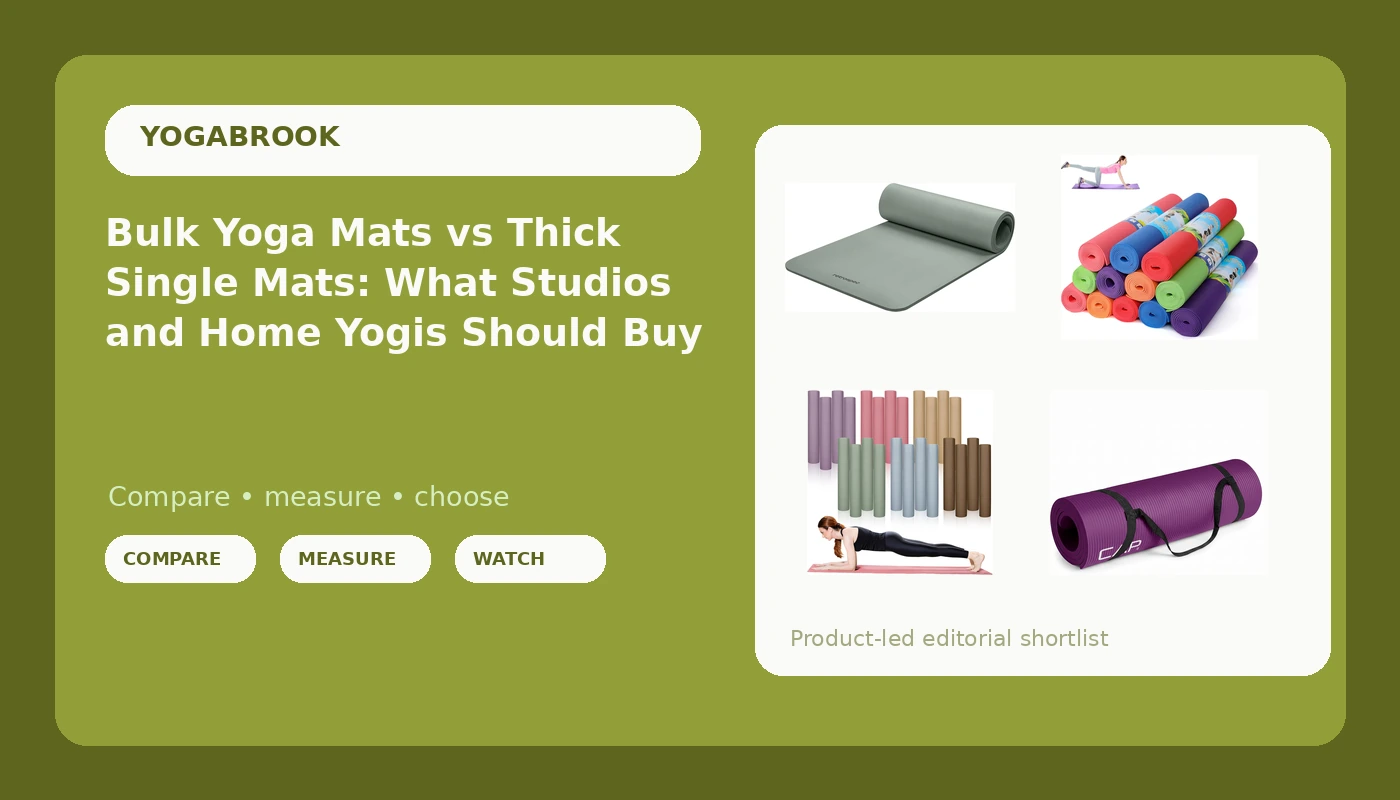
Most people shopping for bulk yoga mats are not shopping for themselves. They are outfitting a church basement class, a school PE unit, a studio loaner rack, or a family room where four people roll out at the same time. That changes every question worth asking. A single mat is a personal object: you break it in, you learn where your hands slide, and you carry it for years. A stack of twelve or twenty-four is inventory. It has to be uniform, it has to survive being rolled and stacked by people who did not pay for it, and it has to be affordable enough per mat that losing one to a scuff does not hurt. This article walks through four mats that come up in that conversation, two bulk packs and two thick single mats, and explains which numbers matter when you buy in quantity and which ones are just box copy.
Related: How Thick Should a Yoga Mat Be? →
Quick answer
If you need matching mats for a group, a bulk pack is the practical answer. The Timgle set is the largest here at 24 mats, and the Amylove set covers smaller groups at 12 mats. Both are sold as sets with stated dimensions, which is exactly what you want when twenty people need the same surface under them. If you are buying for one person and want cushioning, the Retrospec Solana and the CAP Barbell mat are both listed at 1/2 inch thick and both include a carry strap. None of these four are mats I have logged 200 classes on, so treat this as a specification comparison rather than a durability ranking.
Four useful options
| Model | Best fit | What stands out |
|---|---|---|
| Timgle 24 Pack 68" x 24" Yoga Mat Bulk, 4mm Thick | Studios, schools, and loaner racks that need a full set at once | Largest pack here, 24 mats at a 68 x 24 inch footprint with a 4mm thickness |
| Amylove 12 Pieces Yoga Mats Bulk 68x24x0.12 Inch | Smaller groups, workshops, retreats, and family use | 12 mats per set at 68 x 24 inches, listed at 0.12 inch (roughly 3mm) |
| Retrospec Solana Yoga Mat Thick 1/2in with Nylon Strap | One person who wants a thick, cushioned surface | 1/2 inch thick, 72 x 24 inches, includes a nylon strap, BPA free |
| CAP Barbell 1/2-Inch High Density Exercise Yoga Mat with Strap | Home users who want a firm, dense half-inch mat | High density 1/2 inch build, includes a strap, multiple options available |
Studio and classroom set: Timgle 24 Pack 68" x 24" Yoga Mat Bulk, 4mm Thick Extra Long Sports Mat Anti Slip Tear Resistant Yoga Exercise Set for Fitness Stretching Home Workout Gym and Studio
The case for a set this size is boring and real: uniformity. When every mat in the room is the same length, you can lay out a grid in ninety seconds and nobody spends the first five minutes of class shuffling to find space. Replacement is simpler too. If one mat walks off or gets chewed by a studio dog, you are down one of twenty-four rather than short a unique item you cannot reorder. The trade-off is thickness. At 4mm this is a floor-feel mat, not a cushion. That is good for balance and bad for anyone whose knees complain in kneeling poses, so plan on blankets or a folded towel for those students.
Small-group set: Amylove 12 Pieces Yoga Mats Bulk 68x24x0.12 Inch Exercise Non Slip Fitness Workout Mats for Women Men Home Workout Gym Yoga
Twelve is often the smarter number than twenty-four. If your class caps at ten, a dozen mats gives you two spares and a stack you can carry in one trip. The stated 0.12 inch thickness is worth reading carefully, because 0.12 inch is about 3mm, thinner than the 4mm set above. Thinner mats pack down smaller and are easier to stack in a closet, but they offer almost nothing in the way of padding, and on a hard floor they will not forgive a bony spine in supine poses. If your group practices on carpet or a sprung studio floor, that matters less.
Thick single mat: Retrospec Solana Yoga Mat Thick 1/2in Non-Slip Workout Mat with Nylon Strap - 72x24in Exercise Mat for Pilates, Stretching & Fitness - BPA Free, Easy Clean
Half an inch is a different animal from 3mm or 4mm, and the honest trade-off is balance. Every millimeter of foam between your hand and the floor is a millimeter your wrist has to stabilize. For restorative work, floor sequences, Pilates, and stretching, that cushion is a gift. For one-legged standing poses, a mat this thick can feel vague and springy, and people with knee or ankle histories sometimes prefer a thinner mat for exactly that reason. The extra length helps if you are tall, and the included strap solves the problem that thick mats create, which is that they are awkward to carry under an arm.
Dense half-inch option: CAP Barbell 1/2-Inch High Density Exercise Yoga Mat with Strap | Multiple Options
Density is the word that separates two mats with identical thickness numbers. A thick, low density mat compresses under your palms and you sink; a thick, high density mat holds its shape and feels more like a firm surface than a pillow. If you have ever done downward dog on a spongy foam mat and felt your wrists complain, you already know the difference, and it has nothing to do with how many millimeters the box claims. This one sits in the same thickness class as the Solana, so the deciding question is whether you want softness or firmness under your hands.
Prices and availability may change. Product images, names, and retailer links are matched to verified listings. No current price, rating, stock status, or measured result is stated here without current evidence.
What a bulk pack actually solves
Buying twelve or twenty-four mats at once is not about saving money per unit, although that is usually part of it. It is about removing decisions. A studio that owns one set of identical mats never has to explain why one student got the good mat and another got the thin one. Everyone has the same surface, the same footprint, and the same grip characteristics, which means a teacher can cue the same thing to the whole room without adding "if your mat is thicker, this will feel different."
There is also a maintenance argument. Shared mats get cleaned constantly, rolled tightly by people in a hurry, and stacked in piles where the bottom mat carries weight. Thicker, heavier mats resist that abuse better than thin ones, but thin ones dry faster and take up less room. For a loaner rack, thin mats are usually the better call simply because you can fit more of them and they dry overnight. For a studio's own fleet, where the mats live on the floor and get wiped after every class, a slightly thicker mat tends to hold up longer before the edges start to curl.
The last thing a bulk pack solves is the replacement problem. Mats are consumables in a shared setting. Someone will leave one on a bus, someone will spill tea on one, someone will practice in shoes on one and grind a hole through it. When you own twenty-four identical mats, you do not replace a mat, you replace a unit, and the room still looks uniform afterward.
Thickness, density, and the numbers on the box
The single most useful thing to understand about mat shopping is that thickness and density are different measurements and only one of them is usually printed. Thickness is how far the mat sits off the floor. Density is how much it resists compressing when you put weight on it. A 1/2 inch mat that is low density can feel softer and less stable than a 4mm mat that is firm, even though the numbers suggest the opposite. This is why two mats with the same thickness claim can behave completely differently in a standing pose.
The second useful thing is the difference between a stated thickness and a real one. Manufacturer specs are usually measured at the thickest point, and mats taper toward the edges. That is not fraud, it is just how foam behaves, but it means a 4mm mat may read closer to 3.5mm near the border, and a 0.12 inch mat is already very thin before any taper. When you buy in quantity, this matters because you cannot inspect every unit. You are trusting the spec sheet.
Third, material decides grip more than texture does. Texture sells mats, because you can see it in a product photo. Grip comes from what the top layer is made of and how it behaves once your hands are damp. A deeply textured mat made from a slick compound will still slide at minute forty of a warm class. A smooth mat made from a grippy compound will hold. None of the listings here make claims about wet grip specifically, which is a fair thing to note before you buy twenty of anything.
The last number to look at is footprint. A 68 inch mat is the standard length. A 72 inch mat gives taller practitioners a little more room. For a bulk order where everyone shares the same mats, standard length is usually the right call, because it fits more bodies and takes up less storage space.
- Count how many people will actually practice on these mats at the same time, then add two spares.
- Decide whether you need cushioning or floor feel, since a 3mm to 4mm mat and a 1/2 inch mat are different tools.
- Check the stated footprint and compare it to the tallest person in the room.
- Confirm what ships with the mat, because a strap matters a great deal on a half-inch mat.
- Decide your replacement plan before you buy, so a lost mat does not force a redesign of the whole rack.
Practical guidance
- Wipe shared mats after every class with a diluted gentle cleaner, and let them dry fully before stacking.
- Roll mats with the top surface facing out, which keeps the grip side from creasing in storage.
- Store bulk stacks flat or in a loose vertical rack, not compressed under heavy equipment.
- If your group practices on a hard floor, keep a couple of thicker mats on hand for kneeling and restorative work.
- For a hot or humid room, test one mat for a few weeks before ordering a large set, since grip is the property most likely to disappoint.
Which option should you choose?
Choose the Timgle 24 Pack 68" x 24" Yoga Mat Bulk, 4mm Thick when you are outfitting a full classroom, a school program, or a studio loaner rack and want the largest matching set in one order. Choose the Amylove 12 Pieces Yoga Mats Bulk when your group is smaller, your storage is tight, or you want a stack that one person can carry. Choose the Retrospec Solana Yoga Mat Thick 1/2in when you are buying for one person who wants a long, cushioned mat with a strap. Choose the CAP Barbell 1/2-Inch High Density Exercise Yoga Mat with Strap when you want that same half inch of thickness but described as a denser, firmer build.
The caveat is worth repeating plainly. Thickness, footprint, and included accessories are stated specifications, and specifications are not the same as a tested result. Grip in a sweaty room, edge curl after a year of rolling, and how a mat smells after a month of cleaning are the things that actually decide whether a purchase was good, and none of those can be read off a listing. If you can, buy one and live with it for a few weeks before you commit to a set of twenty-four.
The bottom line
For groups, buy the set and buy it uniform. A dozen matching mats at 68 by 24 inches solves more classroom problems than a nicer mat that only half the room owns. For one person, decide between floor feel and cushioning before you decide between brands, because a 4mm mat and a 1/2 inch mat are not competing versions of the same thing, they are two different answers to two different questions. Check current Amazon price on the listing that matches your situation, and give whatever you buy a fair trial before you judge it.