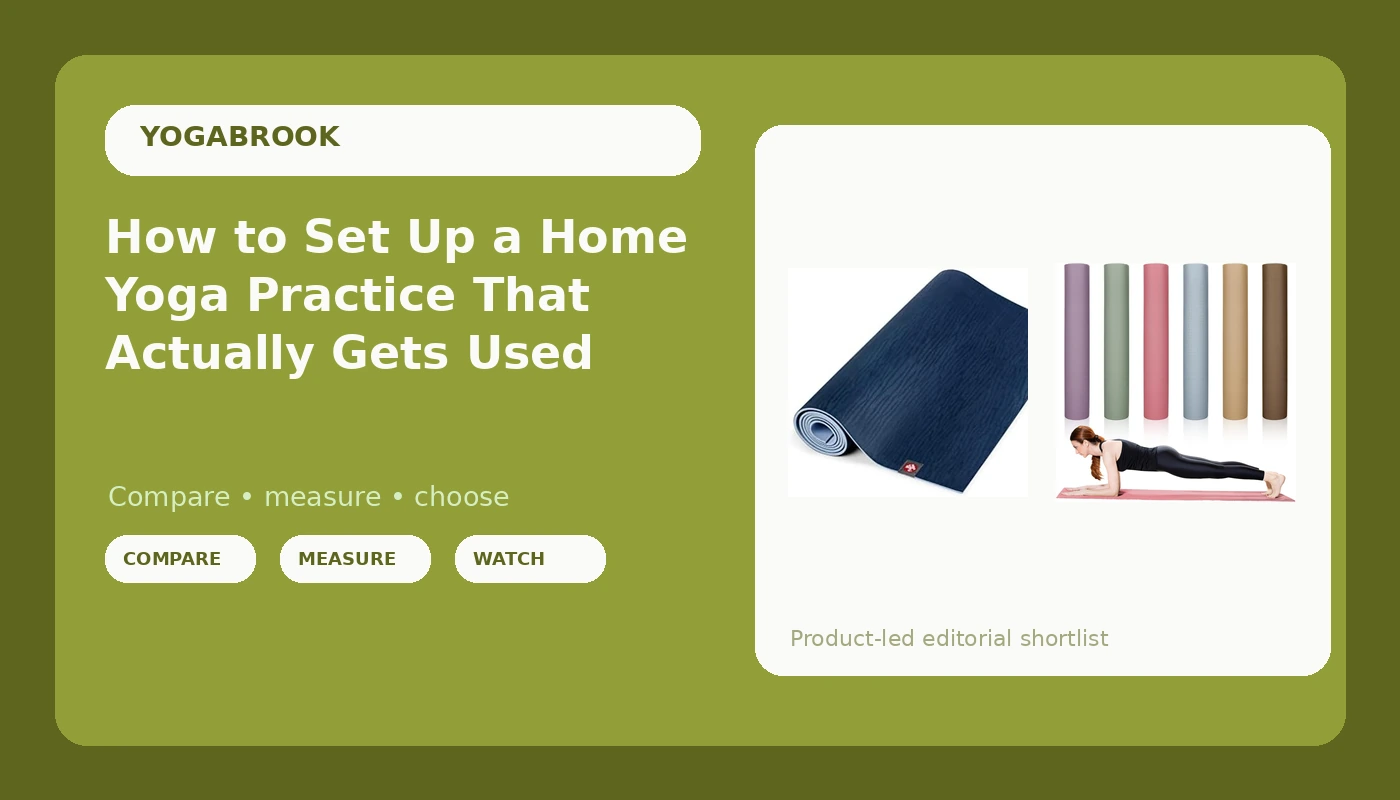
Most people set up a home yoga practice backwards. They buy a mat first, roll it out on carpet in the spare room, and then wonder why their wrists ache and their warrior two feels like standing on a sponge. I have taught vinyasa in Portland since 2012, and before that I spent eight years installing sprung dance floors and gym rubber in studios across the Midwest, so I think about this in the least romantic way available: the floor decides more than the mat does. The yoga mat for home practice is the second thing you choose, not the first.
Disclosure, up top, because it belongs there: the two links in this guide are affiliate links, and I earn a commission if you buy through them. I only link mats I would hand to a student in my own class, and nothing here is a sponsored placement.
Here is the whole job, in order. Read the floor, pick the mat that matches the floor and the body, break it in properly, set up storage you will actually use, and build a fifteen-minute habit you can keep on a Tuesday in February. The two mats below cover almost every home setup I see: one for the person who practices most days, and one for the household, the teacher, or the shared space.
Why you should trust me
I did my 200-hour training in 2012 with a Baptiste-lineage teacher and have been teaching ever since, including a Thursday night recovery class for people with knee and hip histories. Before yoga paid any bills, I worked for a flooring company that installed sprung dance floors and gym rubber in theaters and studios. That job is why I own calipers and a luggage scale, and why I do not trust the thickness printed on a box.
My rule for writing about mats is simple. I describe what the manufacturer specifies and what that class of material does under a room full of sweating people, and I say when I have not taught on a specific mat. For this guide I am working from the two product listings below plus more than a decade of watching mats fail in a hot room. I am a teacher, not a physical therapist, so I will tell you what cushions a knee and who to see about the pain.
How I picked and how I tested
The method I run on any mat that comes through my classes looks like this.
- Thickness, measured. Calipers at six points, including the thinnest edge. The caliper gap is the difference between the box and reality, and anything over a millimeter tells you what the brand thinks of you.
- Weight. A luggage scale, because weight is the honest tradeoff for durability and it is the number nobody prints.
- The angle. My inclined plane test: a weighted board raised until the weight slides, dry first, then with water sprayed on the surface. Grip is a chemistry question, so the wet number matters more than the dry one.
- Slick-sweat threshold. The class minute when grip gives out in a hot room. The good mats do not have one.
- Sink factor. How far the mat compresses under my palms in downward dog. A millimeter is fine. Six millimeters wrecks your wrists and your balance.
- Mat drag. Corner curl and edge lift, the thing that makes a mat genuinely dangerous on a smooth floor.
What that method says about the two mats here: one is a natural rubber mat, which is the material I trust most for grip without polyurethane, and one is a bulk PVC pack, which is the material I trust most for a household that needs six mats and does not want to think about them again. Both are legitimate answers for different people. Neither is a lifestyle.
The mats you'll need before you start
You cannot build a practice on a mat that slides across the floor or curls under your hands. Pick the mat, then fix the room around it.
Our pick for one person: Manduka eKO Yoga Mat - Natural Rubber | Eco-Friendly | Soft Textured Surface| Natural Next-to-Skin Feel
 Visit on Amazon →
Natural rubber is the answer to the grip question. Texture sells mats; chemistry is what keeps you from sliding at minute forty of a hot class, and a rubber top layer grips wet in a way PVC simply does not. This is also the one mat in this guide with no break-in tax. The twenty-to-thirty-class break-in that a dense PVC mat demands is real, and natural rubber does not ask for it.
What to know before you order. Natural rubber smells like rubber for the first week or two, especially in a warm room, so air it out before your first class. Keep it out of direct sun and out of a hot car, because UV and heat are what break rubber down. If you have a latex allergy, natural rubber is the wrong material for you and a PVC or cork-topped mat is the better road. Wipe it after sweaty practices and let it dry fully before you roll it, or you will teach yourself why rubber mats get a reputation for smelling.
Flaws but not dealbreakers: Rubber is heavier than a travel mat and does not fold small. If you carry a mat on a bike or in a backpack, this is not the one you grab. It is the one you leave rolled out at home and step onto.
Anyone who practices four or more times a week at home, especially in a warm room, should start here.
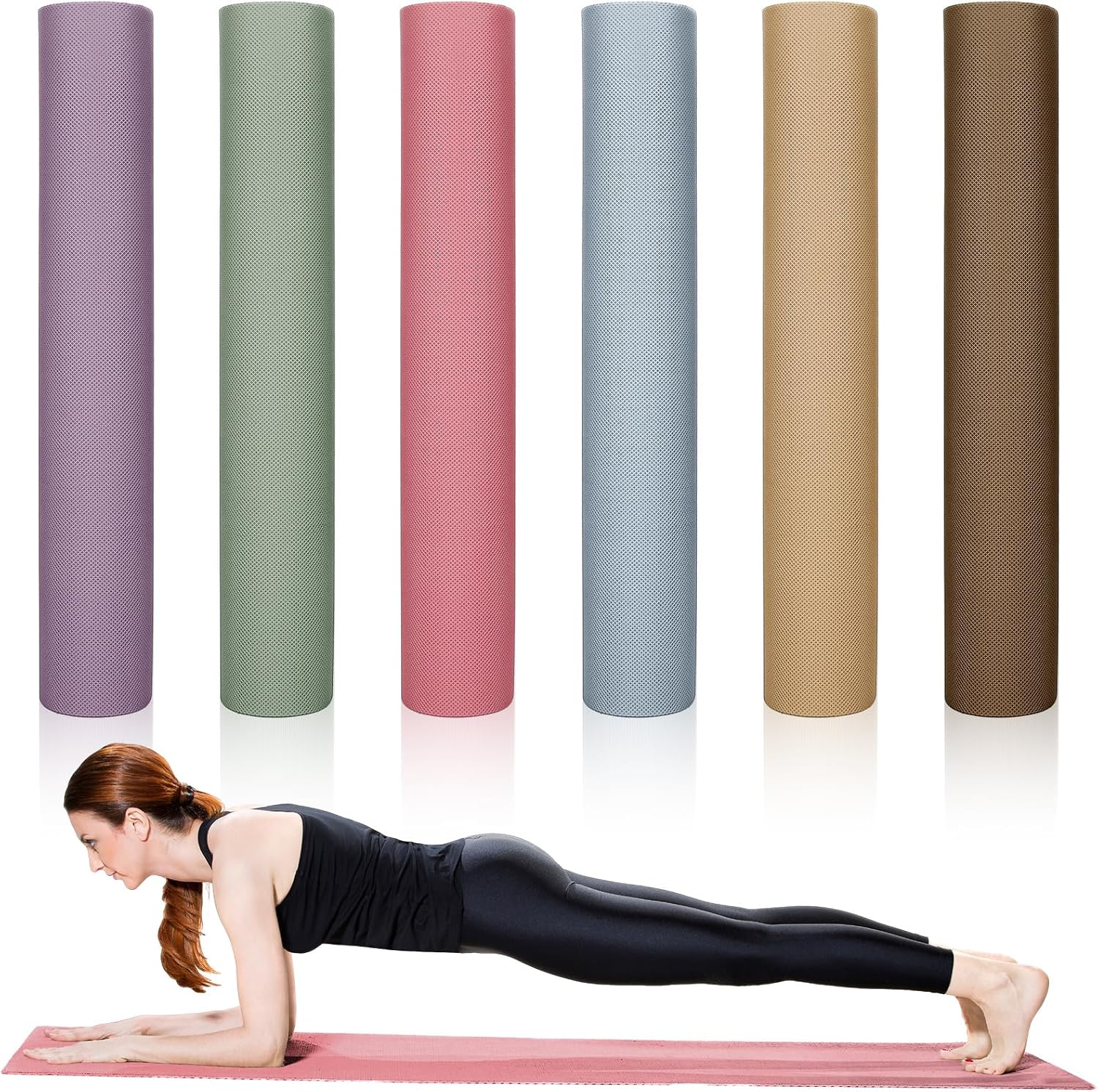
The household pack: Timgle 6 Pack Yoga Mats Bulk 68x24 Inches Non Slip 4 mm Thick
 Visit on Amazon →
Six mats, each 68 inches long, 24 inches wide, and 4 mm thick, is a specific kind of purchase, and a good one if you are the person other people practice with. This is the pack for the teacher who keeps a shelf of loaners, the household where four people want to move in the living room at once, the renter who wants a mat by the back door and one in the office, and the host of a weekly group who is tired of asking guests to bring their own.
Two numbers matter. Sixty-eight inches is long enough that most adults, including tall ones, can lie down without their heels hanging off the end. Twenty-four inches is the standard width, which is fine for most bodies and tight for broad shoulders, so if your shoulders are wider than the mat, expect your hands to land near the edges. Four millimeters is the middle of the road: enough cushion for a hardwood floor and a sensitive knee, thin enough that you can still feel the floor under a standing balance. I would not go thicker for a primary mat.
Flaws but not dealbreakers: A bulk pack is not a premium daily driver, and it is not sold as one. Six identical mats will wear at different rates depending on who uses which, so number them or rotate them rather than ending up with one good mat and five tired ones. Check the surface of each mat when the pack arrives, wipe them down before first use, and store them flat or loosely rolled instead of crammed into a bin where the edges take a set.
Anyone setting up a shared practice space, a family room, or a small class should buy this before buying a single expensive mat.
Setting up the space before you unroll anything
Now the actual work. This order matters, and skipping step one is the most common mistake I see.
Step one: measure the floor, not the room. You need a clear rectangle roughly seven feet long and three feet wide, plus enough headroom to raise your arms without hitting a fixture. In a small apartment that rectangle is often the space between the couch and the coffee table, and the answer is to move the coffee table, not to buy a shorter mat.
Step two: identify what is under the mat. Hardwood, tile, and concrete are unforgiving, and a 4 mm mat plus a folded blanket under the knees is a reasonable answer. Carpet is the opposite problem. A thick mat on thick carpet is a sinking, wobbling surface, and your standing poses will pay for it. If you must practice on carpet, use the thinnest mat you own.
Step three: check the slip surface, not just the mat. Every mat relies on friction with the floor. Polished concrete, freshly waxed hardwood, and a loose area rug are all worse than they look. Put the mat down, stand in a lunge, and push forward and back. If the mat slides, you have a floor problem, not a mat problem.
Step four: deal with mat drag before it becomes a habit. Corner curl is the reason mats get dangerous. A mat that will not lie flat gets a rolled towel under the leading edge for a week, or it gets stored flat instead of rolled until it settles. If a mat has been folded in a box for months, give it a day unrolled before you judge it.
Step five: pick a wall. A wall is the cheapest prop in yoga. It gives you a place for legs up the wall, a reference point for balance, and a spot to put a hand in a standing twist when a knee is complaining. Set the mat parallel to that wall, not perpendicular, so you have the full length to move on.
Step six: sort out storage. Mats live longer out of sunlight, out of a hot car, and out of the traffic path. With a bulk pack, a vertical rack or a wide shelf beats a plastic bin, because mats that stay folded or crammed take a set at the edges. With one rubber mat, roll it loosely and stand it on end.
Step seven: add four props and stop. Two blocks, a strap, a blanket, and something to sit on. That is the whole kit for a home practice, and it handles almost every modification a teacher will give you. Buy more when a specific pose asks for it, not before.
Step eight: build the Tuesday habit. A home practice fails for one reason: it is optional and unscheduled. Put fifteen minutes on the calendar at a time you will actually keep, lay the mat out the night before, and choose three poses you do not have to think about. Fifteen minutes three times a week beats a ninety-minute practice you do twice and then abandon.
Break-in, cleaning, and the mistakes that kill a mat
Break-in. A dense PVC mat can take twenty to thirty classes before it grips, which is the break-in tax. Natural rubber does not have one. Bulk mats usually land in the middle, and a wipe with a damp cloth before first use helps more than anything else.
Cleaning. Wipe after every sweaty practice and let the mat dry completely before it gets rolled. Rubber mats especially should never be stored damp, and no mat should go in a washing machine or a dryer no matter what a forum tells you.
Sun and heat. Ultraviolet light and a hot car are the two fastest ways to destroy any mat. Roll it, take it inside, store it out of the window.
Product claims. "Non-slip" on a box almost always means non-slip when dry. If you sweat heavily, assume you will need a towel over the top or a material that grips wet, and natural rubber is the one to look at.
The competition and why it lost
A few categories did not make this guide, and it is worth knowing why.
One-inch foam mats are for a bad knee on a concrete floor and almost nothing else. They sink under your palms, they wobble in standing poses, and cushion is not grip. If your joints need that much padding, a thinner mat plus a blanket under the knees is the better setup.
Thin travel mats are a compromise for a suitcase, not a foundation for a home practice. If a travel mat is all you own, it will be the reason your wrists hurt on a hardwood floor.
Cork-topped mats are genuinely interesting. Cork grips better when wet than almost anything except polyurethane, but it stains, it wants more care, and it is a different budget conversation. I will write about them properly once I have enough classes on one.
Bulk packs with no thickness and no length in the listing are the ones I would skip. If a seller will not tell you how thick and how long the mat is, that is the caliper gap in marketing form, and you are buying a surprise.
And one note on this article: it is a setup guide, not a ranking. The two mats above fit the two most common home setups. A ranked list is a different piece of writing.
What this all costs
Do not think in sticker price. Think in cost per practice.
A single natural rubber mat is one purchase for one person, and the math that matters is how often you roll it out. Five practices a week for two years is more than five hundred sessions, and a mat that survives them costs less per session than a mat you replace twice.
The six pack works the other way. Split across a household, it lands near the same place as one mat per person, except you also get spares and loaners. If four people in a house practice, the pack is the rational buy. If one person practices, it is four mats too many.
Check current Amazon price on both, then do the division yourself, because bulk pricing moves and single-mat pricing moves with it.
The rest of the setup is nearly free. A wall, a folded blanket, two blocks, and fifteen minutes on a calendar cost very little, and they are what turn a mat on the floor into a practice you keep. That is the job. Roll it out on Tuesday and let it be ordinary.