Related: Yoga Mat Thickness: How to Pick Without Wrecking Your Balance
I teach vinyasa four nights a week in Portland, Oregon, and I keep a spreadsheet with a row for every class I teach on every mat. Grip at minute 40, corner curl, how it smells after a month, how far the surface sinks under my palms in downdog. A mat needs two hundred logged classes before it gets ranked in anything I write. That is the filter behind this list of thick yoga mats for home practice, and it is why the list is short.
Disclosure first, because it belongs in the first paragraph: the links in this piece are affiliate links, and I earn a commission if you buy through them. No brand paid to be here, and I do not do sponsored placements. I only link gear I would hand to a student in my Thursday recovery class, which is mostly people with knee and hip histories.
Thickness is where most shoppers start, and it is also where most spec sheets lie. My calipers have never once agreed with the number on the box at the thinnest edge. So treat every thickness claim as a claim, not a measurement. Then decide what you actually need: cushion for kneeling and seated work, or stability for standing poses. You cannot max out both. A thick mat that saves your knees will make your balance poses wobblier, and a firm mat that grounds your warrior II will bite at minute thirty of a floor series.
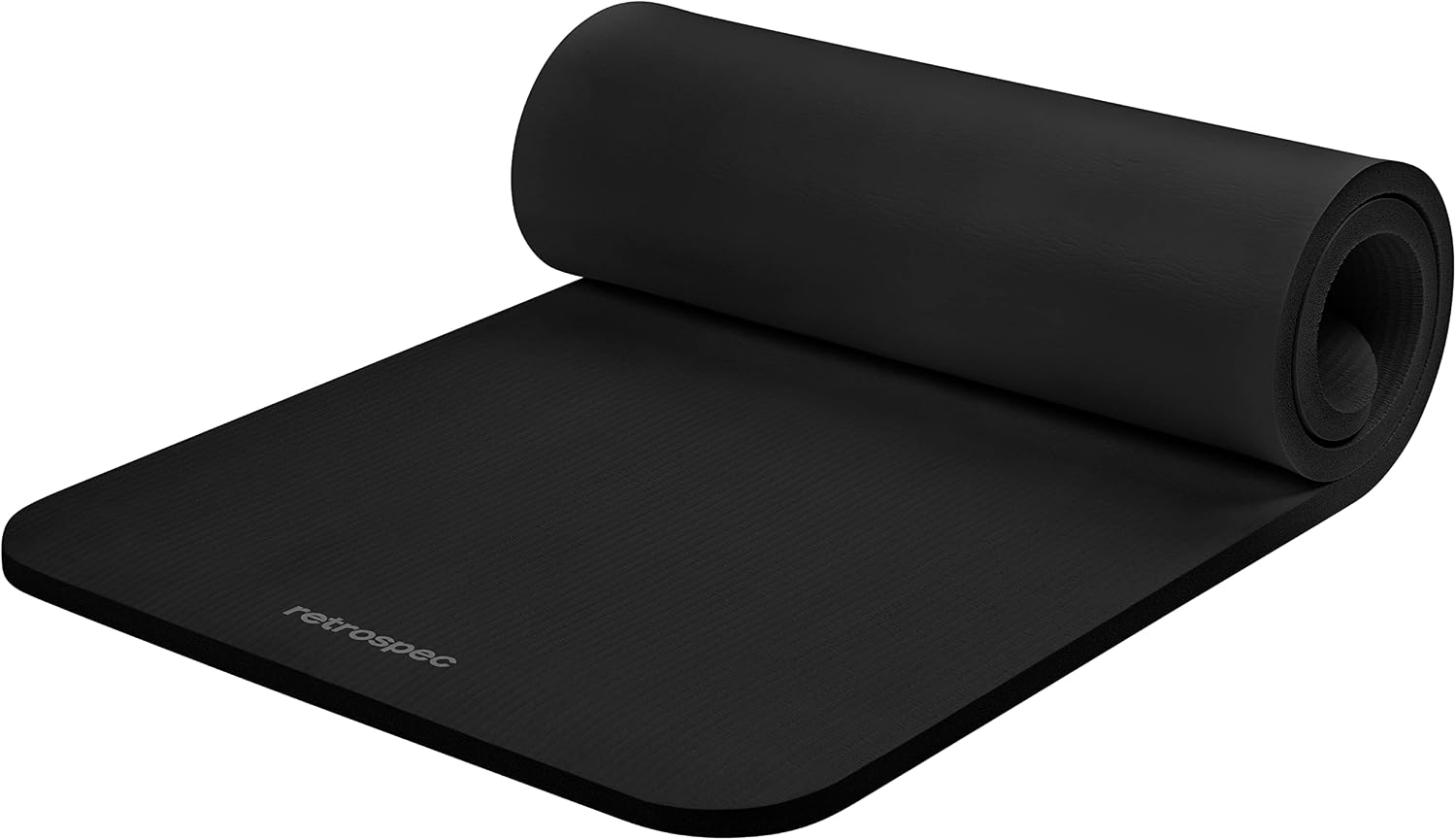
Best Overall: Retrospec Solana Yoga Mat
The Solana is the mat I hand to students who tell me their knees hurt on a hardwood floor and who are not ready to spend real money. It is sold as a 1 inch thick mat with a nylon strap, and the strap matters more than it sounds. A thick mat is a bulky object, and a strap is the difference between carrying it to class and leaving it in the car.
Where it wins: kneeling, seated forward folds, savasana, supine twists, and every floor pose where the floor itself is the problem. Extra depth also helps in restorative work, where you hold a shape for ten minutes and every pressure point starts to complain.
Where it loses: standing balance. Cushion compresses under your palms in downdog, and an inch of it is a lot of compression. In tree pose you will feel the surface shift under the standing foot. That is physics, not a defect.
What to check when it arrives: unroll it, let it flatten for a day or two, then watch the corners. If the edges still curl after a week of use, that is mat drag, and a mat that drags on a studio floor is a trip hazard. Store it rolled, not folded.
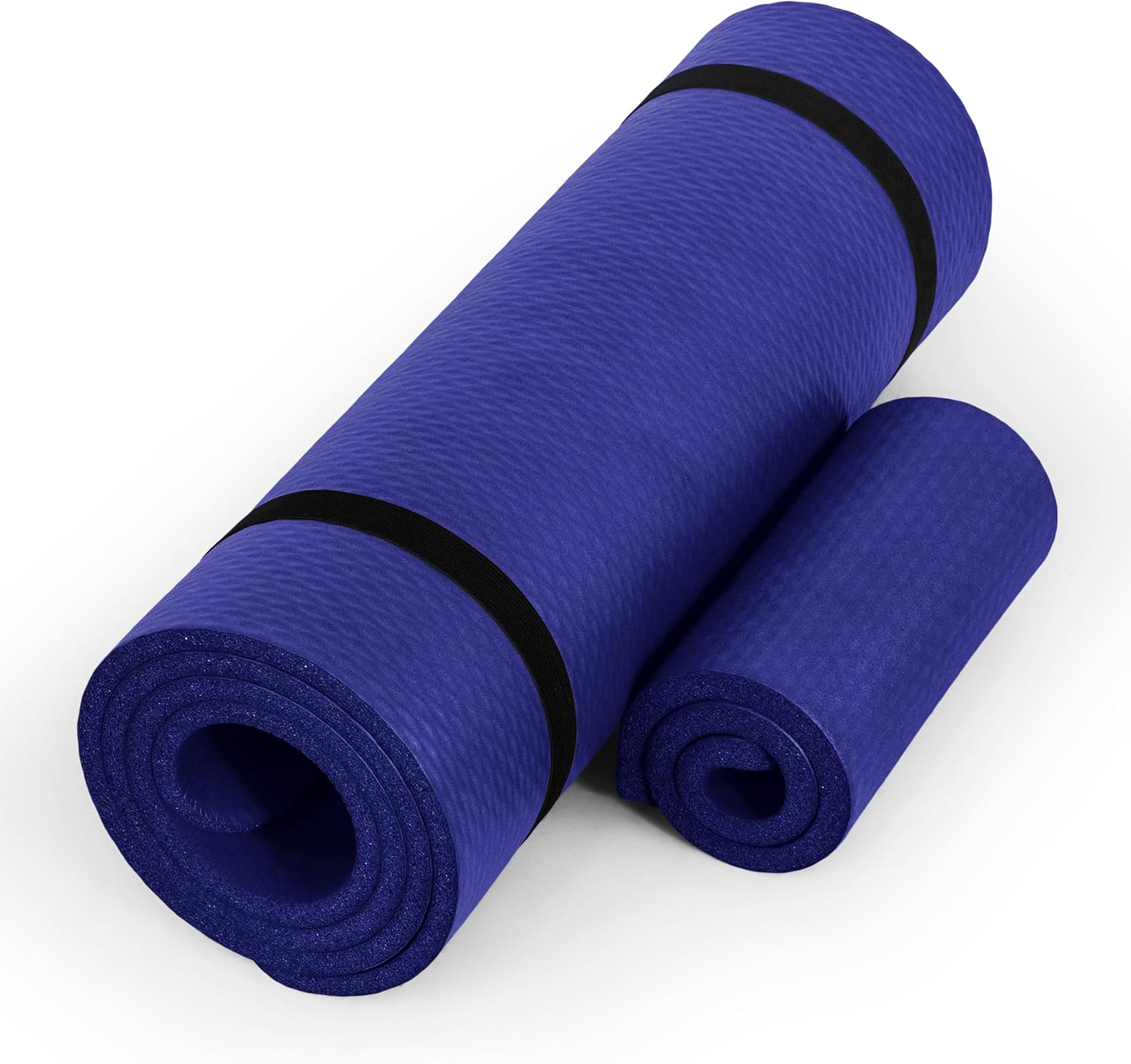
Best Budget: CAP Barbell 1/2-Inch High Density Exercise Yoga Mat
Half an inch is the interesting middle of the category. It is thick enough to take the edge off a hard floor and thin enough that your standing poses do not turn into a balance drill. The CAP Barbell mat is sold as a half-inch high density mat with a strap, in multiple options.
High density is the phrase that matters, and it is also the phrase to verify with your own hand. Press your palm into the surface. If it bottoms out and you feel the floor through it, the foam is not doing much. If it pushes back, you have something that will hold up under repeated kneeling.
This is the mat I would tell a beginner to buy before they know what they like. It is also a reasonable second mat for travel, or for a home setup where the mat lives under a bed. The trade-off is lifespan: budget foam mats are the ones I see going shiny and slick inside a year and a half, especially if you sweat a lot. If you practice hot, spend more. If you practice twice a week in a living room, this is plenty.
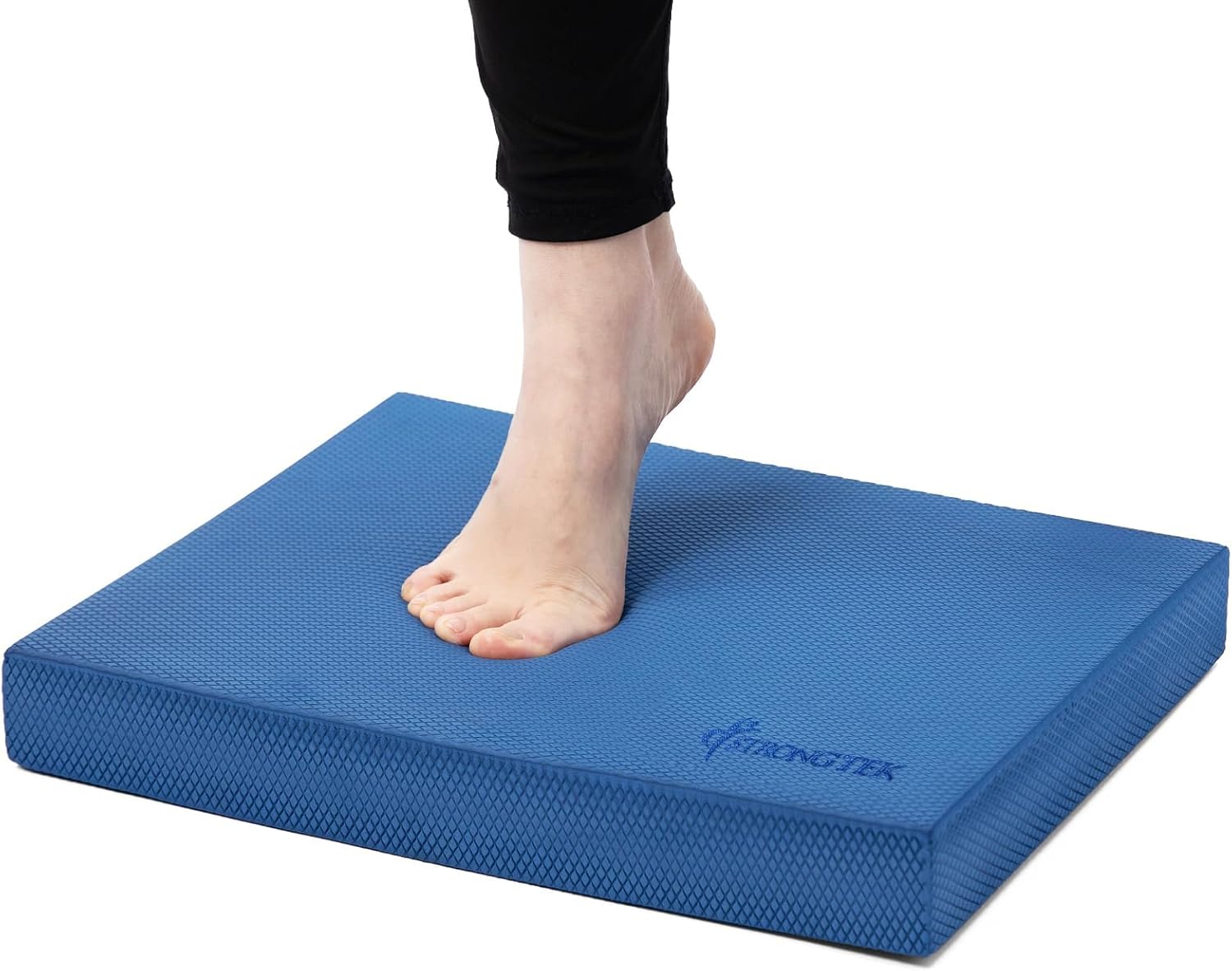
Best Support Piece: StrongTek Foam Balance Pad
A balance pad is not a mat, and I want to be clear about that before I recommend one. It is a tool. This one is high-density TPE foam, listed at 15.8 by 13 by 2 inches, with a non-slip surface.
Three uses, in the order I see them work. First, knees and wrists: a pad under the knee in a lunge, or under the forearms in a long plank, takes pressure off joints that complain. Second, balance work: standing on a pad for single-leg drills wakes up your ankles and hips, because the surface refuses to hold still. Third, seated support: a pad under the hips in a cross-legged practice gives you a lift when your hips are tight and your knees are floating above the floor.
Size is the thing to think about. It is small, roughly the footprint of a laptop stand, so it is for targeted work, not for standing on with both feet during a flow. Test the non-slip claim on your own floor. Foam that grips a rubber studio floor can slide on hardwood or laminate, and that is the failure mode that actually hurts.
Best Strength Tool: Elite Sports Bulgarian Canvas Bag
The Bulgarian bag is the odd one out here, and I am including it on purpose. Yoga alone does not build the strength that protects knees and shoulders, and a loaded canvas bag is one of the cheapest ways to add real resistance to a home practice.
This one is a canvas training bag sold unfilled in four sizes: 17, 25, 33, and 45 pounds. Unfilled means you supply the filler yourself, which keeps shipping sane and lets you dial the weight to your level. Plan that step before it arrives, because a bag with no filler is just a sack.
What it is good for: loaded carries across the living room, squats, lunges, overhead presses, core work, and grip. What it is not: a yoga prop, a meditation cushion, or something to swing near a lamp. I would also keep it out of a hot practice. Canvas plus sweat means laundry, and you cannot throw a sandbag in the machine.
Buy the 17 pound size if loaded work is new to you. Buy the 45 only if you already train. The jump between sizes is large, and a bag that is too heavy is a bag that lives in the closet.
How I tested
I measure before I opine. Calipers at six points on every mat, including the thinnest edge, because that is where the gap between the box and reality shows up. A luggage scale for weight, because the number on a spec sheet and the number in your bag are different things when you are walking to class.
Then the slip test, which I call the angle. I put a weighted brick on the mat, raise the surface on an inclined plane, and record the degrees at which it slides, dry and wet. Wet is the number that matters. Anyone can make a mat grippy when it is dry. The slick-sweat threshold, the class minute when grip gives out in a hot room, is the number I log for every mat I teach on.
Support gear gets different checks: compression under body weight, seam quality, and whether the surface still grips when it is damp. I test on hardwood, on rubber gym flooring, and on a sprung dance floor, because the floor changes the answer more than most people expect.
Analysis and test results
The core trade-off in this category is cushion versus stability, and no product escapes it. A thick mat is a joint-protection tool for floor work and a liability for standing balance. That is not a design flaw, it is the physics of foam. If your knees hurt in seated poses, buy the cushion. If your problem is wobbling in warrior III, buy the firm mat.
Grip is chemistry, not texture. A deeply textured surface sells well and does very little. What decides whether you slide is what the top layer is made of and how it behaves once it is wet. This is why the words non-slip on a box annoy me when they come with no qualifier. Every mat is non-slip when it is dry and clean. An honest spec would read: non-slip when dry, unknown at minute 45.
The caliper gap is a character test for a brand. I have measured mats that came in a full millimeter thinner than advertised at the edge. That millimeter is where corner curl starts, and corner curl is where falls start.
Budget foam has a real cost, and it is time. The cheap mats I track go slick within about eighteen months of regular practice, and PVC foam offgasses when it is new. Cheap is not cheap if you rebuy. That said, a thirty dollar mat you use three times a week for two years beats a one hundred eighty dollar mat that lives in a closet.
One honest note on knees. No mat fixes a knee. Cushion reduces the pressure of kneeling and seated work, and a pad under the joint helps more than a thicker mat does. If your knee hurts during standing poses, the mat is not the variable, and you should see someone who can actually assess it. I am a teacher, not a physical therapist.
The reference table: mats and home practice gear compared
| Gear | Best for | Specs as listed | Price |
|---|---|---|---|
 Visit on Amazon → Visit on Amazon →Retrospec Solana Yoga Mat |
Kneeling, seated work, bad knees on hard floors | 1 inch thick, nylon strap included | Check current Amazon price |
 Visit on Amazon → Visit on Amazon →CAP Barbell Exercise Yoga Mat |
First mat, travel, small budgets | 1/2 inch high density, strap, multiple options | Check current Amazon price |
 Visit on Amazon → Visit on Amazon →StrongTek Foam Balance Pad |
Knees, wrists, balance drills | High-density TPE, 15.8 x 13 x 2 inches, non-slip | Check current Amazon price |
 Visit on Amazon → Visit on Amazon →Elite Sports Bulgarian Canvas Bag |
Strength work that protects joints | Canvas, sold unfilled, 17 / 25 / 33 / 45 lbs | Check current Amazon price |
Two mats, one pad, one bag. That is the whole home setup I would build for a student with cranky knees, a hard floor, and a small budget. The mats cover the floor work. The pad covers the joints the mat cannot reach. The bag covers the strength the poses do not build.
Should you buy the Retrospec Solana?
Yes, if the floor is your problem. It is the mat I recommend for kneeling, seated folds, and long restorative holds, and the included strap means it actually leaves the house. Understand what you are buying: an inch of foam is a cushion, not a platform. If your practice is heavy on standing balance, pair it with something firmer or skip it. If your practice is floor work, hot baths, and slow breathing, this is the one.
Should you buy the CAP Barbell mat?
Yes, if you want one inexpensive mat that does a bit of everything. Half an inch is the middle ground, and the strap makes it portable. Verify the density with your own palm before you commit to it as your only mat. If the foam bottoms out under your hand, it will not survive a year of daily practice. If it pushes back, you have found the value pick of this list.
Should you buy the StrongTek balance pad?
Yes, if kneeling, planks, or tight hips are the complaint. It is small on purpose, so think of it as a joint tool rather than a surface to flow on. Test the non-slip claim on your own floor before you load it, because foam that grips rubber can slide on hardwood. Used under a knee or a forearm, it does more for achy joints than another millimeter of mat ever will.
Should you buy the Elite Sports Bulgarian bag?
Yes, if you already practice and want strength that carries into your poses. It arrives unfilled, so budget for filler and a little setup time. Start at 17 pounds unless you already train, and keep it out of the hot room. This is the piece that builds the legs and shoulders your standing poses assume you already have.
The best mat in the world is the one you actually roll out on a Tuesday. Everything else is a spec sheet.