Most people asking how to choose a yoga mat are asking the wrong question first. They ask which mat is best. The better first question is where the mat will live: in a hot studio three times a week, in the bottom of a carry-on, or stacked in a closet for a class of twelve beginners who show up barefoot and nervous.
I am Maren Holt. I teach vinyasa and a Thursday-night recovery class in Portland, Oregon, and before that I spent eight years installing sprung dance floors and gym rubber in theaters and studios across the Midwest. I know what a floor does under thirty dancers at 9pm. A student of mine slipped on a slick mat in my hot class in 2022 and sprained her wrist, and that is the day I stopped trusting the word "non-slip" on a box.
This post contains affiliate links. I make money if you buy through them, and I only link mats I would hand to a student in my own class. If that bothers you, the criteria below still work without buying anything.
Why you should trust me
I did my 200-hour training in 2012 with a Baptiste-lineage teacher, and I have taught on the same tile-over-concrete studio floor long enough to know which mats curl at the corners by minute 20. The flooring job is the part that matters here. Sprung floors, gym rubber, vinyl over plywood: each surface eats grip differently, and most mat reviews never mention the floor at all.
I keep a spreadsheet with a row for every class I teach on every mat, including grip at minute 40, corner curl, and how the thing smells after a month in a hot room. Thickness on a box is marketing. What I care about is what the top layer is made of and whether it still grabs when my palms are wet.
What I am not: your physical therapist. If your knee hurts, see someone who can diagnose it. I can tell you which mat cushions it and which one makes standing balances harder.
How I picked and how I tested
Two mats are in this guide, and they exist for two different jobs. One is a 1.5mm natural rubber mat that folds into a bag. The other is a ten-pack of 4mm mats meant to equip a room. That is not a ranking. It is a toolbox.
My criteria, in order.
Wet grip. Grip is chemistry, not texture. A pebbled surface sells mats; the material of the top layer decides whether you slide when you sweat. Natural rubber grips well dry and degrades as it gets wet. Polyurethane grips best wet. PVC sits in the middle and depends entirely on the formula.
Thickness that matches your joints, not your ego. More cushion is not more comfort. Every millimeter of foam under your palms is a millimeter you sink into in downdog, and sink is what makes wrists ache and standing balances wobble. 4mm to 5mm is the general-purpose range. 1.5mm is a travel compromise, and I will say plainly that it is not a mat for a bad knee on a concrete floor.
Drag and curl. A mat that lifts at the corner on a slick studio floor is a hazard, not a preference.
Material honesty. Natural rubber comes from trees. PVC comes from a refinery. Neither is free, and a mat you keep for five years beats a "biodegradable" one you replace every two. I will take the honest PVC over the dishonest leaf icon.
Where I fall short on these two specific mats: I have not put a 200-class log on either of them yet. What follows is what the material and the construction tell me, plus the caveats I would give a student before they spent money.
The two mats I would hand you
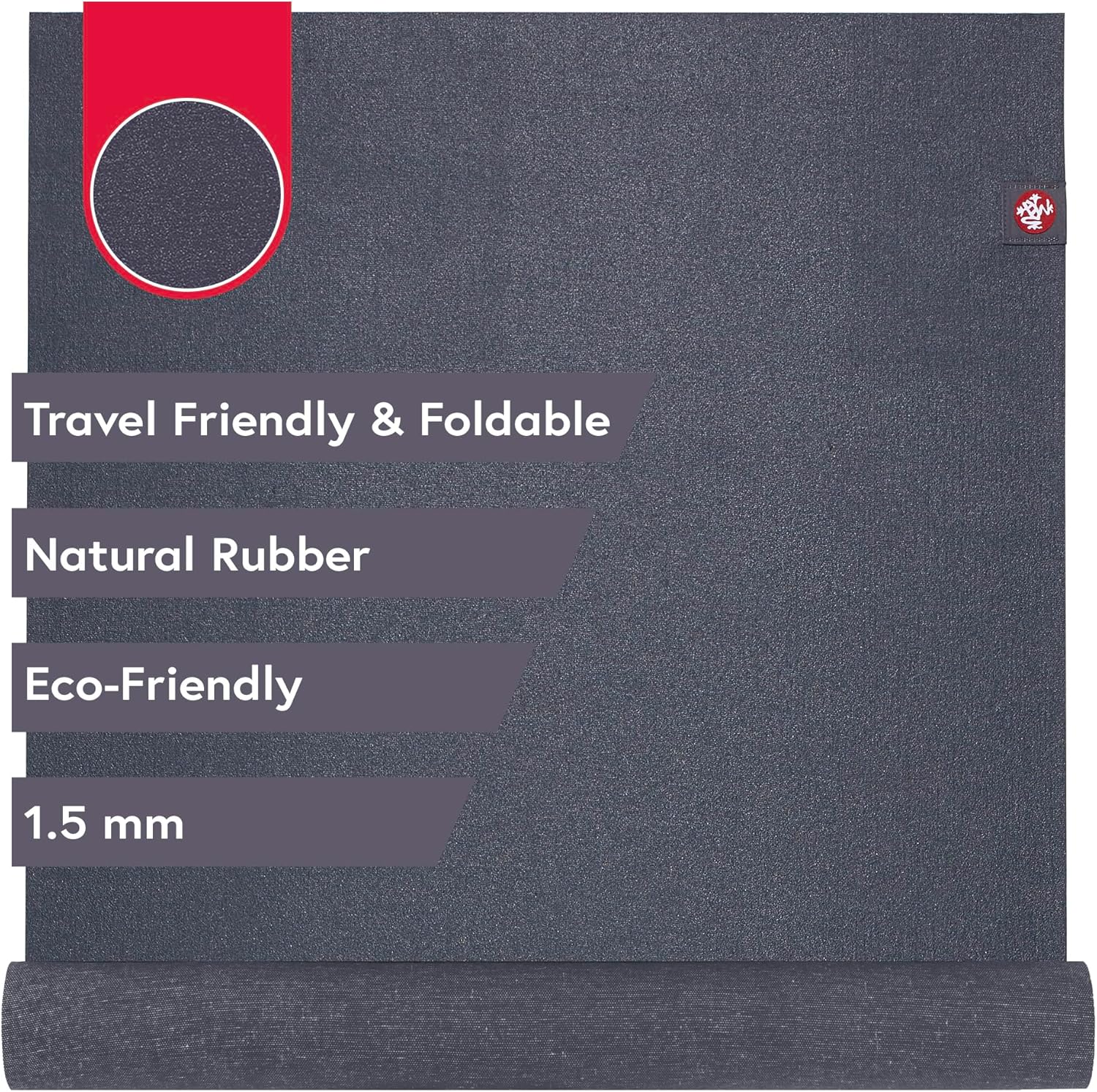
The travel and studio pick: Manduka eKO SuperLite Yoga Mat - 1.5mm Natural Rubber | Foldable & Travel Friendly | Soft Textured Surface | Eco-friendly
 Visit on Amazon →
This is a 1.5mm natural rubber mat, and the number is the whole story. At 1.5mm you are trading cushion for a mat that folds into a square and disappears into a carry-on, which is the only reason to own a mat this thin. On a studio floor over a proper subfloor it is fine. On a hotel-room carpet over slab, it is a sheet of rubber between you and the ground, and your knees will file a complaint.
Natural rubber is the material I trust most when my hands are dry or barely damp. It is also the material that gets slick once it is genuinely wet, and it is a sweat sponge. If you teach hot yoga, this is not your mat. If you travel, it is.
The fold is the real feature. A mat that folds flat does not need to be rolled tight, does not develop the memory curl that rolled travel mats get, and lays down on a hotel carpet without a fight. The tradeoff is that a folded mat has creases, and creases are thin spots. Treat the fold lines as the first place this mat will wear.
Flaws but not dealbreakers: 1.5mm is not enough for a bad knee on a hard floor, and the natural rubber surface needs more cleaning attention than PVC because it holds oil and odor. It is a specialist mat, not an only mat.
Who it is for: the student who flies twice a month and wants the same surface in a Denver hotel as in Portland, and the teacher who wants a spare mat in the car that takes up no room.
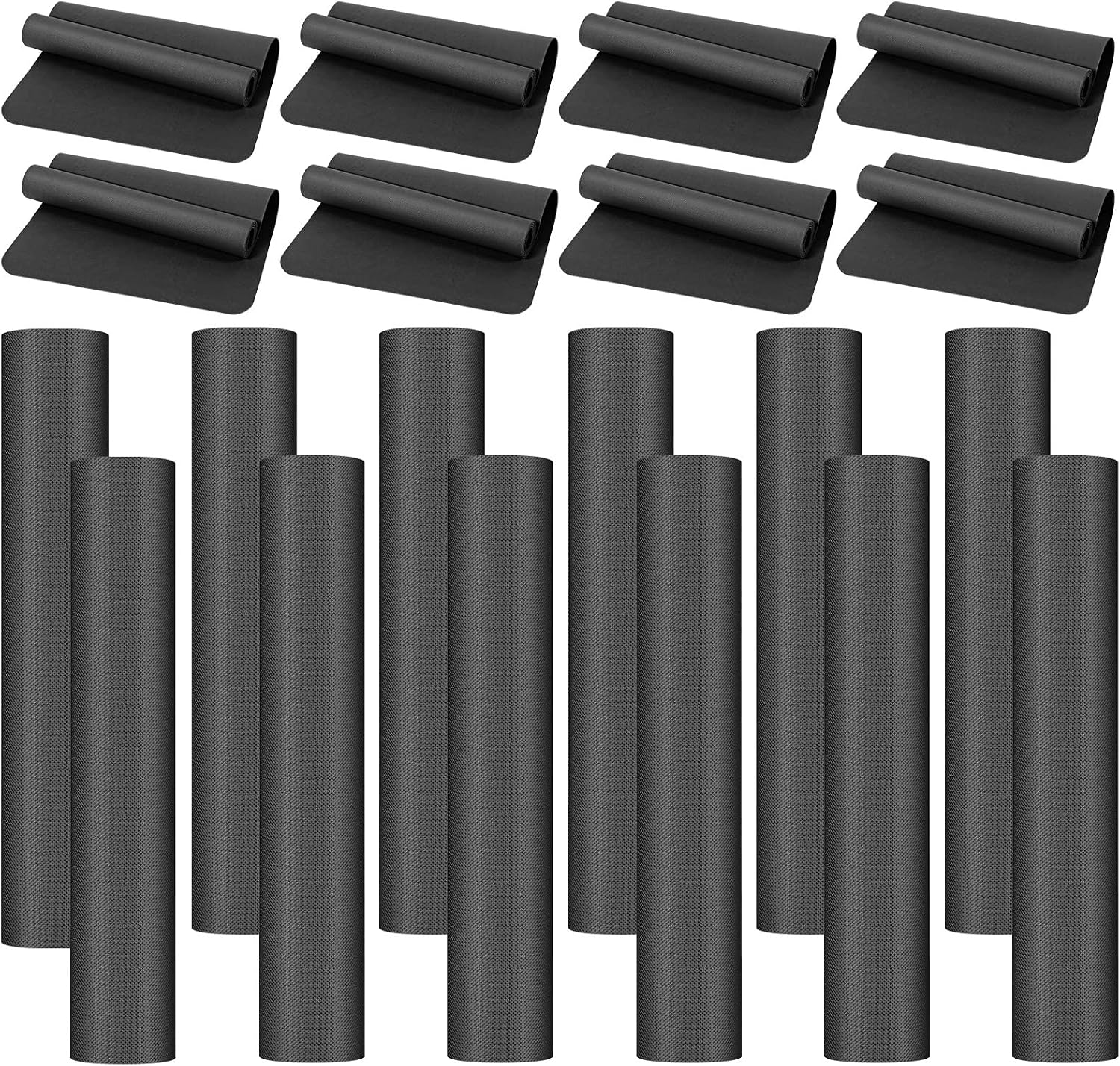
The bulk class pack: LEIFIDE 10 Pack Yoga Mat Bulk 68'' x 24'' x 4mm Thick Yoga Mat
 Visit on Amazon →
Ten mats, 68 inches long by 24 wide, 4mm thick. If you run a class, a community shelf, a church basement program, or a studio that loans mats, this is the arithmetic that matters: ten mats at once is a different purchase than one mat ten times.
68 by 24 is the standard mat footprint, which means these fit standard racks, standard straps, and standard bodies. 4mm is the thickness I recommend to most beginners because it is the middle of the road: enough cushion for kneeling poses, not so much that you sink into warrior two. The honest caveat is that a 4mm mat in a bulk pack is built to a price, and price-built mats usually show it in the top layer. Expect a break-in period where the surface is slicker than it will be in a month, and expect the edges to be the first thing to fray if the mats get rolled tight and stacked.
Where a ten-pack wins is turnover. A studio that loans mats replaces them constantly, and a ten-pack means you always have a clean, dry one on the shelf instead of handing out the same damp mat to the fourth person of the evening. If your program's problem is "we never have enough mats," this solves it in one order.
Flaws but not dealbreakers: A bulk pack is not a premium mat. If you are buying for one person who practices five times a week, buy one better mat instead of ten adequate ones. And check the length against your tallest student, because 68 inches is standard, not generous.
Who it is for: studio owners, teachers running donation classes, school and corporate wellness programs, and anyone equipping a room rather than a person.
The actual workflow for choosing your mat
Step one: Name the job before you name the mat. Travel, hot class, home practice, or loaner fleet. One mat cannot do all four well, and every bad mat purchase I have watched started with someone buying a travel mat to use as a daily mat.
Step two: Measure your body and your bag. Lie down on the floor and mark where your head and heels land. If you are over about 5 foot 10, a 68-inch mat is the floor of acceptable, not the ideal. Then measure your bag or your car trunk. Portability is a real constraint, not vanity.
Step three: Match thickness to your joints and your floor. On a sprung studio floor over a subfloor, 3mm to 5mm is plenty. On concrete covered in thin vinyl, or in a basement, add a millimeter or two, or bring a knee pad. A 1.5mm mat on concrete is a mat for people who do not have knee opinions yet.
Step four: Match material to your sweat. Dry hands, natural rubber. Wet hands, polyurethane or cork. Somewhere in the middle, a decent PVC. If a listing says "non-slip" and never says "when dry," assume it means dry.
Step five: Test grip at minute 40, not minute one. In the store, press your palm flat on the mat and drag it sideways, then do it again with a wet hand. This is the single most useful thing you can do before buying, and almost nobody does it. If you are shopping online, read for reviews that mention sweat and heat, not for the ones that say it feels soft.
Step six: Check the underside against your floor. Flip the mat over. Smooth rubber undersides grip hard floors. Textured undersides grip carpet. A mat with a smooth underside on a smooth studio floor is the classic corner-curl setup, and corner curl is what puts people on the ground.
Step seven: Handle the break-in. New mats are slick. That is normal and it is not a defect. Wipe a new mat down with a damp cloth and a drop of mild soap, let it dry fully, then use it. Some surfaces need several sessions before they grab. Do not "fix" a slick mat with oil, lotion, or a salt scrub you read about online.
Step eight: Clean it and keep it. Wipe after every hot class. Hang to dry rather than rolling damp. Store it flat or loosely rolled. A mat that dries fully lasts twice as long as one that goes back in the bag wet.
What I left out and why
The one-inch foam mats are not in this guide. For a bad knee on a hard floor they are better than nothing, but for standing poses they are a disaster: you sink, you wobble, and your warriors suffer. Cushion is not grip, and no amount of foam fixes a slick topsheet.
The bottom of the PVC market is not here either. The cheapest mat on the shelf is a real option if money is the constraint, and I would rather see you practice on a cheap mat than not practice. But cheap PVC offgasses, goes slick, and typically dies inside eighteen months, at which point you buy another one. Cheap is only cheap if you do not rebuy.
Cork is the interesting material I am still working through. It grips wet better than almost anything except polyurethane, and it stains, and it smells like a wine cellar for the first month. If you sweat heavily and you hate the feel of rubber, it is worth a look. It is not a beginner's first mat.
What this all costs
I am not going to quote you a price here, because listings move and I would rather you look at the live number. The math is the same either way: take the price on the listing and divide it by the number of classes you will actually attend. A mat used three times a week for two years is a little over three hundred uses. That puts even a mid-priced mat in the pennies-per-class range. A ten-pack for a studio divides across every student who ever borrows one.
The purchase that costs the most is the mat you buy twice because the first one slid, or the mat you never roll out because you hate how it feels. Pick for the job, check the grip with a wet hand, and get on with practice.