Related: Best Yoga Mat for Bad Knees: Cushion Without the Wobble
I have one hard rule about thin yoga mats for beginners: if you cannot hold downward dog at minute 40 of a warm class without your hands creeping toward the front edge, the mat is wrong for you, no matter what the box claims. I teach vinyasa and a Thursday night recovery class in Portland, Oregon, and I have spent years watching students fight their mats instead of their hamstrings.
Before anything else, the disclosure: some links in this article are Amazon affiliate links, and I earn a small commission if you buy through them. That is the business model, and I would rather name it in the first paragraph than bury it at the bottom. My rule is that I only link mats and mat gear I would hand to a student in my own class.
The four products below cover the beginner end of the market: two thin mats, one thicker high density mat for cranky knees, and one carrier bag. None of them is a $150 studio mat, and none of them needs to be. A thin yoga mat for beginners should do three things well. Stay put when you sweat. Lie flat when you unroll it. Survive being carried to class twice a week.
Best Overall: Gaiam Essentials 1/4" Thin (6mm) Yoga Mat
This is the mat I point at when a new student asks what to buy on the way out of class. It is the sensible default of the yoga world, and that is a compliment. The brand calls it a 6mm mat, the strap is included rather than sold as an extra, and it rolls up small enough to ride on the back of a bike through Southeast Portland, which is how half my students get to the studio.
What I like is the middle. Six millimeters is enough that my knees do not file a complaint in low lunge, and thin enough that I can still feel the floor under my standing foot in tree pose. That feedback matters more than most beginners realize. A mat that swallows the ground makes balance harder, not easier, and this one does not swallow anything.
The honest limitation is the top surface. It is fine dry, and fine for the first half of a warm class. When a room hits the mid eighties and everyone is dripping, the grip fades before the class ends. That is the slick-sweat threshold, and this mat has one. If you practice hot, look at a mat with a polyurethane or cork top layer instead. For everyone else, for vinyasa, Pilates, a gym floor, a hotel room, this is the one I would buy first.
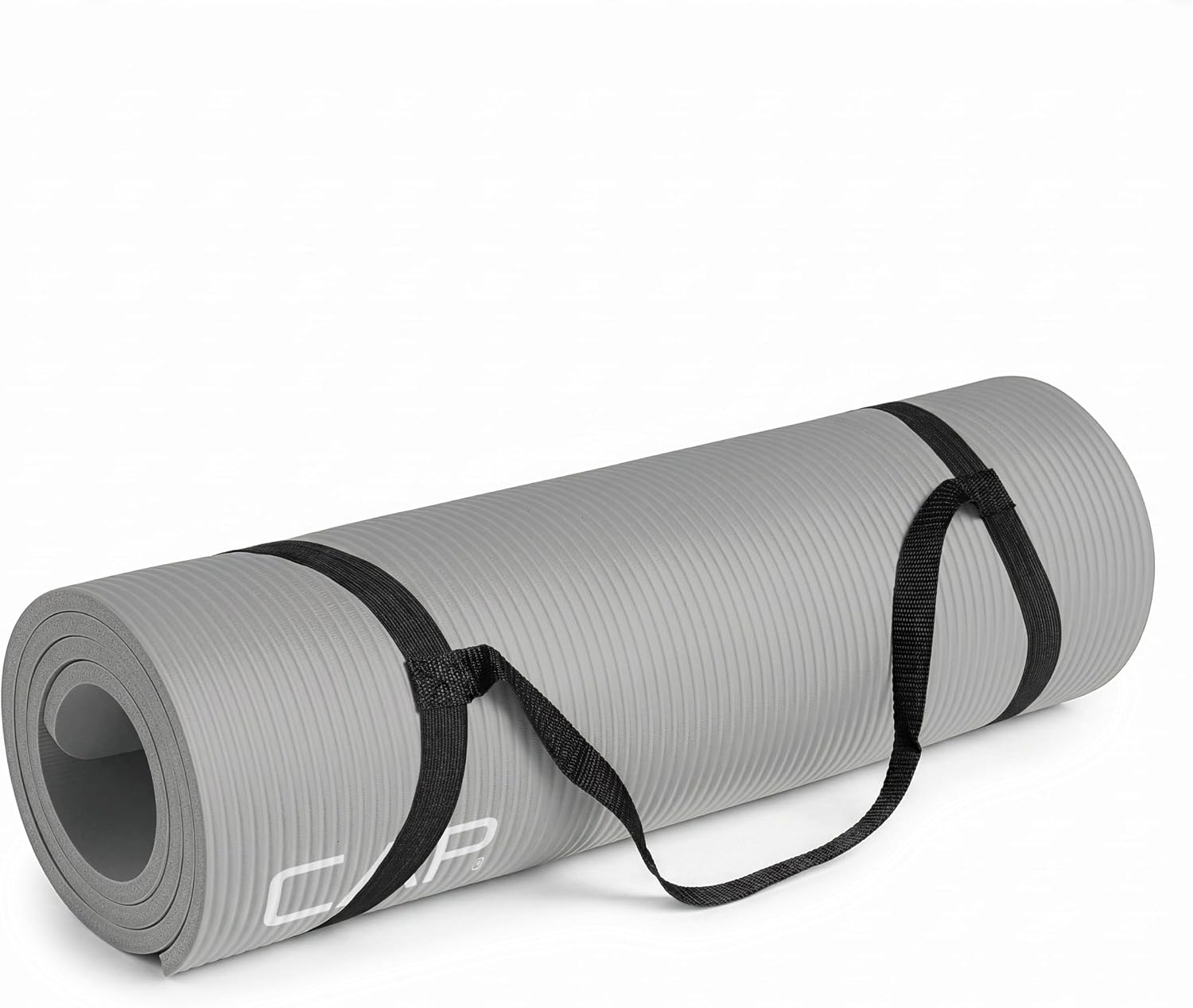
Best for Knees and Hard Floors: CAP Barbell 1/2-Inch High Density Mat
Here is where my two brains argue. The teacher in me wants everyone on a thin mat, because thin mats teach you where your weight is. The other brain, the one that spent eight years installing gym rubber and sprung floors, knows that a concrete slab in a basement apartment will wreck your knees in child's pose before it ever teaches you anything about alignment.
This CAP Barbell mat is the compromise. The brand lists it at half an inch thick, and the words that matter in the name are high density. Cheap thick foam sinks under your palms and your knees, which is the sink factor, and sink is what makes thick mats dangerous. A dense core compresses less, so you get the cushion for kneeling and supine work without the mattress feeling in warrior two.
It is heavy. Half an inch of dense material is not a mat you want to carry across town, and if you are commuting to class three times a week, this is the wrong choice. If your practice lives in one room on a hard floor, and your knees or hips have opinions, this is the mat I would hand you before the thin ones. It comes with a strap, and it is the one in this group I would pick for a home setup over tile.
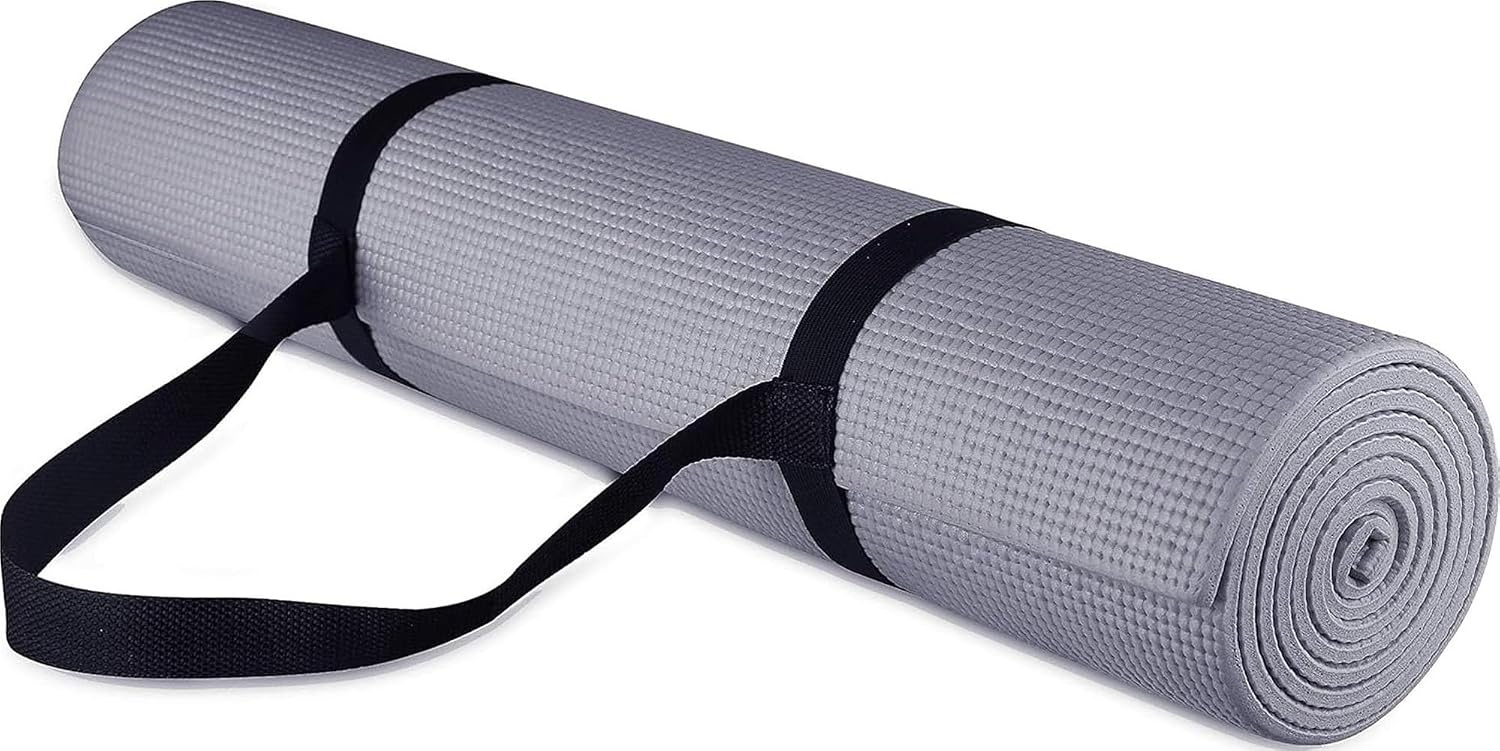
Best Budget: Fitvids All Purpose 1/4-Inch Mat
The Fitvids is the mat I hand a student who is not sure yoga will stick. It is a quarter inch thick, it weighs almost nothing, and it comes with a carrying strap, which means the whole kit costs less than a single studio class pack in most cities. If you are in month one, that is the right amount of commitment.
The anti-tear claim in the name is doing real work, because the failure mode of cheap mats is not grip, it is edges. They shred where your heels catch them, they split at the fold line, and the corners curl up like a scroll that will not stay closed. This one holds up better than most at the price, and the included strap keeps it rolled tight so the curl never sets in the first place.
Two things to know. It is a thin mat, so if you are practicing on hardwood over a crawlspace, your knees will feel it and you should look at the CAP instead. And it is PVC, which means it will smell like a new shower curtain for the first week. Unroll it in a garage or on a porch for a few days before you bring it inside. Clean it after sweaty classes, because cheap PVC holds onto odor in a way that natural rubber does not. It is not the mat you keep for a decade. It is the mat that gets you to class, and that is a real job.
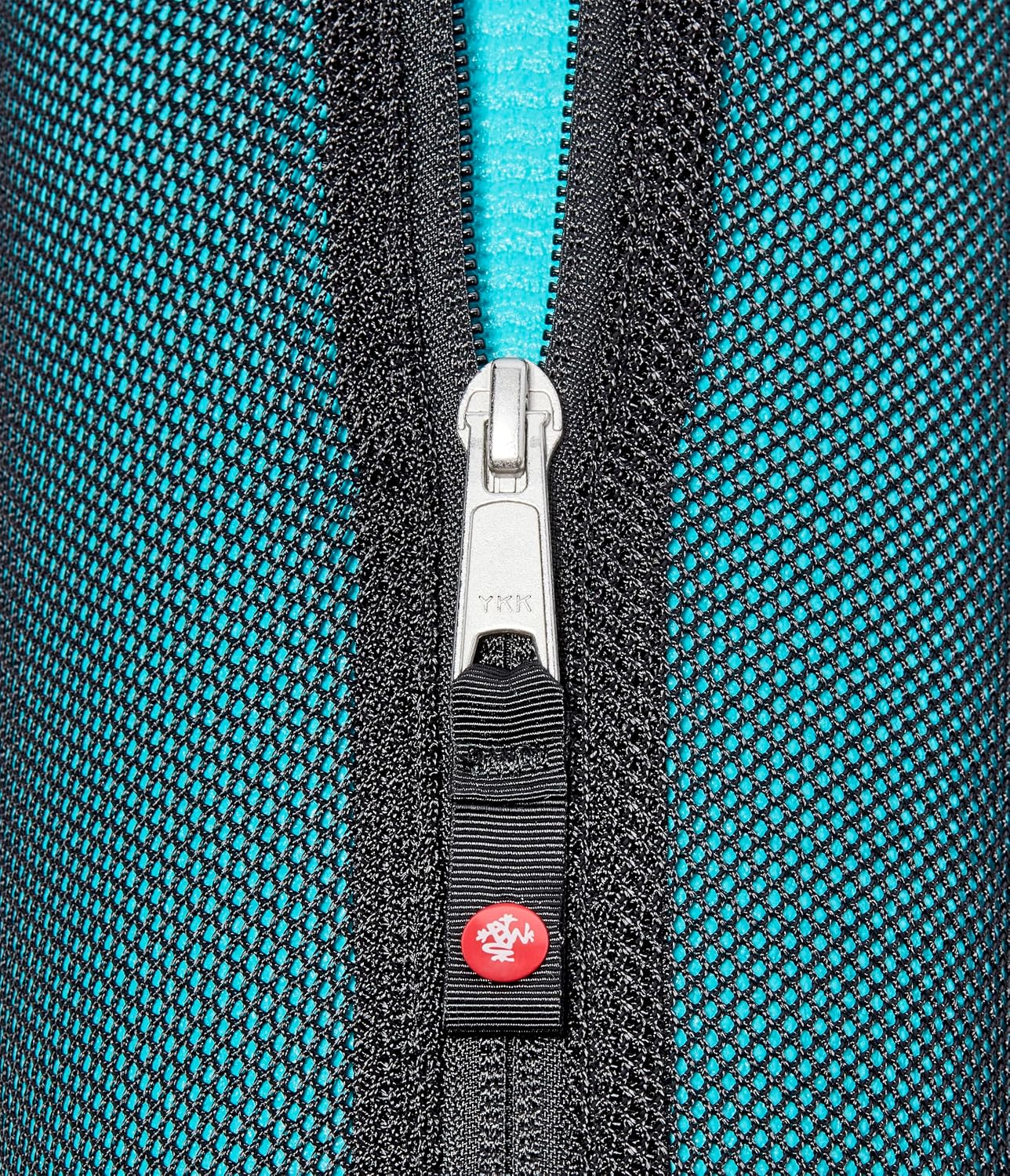
The Carry Solution: Manduka Breathe Easy Full Zip Mat Bag
This is the one item here that is not a mat, and it is the one I get asked about most after class. The reason is boring and practical: the most common way a mat dies is not sweat, it is transit. Mats get dragged across parking lots, crushed under gym bags, and left in hot cars where the edges take a set that never comes out.
The full zip opening is the feature that matters. Sling bags with a narrow mouth make you fight your mat in and out, and fighting it is what bends the corners. Manduka says this bag suits most yoga mats, and the adjustable strap lets you wear it crossbody, which keeps both hands free for a water bottle and a coffee, the true Portland commute loadout. There is a pocket for keys and a phone, and the fabric breathes, which matters more than people think. A mat sealed in a plastic sleeve after a hot class is a mat that grows a smell.
How I test mats
Every mat that gets a recommendation from me goes through the same routine, and it starts before the mat comes out of the packaging. I check the stated thickness against what the mat actually feels like at the thinnest edge, because the number on the box is marketing until proven otherwise. That gap between the claim and the reality is the caliper gap, and anything over a millimeter is a brand telling you a story.
Then I run the angle test. A weighted block on the mat, a board raised slowly, and I note the degrees at which it starts to slide, dry and then wet. Grip is a chemistry problem, not a texture problem. The little bumps and ridges printed on a mat sell it on a shelf, but what decides whether you slide at minute 40 is what the top layer is made of. PVC behaves one way, polyurethane another, cork another.
Then I teach on it. That is the part no spec sheet can replace. I watch where students' hands drift, whether the corners lift when they step off, whether the mat smells like a tire on day 30, and whether it still lies flat after a month of being rolled and unrolled twice a week.
What these four have in common
All four are honest about what they are. None of them claims to be a hot yoga mat. None of them is pretending to be a $150 studio mat with a five year warranty, and that is exactly why they belong in a beginner's bag. You do not know yet whether you want to spend that money, and you should not, because a mat you use every week beats a mat you use twice.
The tradeoff across the group is thickness against portability and stability. The Fitvids and the Gaiam are thin and easy to carry, which is what a commuter needs. The CAP is thick and heavy, which is what a hard floor needs. The Manduka bag is the only thing here that makes any of them last longer, because it solves the transit problem that kills mats.
If I had to hand one mat to a brand new student walking into my Thursday class, it would be the Gaiam. If that student told me they practice in a basement on concrete, it would be the CAP. If they told me they were not sure they would come back next week, it would be the Fitvids, because the price of finding out should be small.
| Mat | Thickness as listed | Best for | What I would tell a student |
|---|---|---|---|
 Visit on Amazon → Visit on Amazon →Gaiam Essentials Mat |
6mm | Most beginners | Buy this one first. Strap included. |
 Visit on Amazon → Visit on Amazon →CAP Barbell High Density Mat |
1/2 inch | Knees, hips, hard floors | Cushion without the wobble. Heavy to carry. |
 Visit on Amazon → Visit on Amazon →Fitvids All Purpose Mat |
1/4 inch | Trying yoga without a big spend | Thin, light, replaceable. Air it out first. |
 Visit on Amazon → Visit on Amazon →Manduka Breathe Easy Bag |
Not a mat | Carrying any of the above | The cheapest way to make a mat last longer. |
Should you buy the Gaiam Essentials?
Yes, for most people reading this. It is the mat that does ninety percent of what an expensive mat does, it lies flat out of the box, and the strap is in the bag rather than a separate purchase. It will get slick in a hot room and you will notice it around the middle of a hard class. If you practice in a heated studio, that is a real limitation and you should look at a polyurethane topped mat instead.
For everyone else, this is the one I would buy, and it is the one I recommend to students who ask me in the parking lot.
Should you buy the CAP Barbell 1/2-Inch?
Yes, if your practice happens in one room on a hard floor and your knees or hips have been complaining. The high density core is the point. It gives you cushion without the sinking feeling that turns every standing balance into a negotiation, and it comes with a strap for storage.
No, if you carry your mat to class. Half an inch of dense material is heavy, and heavy mats stay in the car, and mats that stay in the car do not get used. That is the whole test. The best mat is the one you actually roll out.
Should you buy the Fitvids?
Yes, if you are three classes in and still deciding whether this is your thing. It is thin, light, and cheap enough that walking away costs you almost nothing. Air it out for a few days before the first class, clean it after sweaty sessions, and expect to replace it within a couple of years if yoga sticks.
If you already know you will be practicing twice a week for the next three years, skip it and go straight to the Gaiam.
Do you need the Manduka bag?
No, and it is the item here I would buy last. But buy it eventually. A bag keeps your mat out of the sun, off the pavement, and away from whatever is growing in the trunk of your car, and it stops the corners from taking a set. Manduka says it fits most mats, the full zip makes loading easy, and the adjustable strap goes crossbody. It is the least exciting purchase in this article and probably the one that adds the most months to the life of whatever mat you choose.