Yoga mat thickness is the first spec most people read and the last one that tells them much. The number on the box describes a slab of foam, not the thing you actually stand on at minute forty of a warm class, when your palms are damp and your standing leg has started to wander. A thick mat cushions knees and wrists; a thin mat puts you closer to the floor and makes balance easier to read; a modular tile floor is a different product solving a different problem entirely. This post walks through four options that cover those jobs, what each one is for, and how to decide which one you will actually unroll on a Tuesday.
Some links here are affiliate links, which means I earn a commission if you buy through them. That does not change what I recommend, but it does mean you should read the reasoning rather than only the table.
Related: How to Clean a Yoga Mat Without Killing the Grip →
Quick answer
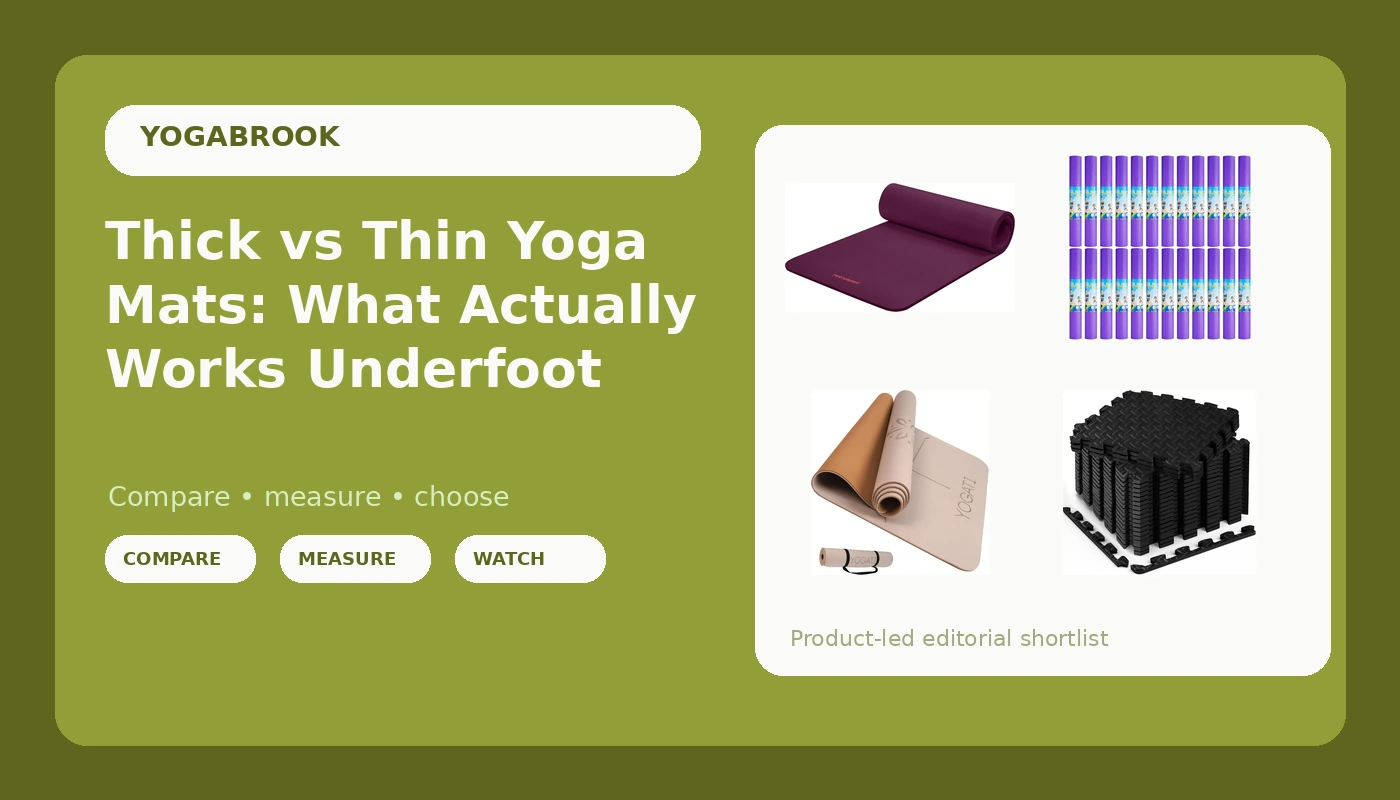
There is no single correct yoga mat thickness, because the right number depends on what you do on the mat and what is underneath it. A 1/2 inch mat like the Retrospec Solana puts a real layer of foam between your knees and a hard floor, which suits restorative work, stretching, and anyone with cranky joints. A 3 mm mat like the Funtery bulk set sits close to the floor, which makes standing poses and balance work more honest. Printed alignment lines, like the ones on the YOGATI mat, help you keep hands and feet where you put them. Interlocking EVA foam tiles are not a yoga mat at all; they are a floor surface, useful under a thin mat or in a home gym corner.
4 useful options
| Model | Best fit | What stands out |
|---|---|---|
| YOGATI Yoga Mat with Strap with Alignment Lines | Guided practice at home | Alignment lines printed on the surface and an included strap |
| Retrospec Solana Yoga Mat Thick 1/2in | Cushion for knees, wrists, and floor work | 1/2 inch thickness, 72 x 24 in surface, nylon strap, BPA free |
| Funtery 3 mm Thin Yoga Mats Bulk | Studios, group classes, balance work | 3 mm thin profile, 68 x 24 in, sold as a bulk set |
| 18 Pcs EVA Foam Floor Tiles | The floor underneath everything | 18 interlocking EVA foam puzzle tiles |
The alignment pick: YOGATI Yoga Mat with Strap with Alignment Lines
Alignment lines are the most underrated feature on a home mat, because most people practicing at home are not being watched. In a studio, a teacher tells you your right hand has crept forward again. At home, a printed line does the same job for free, and it is especially useful for anyone learning sun salutations, where the difference between a good lunge and a sloppy one is a few inches of foot placement. The trade-off is the same one every thick mat carries: more foam under your hands and feet means a slightly softer, less immediate connection to the floor in standing balances. For seated work, floor stretches, and guided sequences, that is a fair trade.
The cushioned default: Retrospec Solana Yoga Mat Thick 1/2in Non-Slip Workout Mat with Nylon Strap
Half an inch is the point where a mat stops being a surface and starts being a cushion. That is genuinely helpful if your practice leans toward restorative poses, long holds, stretching, or mat Pilates on a hardwood or concrete floor, and it is close to essential if you have knee or wrist history. The cost shows up in standing postures. Every millimeter of foam compresses under your weight, so your palm sinks slightly before it settles, and that small delay is what makes a thick mat feel vague in tree pose or a one-legged balance. If you spend most of your mat time seated or supine, you will never notice. If you spend it standing on one leg, you will.
The thin bulk option: Funtery 3 mm Thin Yoga Mats Bulk, 68 x 24 in
A 3 mm mat is a different philosophy. You are basically on the floor, with a thin layer of material to keep your skin off it and give your hands something to push against. That is why thin mats show up in studios, where a room full of people needs a stack of identical mats that store in a small footprint, and it is why experienced practitioners often prefer them for balance work: there is almost nothing between your foot and the ground, so your ankle does the work instead of the foam. The obvious trade-off is that 3 mm offers very little cushioning. If your knees complain in tabletop or you practice on concrete, this is the wrong category of mat, no matter how good the grip is.
The base layer: 18 Pcs EVA Foam Floor Tiles, Puzzle Exercise Mat Set for Gym
This one belongs in the conversation because people keep buying it for the wrong reason. Interlocking EVA tiles are a floor, and they solve a floor problem: a cold basement, a garage slab, a spare room where you also lift weights, or any hard surface you want to soften before you put a mat down. They are not a substitute for a yoga mat. Foam tiles compress a lot under a standing pose, the seams create edges your hands and feet can catch on, and a wide flat surface does not roll up or travel. The sensible combination is a thin mat on top of tiles if your knees need the extra layer, or tiles alone for the corner where you do floor work and dumbbell work side by side.
Prices and availability may change. Product images, names, and retailer links must be matched by verified ASIN. Do not state a current price, rating, stock status, or measured result without current evidence.
What yoga mat thickness actually changes
Thickness is really two variables pretending to be one: cushion and stability. Cushion is how much the material compresses under a knee, a wrist, or a hip bone. Stability is how much it compresses under a standing foot, and those two things pull in opposite directions. A mat thick enough to protect your knees in a long kneeling sequence is also thick enough to wobble under you in warrior three. That is not a flaw in any particular mat; it is physics, and no brand has repealed it.
The number that matters most is not the headline thickness but how the mat behaves at the thinnest point. Foam mats are frequently compressed at the edges or rolled tighter in one direction, and a mat that measures a full half inch in the middle can be noticeably thinner along one side. That is also where corner curl starts, and a mat whose corners will not lie flat is a mat you will trip over in a dark room at 6am.
Material matters too, though it is a separate question from thickness. PVC, natural rubber, EVA foam, and cork-topped mats each have different grip characteristics, different weights, and very different environmental footprints. Natural rubber and cork generally outperform PVC on sustainability, while PVC tends to win on price and durability. A mat you keep for five years beats a compostable one you replace every eighteen months, so the honest question is not which material is virtuous but which mat you will still be using in 2031.
Finally, think about where the mat lives. A mat that stays rolled in the corner of a spare room can be heavy, thick, and cheap. A mat that travels to a studio three times a week needs to be light and to lie flat immediately after being unrolled. Those are different products, and no single mat is optimal for both.
Matching a mat to your body and your floor
Start with the floor, not the mat. A padded tile surface plus a thin mat behaves very differently from a thin mat on concrete, and knowing which one you have narrows the field immediately.
- Identify the surface under the mat: hardwood, concrete, carpet, or a padded tile floor. Harder surfaces argue for more cushion.
- Count how much of your practice is standing versus seated. Mostly standing favors thin; mostly seated, kneeling, or supine favors thick.
- Check your joints honestly. If knees, wrists, or hips complain during class, cushion is not a luxury, it is the point of the purchase.
- Measure your space and your body. A 68 x 24 in mat and a 72 x 24 in mat look similar on a spec line but feel different if you are tall or you like to spread out in a wide-legged forward fold.
- Decide whether the mat travels. If it leaves the house, a strap and a manageable weight matter more than an extra few millimeters of foam.
Practical guidance before you buy
- Buy for the practice you actually do, not the one you plan to start in January. A mat sized for hot vinyasa is wasted on a stretching routine in front of the television.
- Treat alignment lines as training wheels with no shame attached. They are genuinely useful for anyone practicing without a teacher in the room, and they fade into the background once your placement is automatic.
- Do not stack two thick mats hoping for more comfort. You get more wobble and less stability, and the top mat slides on the bottom one.
- If your knees need cushion on a hard floor, put the padding underneath, in the form of interlocking tiles, and keep a thin mat on top where your hands and feet need feedback.
- Expect a break-in period from any mat with a smooth top surface. Grip usually improves after a few sessions as the surface loses its factory slickness, and cleaning habits affect it too.
Which option should you choose?
Choose the YOGATI Yoga Mat with Strap with Alignment Lines when you practice mainly at home and want printed guides plus a strap without buying them separately. Choose the Retrospec Solana Yoga Mat Thick 1/2in Non-Slip Workout Mat with Nylon Strap when cushion matters most, whether that is knee and wrist comfort, restorative work, or a hard floor in a cold room. Choose the Funtery 3 mm Thin Yoga Mats Bulk, 68 x 24 in when you need several thin mats at once, for a studio, a class, or a household where more than one person practices. Choose the 18 Pcs EVA Foam Floor Tiles, Puzzle Exercise Mat Set for Gym when the problem is the floor itself and you want a padded surface that a mat or a set of dumbbells can sit on.
The caveat worth repeating: thickness, material, and price all interact, and a spec sheet will not tell you how a mat feels under your particular knees on your particular floor. Buy from a seller with a return window you can actually use, and give the mat a week of real practice before you decide.
The bottom line
Yoga mat thickness is a trade, not a ranking. Thick mats buy cushion and pay for it in stability; thin mats buy ground feel and pay for it in comfort; interlocking foam tiles solve a floor problem and should not be asked to solve a mat problem. The useful question is not which thickness is best, but which of those trades matches the way you practice, the surface you practice on, and the joints you have to live in for the next thirty years. Get that right and the mat disappears, which is exactly what you want from a tool.