Most yoga mats are not slippery because they were cheap. They are slippery because of what the top layer is made of, and what is sitting on top of it. A non slip yoga mat is a chemistry problem before it is a texture problem, and no amount of embossed chevrons on the surface fixes a top layer that turns greasy the moment your palms start to sweat.
I teach vinyasa and a Thursday night recovery class in Portland, Oregon, and in 2022 a student slipped on a slick mat in my hot class and sprained her wrist. That is the day I stopped trusting the words "non slip" on a box and started asking a better question: non slip when, exactly? Dry at minute two is easy. Wet at minute 45 is the whole game.
Two disclosures before we start. This post contains Amazon affiliate links, and I earn a commission if you buy through them. I only link mats I would tell a student in my own class to buy. Second, I am a teacher and a former flooring installer, not a physical therapist. If your knee hurts, go see someone. I will stick to the mat.
Here is how to get grip out of whatever mat you already own, and how to pick one that starts with more of it.
Why you should trust me
I danced from age six, ballet first and then modern, until I tore my ACL at 19 during a company audition in Columbus, Ohio. Yoga was my rehab, and it turned into my life. I finished a 200-hour training in 2012, and I paid for it by working eight years for a flooring company that installed sprung dance floors and gym rubber in theaters and studios across the Midwest.
That job is why I think about mats the way I do. I have watched what a floor does under 30 dancers at 9pm. I know that grip is measurable, that cushion and stability fight each other, and that a mat which curls at the corners is a trip hazard, not a cosmetic problem.
I teach vinyasa plus a recovery class for people with knee and hip histories. I keep a class log for every mat I teach on, noting the minute grip starts to give in a hot room, whether the corners lift, and how the mat smells after a month. My rule for this site is simple: if I would not hand it to a student, it does not get a link.
How I judge a mat before I recommend one
Four things decide whether a mat grips, and only one of them is on the box.
The top layer. Closed-cell vinyl, which is most budget mats, beads sweat and gets slicker as class goes on. Open-cell natural rubber absorbs a little moisture and holds better, and it smells like rubber. Polyurethane tops grip wet better than anything else and scuff if you look at them wrong. Cork is the interesting new one: it grips better wet than dry, and it stains. Texture is marketing. Chemistry is grip.
The sink factor. How far the mat compresses under your palms in downward dog. A millimeter or two of give is fine and kind to your knees. Six millimeters of sink wrecks your wrists and makes standing balances wobble, because your hand is never on a stable surface.
Mat drag. Corner curl and edge lift. A mat that will not lie flat is a mat that can slide out from under you on a smooth studio floor.
The claim on the box. If the words "non slip" appear without "when dry" anywhere near them, treat the claim as a question, not a fact.
One more thing I look at: thickness. Half an inch, 6mm, 8mm, those numbers sell mats, and brands round them in their own favor. If you own calipers, measure the thinnest edge. The gap tells you how much the rest of the spec sheet is worth.
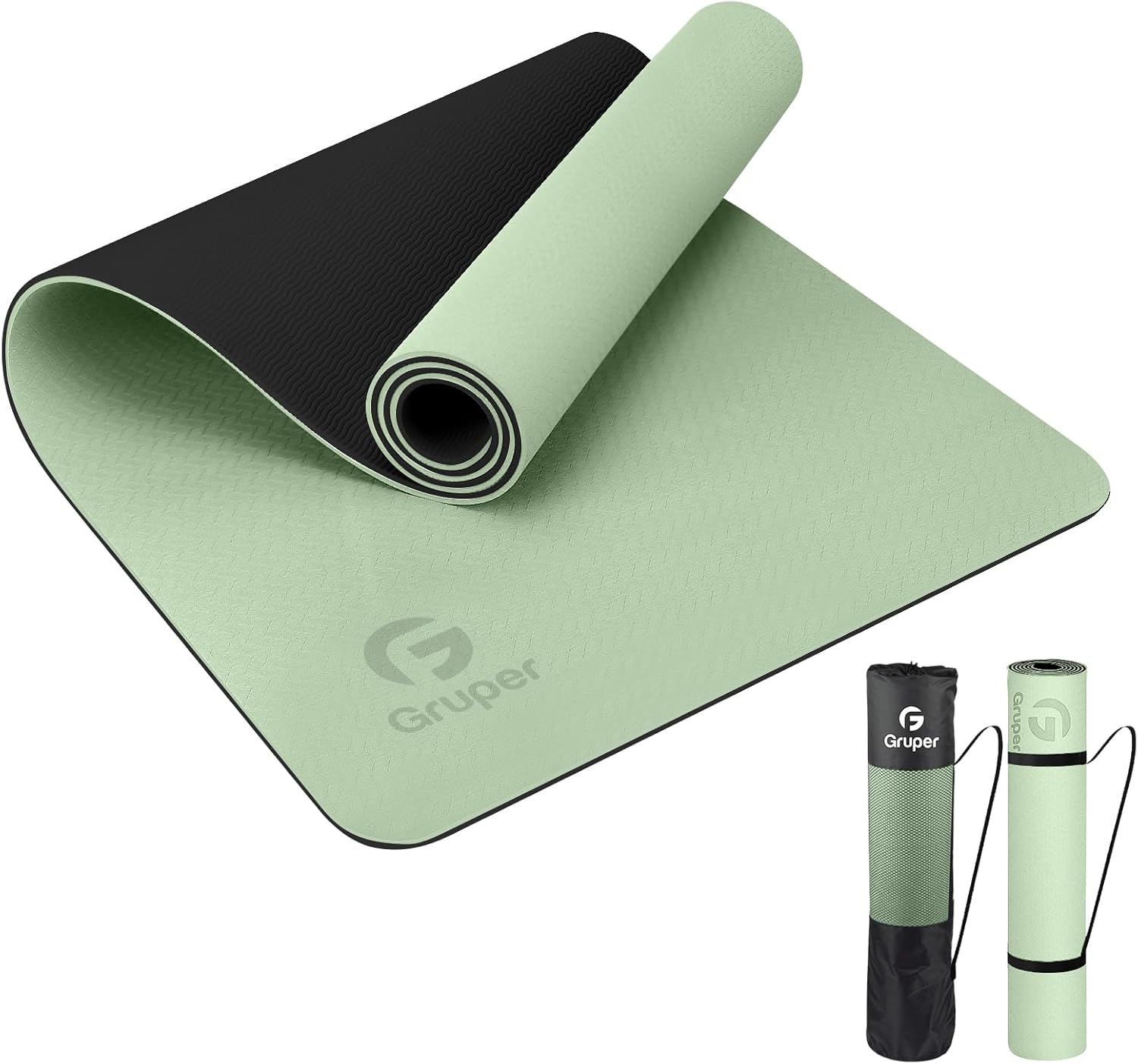
Best for a first mat you will actually carry: Gruper Yoga Mat Non Slip, Eco Friendly Exercise Mat with Carrying Strap
 Visit on Amazon →
The Gruper is the shape of mat I point beginners toward: a non slip surface, an eco friendly material story, and a carrying strap in the box. That last one matters more than people admit. The best mat in the world is the one you actually roll out on a Tuesday, and a mat with a strap is a mat that leaves the house.
Two honest caveats. First, "non slip" on a closed-cell mat usually means non slip while your hands are dry, so budget for a towel over the top in a hot room. Second, "eco friendly" can mean almost anything on a mat. Ask what the top layer is made of and where the foam comes from before you treat the word as a promise. A mat you keep for five years beats a "biodegradable" one you replace every two.
Flaws but not dealbreakers: Sweat beads on the surface instead of soaking in, so grip fades late in a hot class, and a thinner mat puts more pressure on your knees in kneeling poses. Both are fixable with a towel and a folded blanket.
Beginners, commuters, and anyone whose practice runs dry to moderately sweaty will get years out of this one.
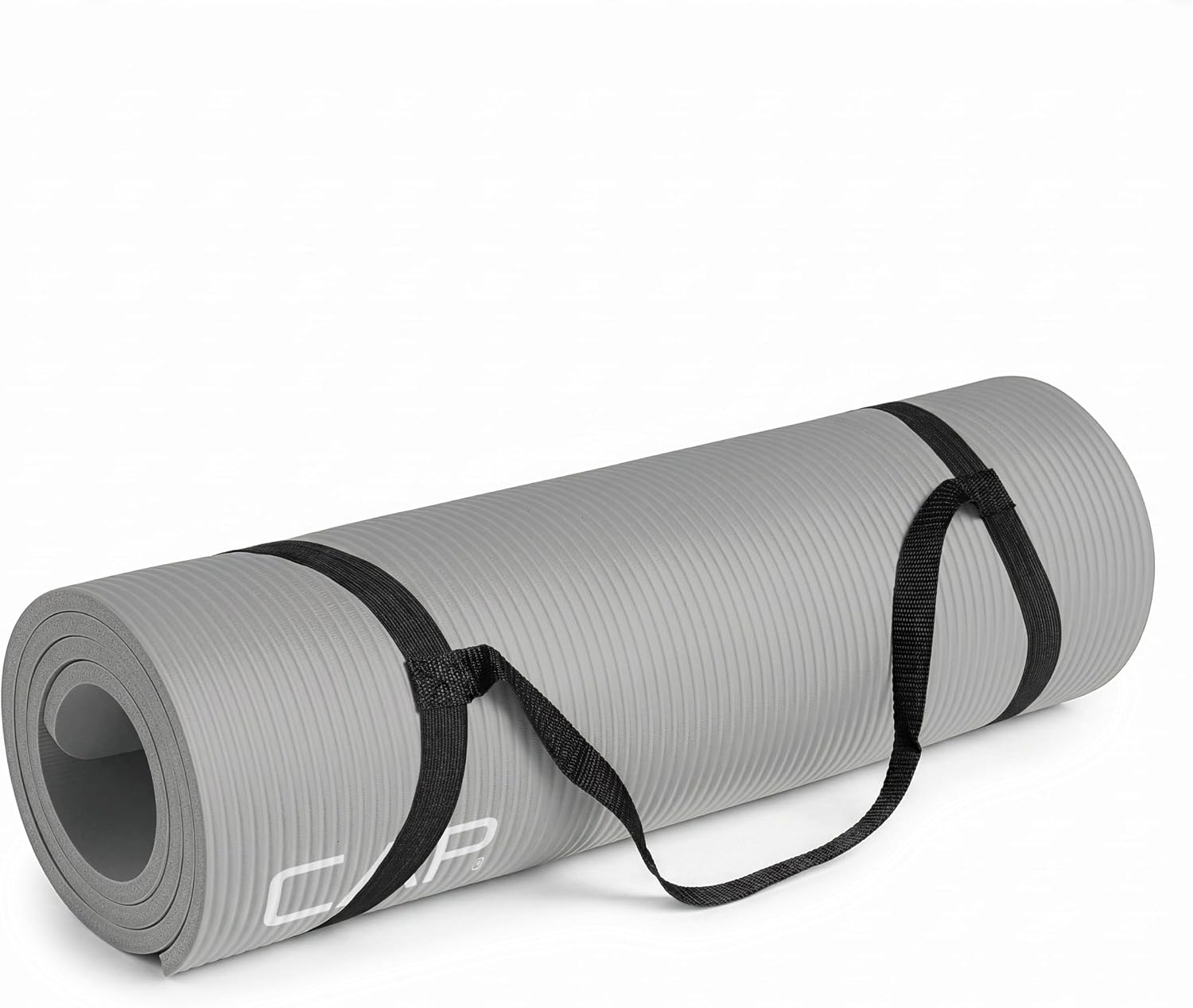
Best for hard floors and cranky knees: CAP Barbell 1/2-Inch High Density Exercise Yoga Mat with Strap
 Visit on Amazon →
Half an inch of high density foam, a strap in the box, and multiple color and size options. This is the mat I hand people who practice on tile, concrete, or a basement floor, and the one I suggest to students coming back from a knee or hip injury. Cushion is what buys you a second decade of kneeling.
The tradeoff is the sink factor. Every millimeter of foam between your palm and the floor makes standing balances less stable, and half an inch is a lot of foam. So this is a wonderful mat for restorative, yin, floor work, and slow flows, and a frustrating one for anyone working on handstands or one-legged balance. My dancer's knees want the cushion. My flooring brain knows what the cushion costs.
Flaws but not dealbreakers: Thick foam can wobble under standing poses, and it curls at the corners if you store it rolled tight in a cold car. Store it flat, or rolled loosely with the top side out, and it behaves.
Home practitioners on hard floors, people with knee and hip histories, and anyone who spends more of their practice sitting and kneeling than standing will get the most out of it.
The actual grip workflow
This works on any mat, including the one already in your closet. Do the steps in order.
Step one: strip the factory film. New mats leave the factory with mold-release residue on the top layer. Wash a new mat with a drop of mild dish soap and warm water, wipe it with a clean cloth, and let it air dry completely before the first class. Skip the washing machine and skip the dryer.
Step two: pay the break-in tax. Some mats grip from the first downward dog. Others, especially dense vinyl mats, need 20 to 30 classes before the top layer stops being slick. Do not judge a mat in week one, and do not assume it is defective. Give it a month of real practice first.
Step three: clean the floor, not just the mat. Dust, grit, and floor polish are grip killers. In my studio the floor gets mopped between classes for exactly this reason. At home, a damp microfiber pass over the floor before you unroll beats any mat upgrade you can buy.
Step four: check your hands. Hand lotion, sunscreen, and oil are the most common reason a good mat suddenly fails. Wash your hands before class and keep the lotion for after. This single step solves more grip complaints than any product does.
Step five: add a towel for hot rooms. In a heated class, a microfiber towel laid over the top of the mat is what actually holds a sweaty hand. The mat underneath is the backup, not the primary grip surface. This is true of every mat I have ever seen, at every price.
Step six: kill the curl. Corner curl comes from storing a mat rolled tight, top side in, in a hot car. Roll it the other way for a few hours, store it flat when you can, and never leave it in a hot trunk. A mat that lies flat is a mat that will not slide out from under your foot in warrior two.
Step seven: clean it the right way. Mild soap and water, a soft cloth, air dry. Skip citrus and solvent cleaners, skip essential oil blends, and skip anything that promises to "restore tack." Those products strip the top layer and leave an oily film that makes the next class worse.
Step eight: know when it is finished. If a mat has been cleaned, broken in, and still goes slick fifteen minutes into a warm class, the top layer is gone. No spray brings it back. Replace it, and put the old one under a treadmill or in the garage.
Where these two mats stop working
Neither of these is a hot yoga lifeline, and I would rather say so than let you find out at minute 40 in a 105-degree room. A half inch of foam is cushion, not grip. Cushion keeps your knees happy and does nothing for a wet palm. If your practice is hot and sweaty, plan on a towel over the top, and plan on replacing the mat sooner than the label suggests.
The same goes for the eco friendly label on any budget mat. PVC is the least eco friendly mat material there is, and it is also the cheapest and the most common. If sustainability is your priority, the honest move is to buy one mat and keep it for five years, not to buy three biodegradable ones and replace each in eighteen months.
If you are shopping for a rubber mat with a polyurethane top and a price to match, that is a different conversation for a different post. These two are the entry tier, and they are good at being the entry tier.
What this all costs
Both mats here sit in the budget tier, and you can see the current number at the link, because prices move and I am not going to pretend a figure from last month is still true. Check current Amazon price on each before you decide.
The math that matters is cost per class, not cost per mat. A mat you use three times a week for five years is 780 classes. A mat you replace every eighteen months costs you three and a half mats over the same stretch, plus the three weeks you spend telling yourself the old one is fine while you slide around on it. Cheap is only cheap if you keep it.
So here is the whole thing in one line: wash your hands, wash your mat, break it in, store it flat, put a towel over the top when you sweat, and replace it when the top layer gives up. That is how a budget mat outlasts a mat that costs five times as much.
Roll it out. That is the job.