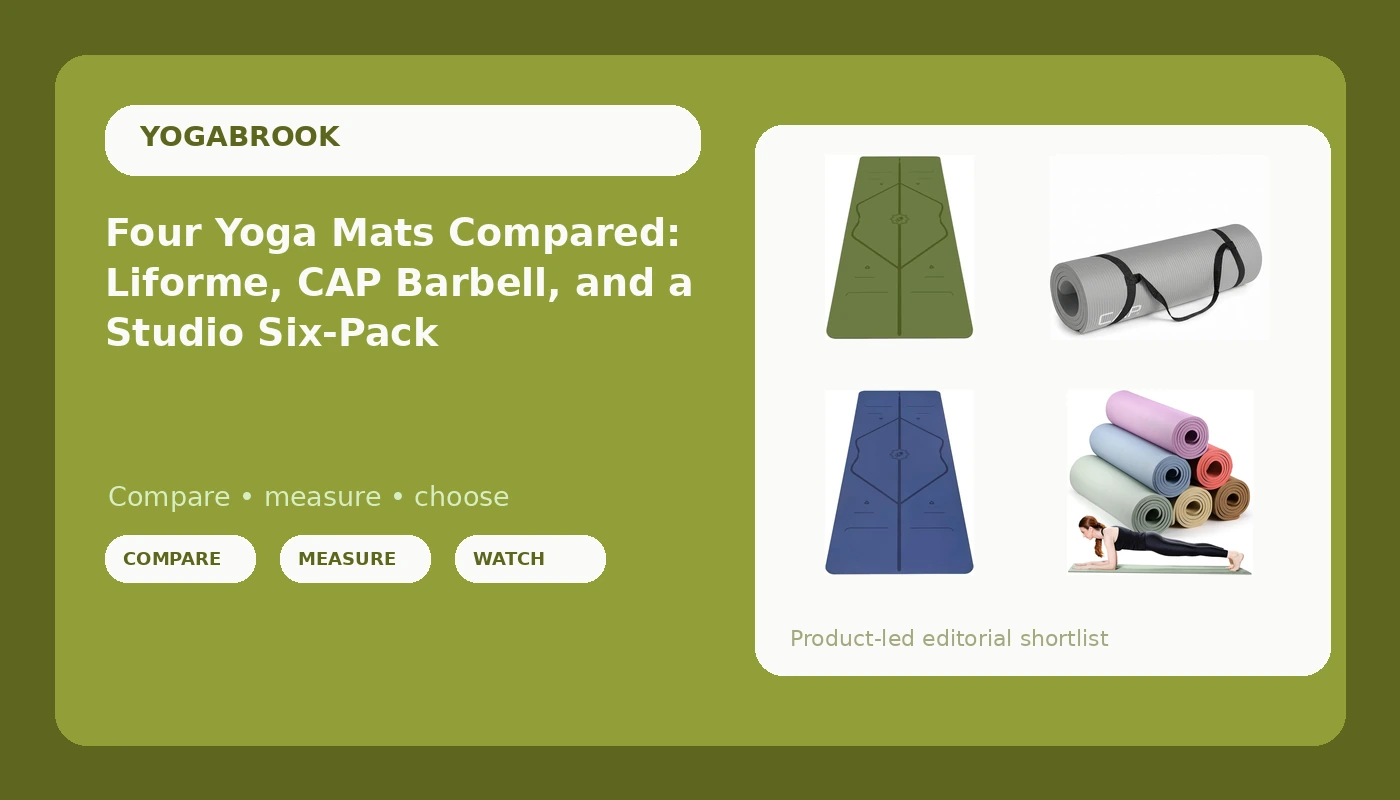
I teach vinyasa and a Thursday-night recovery class in Portland, Oregon, and I keep a spreadsheet with a row for every class I teach on every mat. That habit started after a student slipped on a slick studio mat in 2022 and sprained her wrist, and it is the reason this comparison of four yoga mat listings exists. If you are shopping for the best yoga mats for grip and honest cushioning, the four records below cover the whole spread of the category: two Liforme Classic listings, a half-inch CAP Barbell mat that ships with a strap, and a six-pack of 10mm Timgle mats built for volume.
Full disclosure, because I would rather name it than pretend it is not there: the links in this article are affiliate links, and if you buy through them I earn a small commission. My rule is that I only link mats I would hand to a student in my own class, and I say that in the first paragraph every time. This is a comparison, not a sponsored list, and no brand paid for a placement here.
The short answer: if you sweat, the Liforme Classic is the grip pick. If you are equipping a studio, a retreat, or a family of six, the Timgle pack is the volume answer. If you want one forgiving mat for a hard bedroom floor and bad knees, the CAP Barbell half-inch is the sensible default.
Related: How to Stop Sliding in Downward Dog
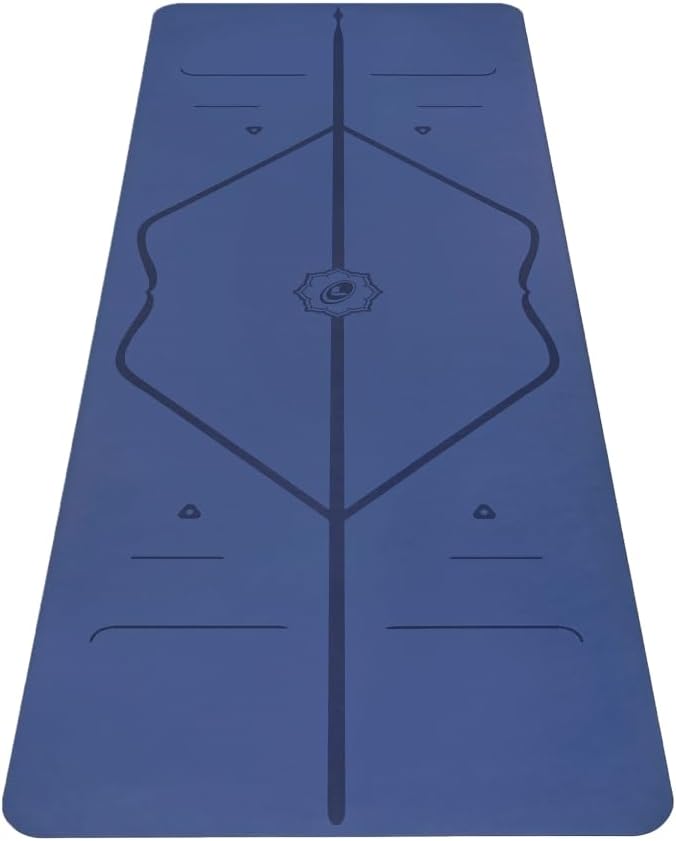
Liforme Classic Yoga Mat
Alignment markings that stop you creeping across the mat in warrior, plus the wet-grip reputation the line is built on
The most expensive way into this group, and the top layer is the fussiest one here to keep looking new
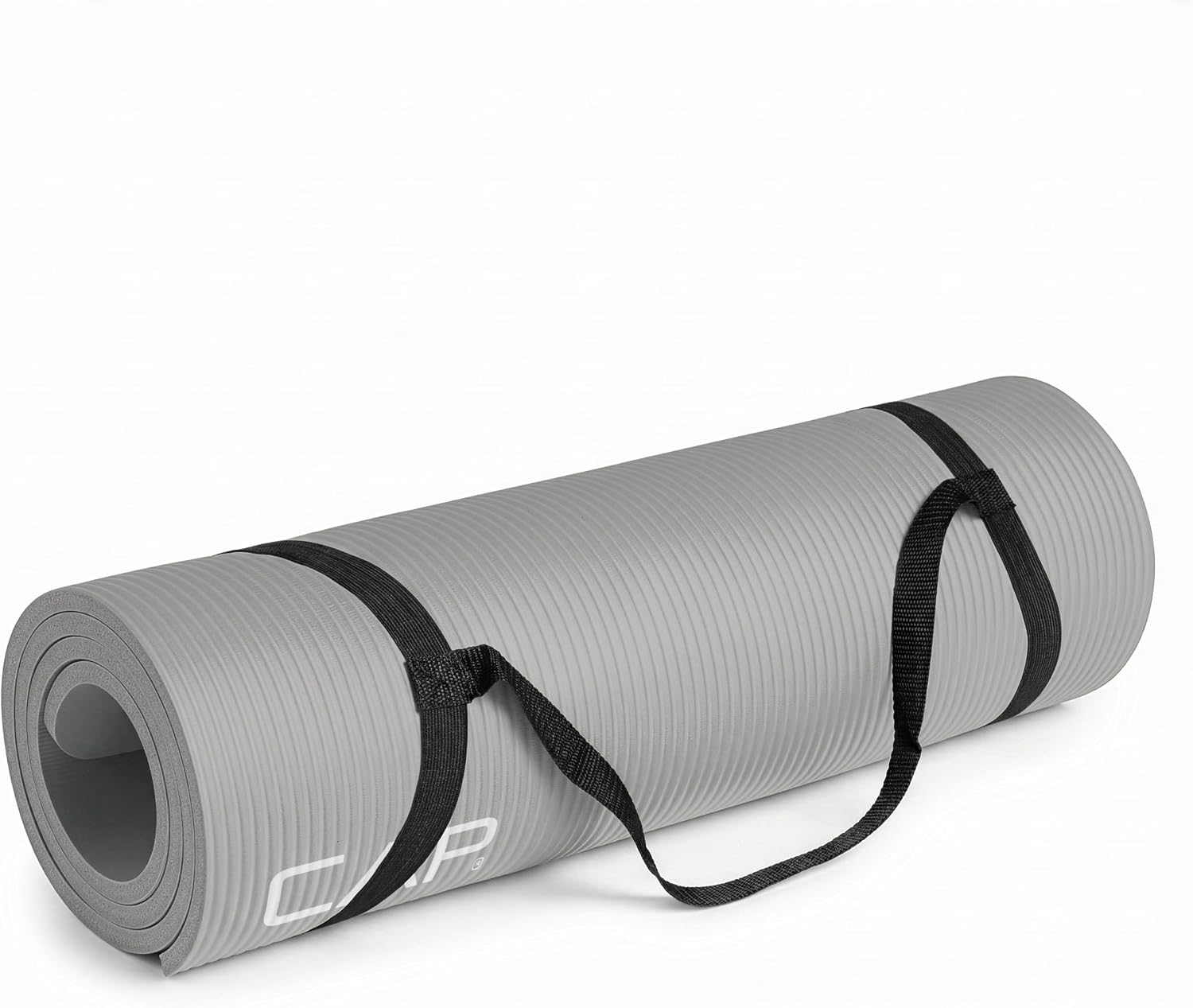
CAP Barbell 1/2-Inch High Density Exercise Yoga Mat with Strap
Half an inch of high-density foam, a carry strap in the box, and multiple color and length options
Cushion is not grip, and half an inch of foam is a lot of sink for standing balances

Liforme Classic Yoga Mat (second listing)
The same alignment mat as the first Liforme entry, listed separately so you can check both pages for the color and size you want
Two listings for one product name means you do the comparing, and the top-layer care is the same chore either way
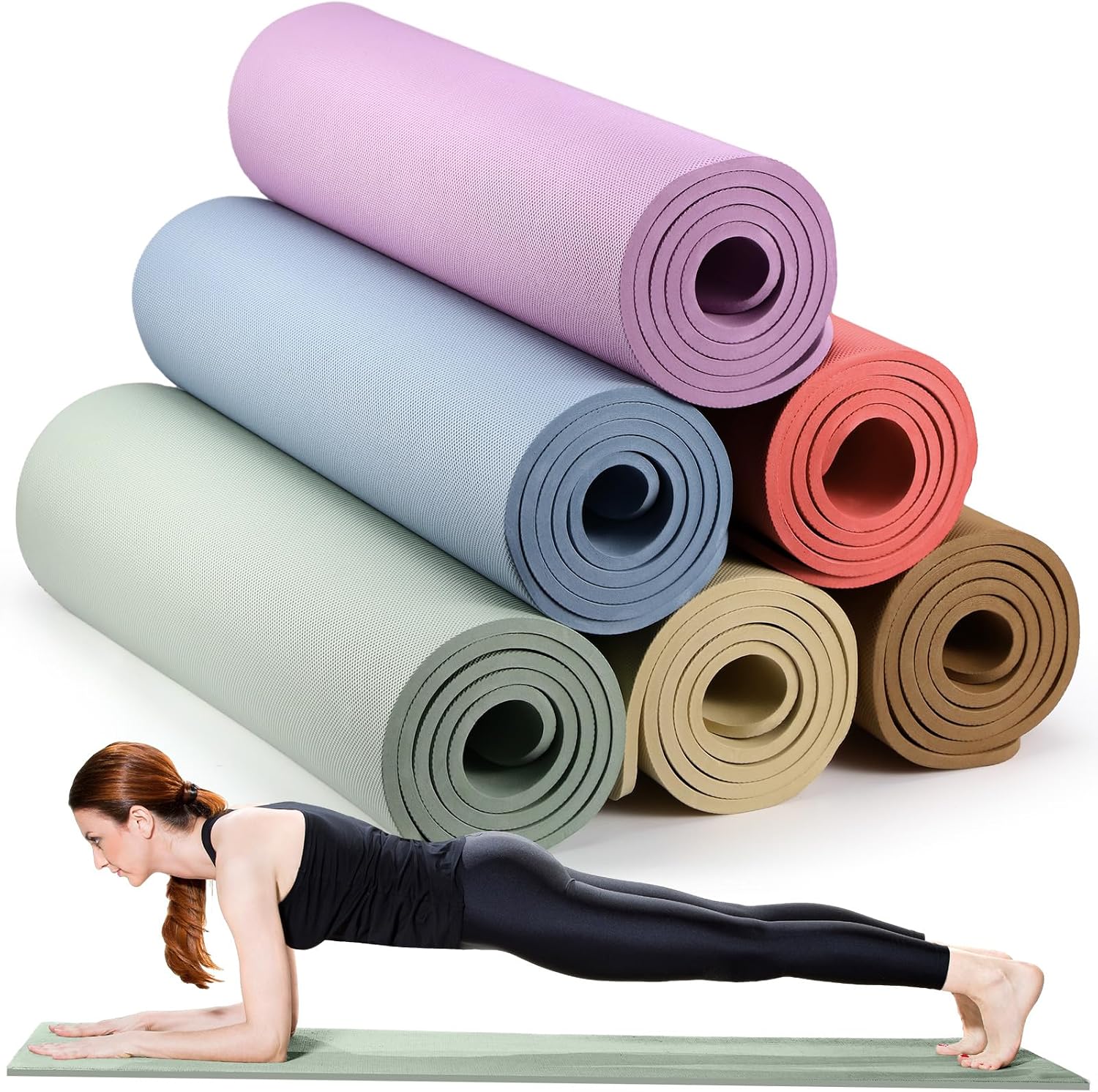
Timgle 6 Pcs 10mm Thick Yoga Mat Bulk, 68 x 24 Inches
Six mats, 10mm thick, 68 by 24 inches each, one purchase, which is the studio supply problem solved in a single click
Bulk foam with no alignment system and no individual grip story, and storing six mats is its own project
Prices and availability were captured from Amazon Creators API and may change.
How I compare mats before I recommend one
The calipers come out before the mat comes out of the tube. I measure thickness at six points and compare the thinnest edge to whatever the box claims, because the gap between the two is a character test for a brand. Then the luggage scale, then the inclined-plane slip test: a weighted board, a weighted brick, and the angle in degrees at which the brick starts to move, dry first and then with water sprayed on the top layer. After that the mat goes into the teaching rotation, and I log the minute when grip gives out in a hot room, how the corners curl on a studio floor, and what it smells like at month one.
I will be straight with you about where these four stand. The Liforme line and the CAP Barbell mat are known quantities to me from years of teaching, and the Timgle bulk pack is the kind of thing I buy for the studio shelf, not for my own practice. A full 200-class log on every listing in this batch is not in yet, so I am comparing stated specifications, materials, and category behavior here, not handing you a lab report I did not run. That distinction matters to me and it should matter to you.
The alignment mat: Liforme Classic, in two listings
The Liforme Classic is the mat that shows up in hot classes for one reason: grip chemistry. The top layer on this line is a polyurethane-style surface, and polyurethane is the one material I have found that gets grippier as it gets wet. Natural rubber is excellent when you are dry or barely damp. PVC is fine until minute forty, then it turns into a skating rink under a sweaty palm. Polyurethane does the opposite of all of that, which is why hot yogis pay for it and why I stopped arguing with them about it.
The second thing the Classic brings is the alignment system. The etched lines and center markers sound like a gimmick until you teach a room of beginners and watch every one of them drift a foot to the right over a sixty-minute flow. Markings give people a reference point they can feel without looking. I have watched that single feature fix a student's lunge stance more reliably than three verbal cues.
The honest costs are real. This is the priciest mat in the comparison, and the top layer of the Liforme line is the fussiest surface I own: it scuffs, it shows every mark, and it does not love being dragged across a parking lot. If you want a mat that looks factory-new at year three, this is not it. If you want a mat that grips at minute fifty of a 26&2 class, it is.
Two notes on the two Liforme listings here. They carry the same product name, and they are separate pages, which usually means different colorways or bundled options rather than two different mats. Open both and compare the images and the option menus before you commit. The affiliate link in each row goes to its own listing, so the row you click is the page you land on.
The forgiving pick: CAP Barbell half-inch with strap
The CAP Barbell mat is the other end of the philosophy. Half an inch of high-density foam, a strap included, and a handful of color and length options. For a beginner on a hardwood floor, or for anyone with cranky knees and a restorative practice, this is a reasonable place to start, and the strap is the underrated part. A mat you can carry rolled and cinched is a mat that actually leaves the house.
What I want you to understand is that thickness is not grip. They are unrelated properties that get marketed as if they were the same thing. A half-inch of foam under your palms in downward dog compresses, and every millimeter of that compression costs you stability in standing poses. My dancer's knees want the cushion. My flooring brain knows that a soft mat on a hard floor is a wobble machine, and I have watched people blame their balance for something their mat was doing to them.
So the CAP Barbell is a good fit for floor work, yin, restorative, core on the back, and knees that need a landing pad. It is a poor fit for a standing-balance practice, for hot rooms, and for anyone who wants alignment feedback. It is also foam, and foam mats have a lifespan measured in a couple of years of hard use, not a decade.
The volume answer: Timgle six-pack, 10mm, 68 by 24 inches
The Timgle pack is a different kind of product, and I mean that as a compliment. Six mats, each 10mm thick and 68 by 24 inches, in one purchase. That is a studio, a school program, a retreat, a church basement class, or a family that keeps losing mats to the garage. Buying in bulk is the only sane way to equip a room, because mismatched donated mats of unknown age are how people end up sliding.
The specifications are straightforward: 10mm is generous cushion, and 68 by 24 inches is the standard footprint, which means tall practitioners will have their heels near the edge on a wide stance, the same as almost every mat at this size. There is no alignment system on these and no premium top layer. They are foam, they will feel like foam, and in a hot room they will get slick the way every foam mat gets slick once the sweat pools.
Where the pack earns its place is in the arithmetic of a studio shelf. Six identical mats mean six students have the same experience, replacements are simple, and nobody is hunting for the one good mat before class. The costs are storage and smell: six new foam mats offgas, and you want them unrolled in a ventilated room for a few days before they go into a closed cabinet. If you are buying for one person, six mats is five too many, and I would rather you spend the same money on one mat you keep for five years than on six you store in a closet.
Thickness, sink, and the trade-off nobody prints on the box
Every mat in this comparison sits somewhere on the same curve. More thickness buys joint comfort and costs stability. A 10mm mat like the Timgle and a half-inch mat like the CAP Barbell will feel wonderful under your spine in a supine twist and vague and spongy under your hands in a plank. A thin, dense mat like the Liforme transmits the floor to you, which is exactly what you want for balance and exactly what hurts if your knees are already angry.
My rule for students is simple. If your practice is mostly standing, flowing, and balancing, go thinner and denser. If your practice is mostly floor-based, restorative, or you are coming back from an injury, go thicker and accept the wobble. If you do both, you need two mats, and that is not a sales pitch, it is just what the physics costs.
Grip is chemistry, not texture
Here is the thing I wish every box said out loud. Non-slip is a claim with a missing clause. Almost every mat is non-slip when dry and at room temperature. What matters is what happens at minute forty of a hot class, and that is decided by the top layer's material, not by how bumpy the texture looks in a product photo. Polyurethane grips wet. Natural rubber grips dry and turns into a sponge when soaked. PVC does neither especially well but costs the least and lasts a long time if you clean it.
That is the whole reason the two Liforme listings sit at the top of this table and the foam mats sit below them. It is not brand loyalty. It is what the surface does when your hands are wet. If you are not a heavy sweater, the gap narrows a lot, and the CAP Barbell becomes a much more defensible purchase.
Who should buy which
- Hot yoga, sweaty palms, alignment feedback wanted: the Liforme Classic. Check both listings, pick the option you like.
- Bad knees, hard floors, restorative and floor work: the CAP Barbell half-inch with the strap.
- A studio, a program, a retreat, or a big family: the Timgle six-pack, unrolled and aired out first.
- One person, one mat, tight budget, mostly standing practice: honestly, none of the foam options here. Buy a dense mat you will keep.
The trade-offs I will not pretend away
The two Liforme rows are the same product name on two pages, and you should treat them as one decision with two checkout options, not two competing mats. The CAP Barbell mat and the Timgle pack are both foam, and foam is a wear item. It will compress where you stand, it will eventually peel, and it will not be the mat you hand to your kid in ten years.
Bulk buying is not automatically cheaper in the way that matters. Six mats at a low per-mat cost is a bargain for a room and a waste for a person. And durability and portability are still opposed in this category: the mats that survive the most classes are usually the ones that are heaviest to carry, and the mats that travel well are usually the ones that get replaced first.
What I am testing next
Cork is the material I have the most hope for and the most questions about. It grips wet better than anything except polyurethane, and it stains like a cutting board, which is a real trade for a hot-room mat. I am also watching the algae-foam and recycled-rubber blends that have been arriving in samples, because half of them will turn out to be greenwashing with a leaf icon and half will be genuinely good.
Whatever I find, the standard stays the same. Two hundred classes on a mat before it earns a ranking, calipers before opinions, and a first-paragraph disclosure every time. Roll something out on a Tuesday and see how it behaves at minute forty. That is the test that matters.