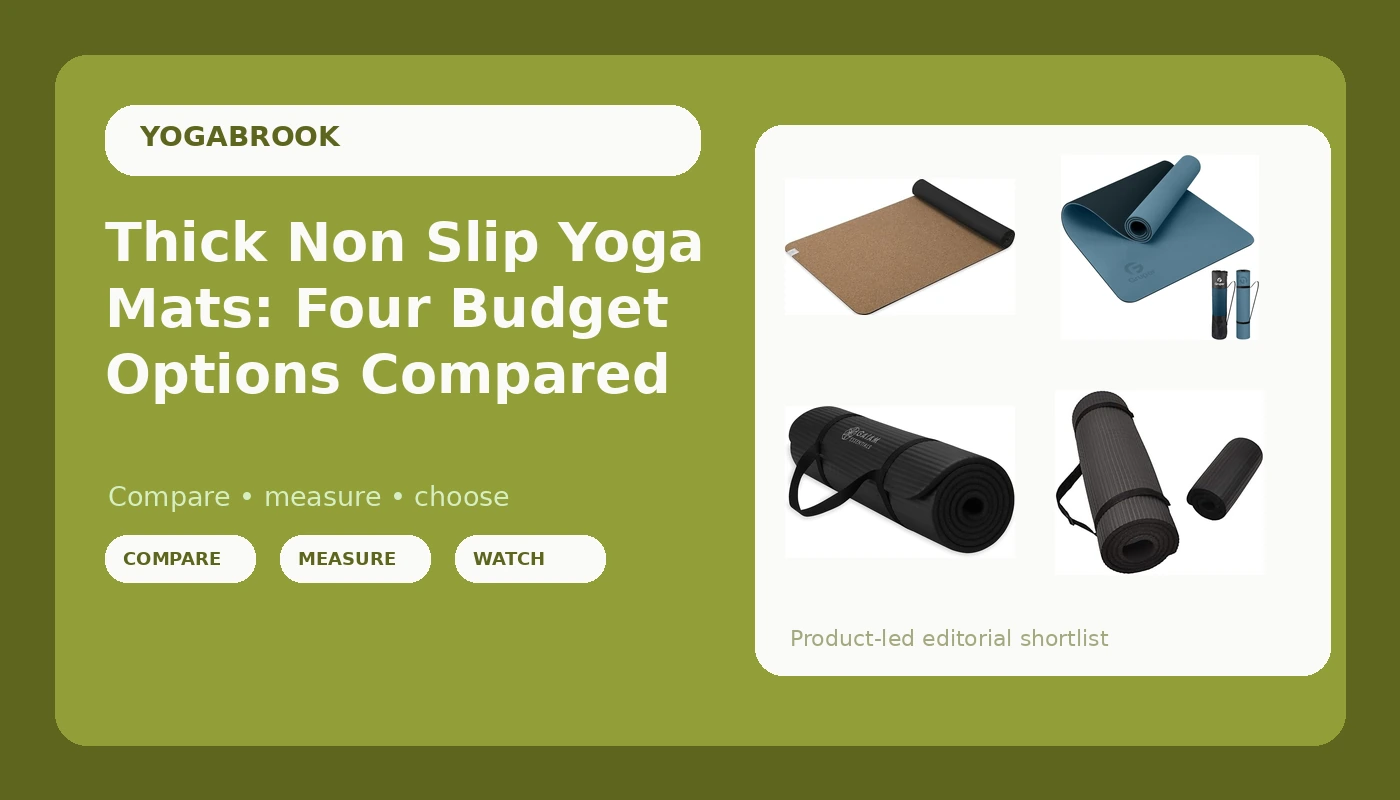
A thick non slip yoga mat solves two problems at once and quietly creates a third. The cushion protects knees, wrists, and hips on hard floors. The grip keeps your hands from creeping forward in downward dog. And the thickness that makes both of those possible also makes standing balances wobblier, because foam compresses under bodyweight and your ankle has to work harder to find the floor. That trade-off is the whole buying decision, and it is why "thick" and "non slip" are two separate questions that deserve two separate answers.
This is an explainer, not a ranking. It walks through four budget mats, what each one is actually built for, and how to decide between them without overthinking it. Full disclosure before anything else: this post contains affiliate links and I earn a commission if you buy through them. That is the deal, and I would rather name it in the first paragraph than bury it at the bottom. It is also why every claim below is tied to what the listing actually says, not to a number I made up.
Related: How to Keep a Yoga Mat From Sliding on a Studio Floor →
Quick answer
For general yoga, Pilates, and floor work, a mat in the 5mm to 6mm range with a textured, closed-cell top layer covers the most ground for the least money, and it is the range most beginners should start in. Go thicker, closer to half an inch, only if your knees or wrists need real cushioning on a hard floor, and accept the balance penalty that comes with it. Go thinner than 5mm only if you already know you want a firmer, more grounded feel. None of the four mats below can be called the best on the evidence available, but each one fits a different set of the same constraints.
Four useful options
| Model | Best fit | What stands out |
|---|---|---|
| Gaiam Yoga Mat - Premium 5mm Solid Thick Non Slip Exercise & Fitness Mat for All Types of Yoga, Pilates & Floor Workouts (68" x 24" x 5mm) | Everyday vinyasa, Pilates, general floor work | Listed at 5mm with a stated 68" x 24" surface, so the length suits taller practitioners better than a standard mat |
| Gaiam Thick Yoga Mat, Exercise & Fitness Mat with Easy-Cinch Carrying Strap | Beginners who want more cushion than a standard mat | Thicker build sold with an easy-cinch carrying strap included |
| Gruper Yoga Mat Non Slip, Eco Friendly Fitness Exercise Mat with Carrying Strap | Shoppers working to a tight budget who want a strap in the box | Described as non slip and eco friendly, and ships with a carrying strap |
| Fitvids All Purpose 1/2-Inch Extra Thick High Density Anti-Tear Exercise Yoga Mat and Knee Pad with Carrying Strap | Knees, wrists, and hard floors; restorative and floor-based work | Extra thick at a listed half inch, with anti-tear construction and a knee pad role in the listing |
The everyday all-rounder: Gaiam Yoga Mat - Premium 5mm Solid Thick Non Slip Exercise & Fitness Mat for All Types of Yoga, Pilates & Floor Workouts (68" x 24" x 5mm)
The trade-off here is the honest middle. You give up the deep cushion of a half-inch mat, which means kneeling poses on a hardwood floor will feel like kneeling poses on a hardwood floor. In exchange you get a surface that does not swallow your balance, and a mat that rolls up small enough to carry without a second thought. If you practice two or three times a week and your joints are not complaining, this is the shape of mat that stays rolled out instead of gathering dust.
The budget cushion: Gaiam Thick Yoga Mat, Exercise & Fitness Mat with Easy-Cinch Carrying Strap
The trade-off is stability. Extra cushion means your palms and feet sink a little further before they find resistance, and that small amount of sink is what turns a steady warrior two into a wobble. If your practice is mostly restorative, mostly floor-based, or you are working on a concrete slab, that is a fair exchange. If you are chasing balance work and arm balances, it is not.
The budget eco-labeled pick: Gruper Yoga Mat Non Slip, Eco Friendly Fitness Exercise Mat with Carrying Strap
Here is where I stop being polite. "Eco friendly" is printed on a lot of mats, and it means very little on its own. PVC is the least environmentally friendly mat material there is, and it is also the cheapest, which is why it dominates the budget shelf. A mat that lasts five years beats a mat labeled biodegradable that you replace every eighteen months, every single time. Buy this one because it is inexpensive and it comes with a strap, not because of the leaf-shaped word on the box.
The extra-thick option: Fitvids All Purpose 1/2-Inch Extra Thick High Density Anti-Tear Exercise Yoga Mat and Knee Pad with Carrying Strap
The trade-off is the one nobody puts on the box. Half an inch of foam is wonderful under your knees and terrible under your standing foot. High density helps, because denser foam compresses less, but it does not erase the effect. If your practice is restorative, yin, or floor-based strength work, this is a sensible buy. If you are trying to hold a one-legged balance for thirty seconds, you will feel every millimeter.
Prices and availability may change. Product images, names, and retailer links must be matched by verified ASIN. Do not state a current price, rating, stock status, or measured result without current evidence.
Thickness, measured in millimeters and in consequences
Every mat listing gives you a thickness number, and almost no listing tells you what that number does. Here is the translation.
Under about 4mm, you are on a travel mat. It packs down to nothing, it puts you in direct contact with the floor, and your knees will file a complaint. Between 5mm and 6mm is the working range for most people: enough cushion for seated and supine poses, little enough compression that standing poses stay honest. At 8mm and up, you are in comfort-mat territory, and at a half inch, roughly 12.7mm, you are on a mat that behaves more like a padded floor than a yoga surface.
The number that matters more than thickness is what happens when you put weight on it. Press your palm into a mat and watch how far it sinks before it pushes back. A millimeter or two of give is comfortable. Several millimeters of give means your wrist is constantly chasing stability, and in a long downdog that shows up as fatigue rather than pain, which is harder to notice and harder to fix. This is also why thickness claims deserve a skeptical eye in general: across the category, listed thickness and actual thickness at the thinnest edge do not always match, and a mat that measures thinner than advertised will feel firmer than you expected.
Length is the other spec people skip. A standard mat is 68 inches, and the 5mm Gaiam and most mats in this group land there. If you are over about 5 foot 10, or you practice with a wide stance, measure your reach before you buy. A mat you hang off the end of is a mat you stop using.
Why grip is a chemistry problem, not a texture problem
Texture sells mats. Chemistry decides whether you slide. A deeply embossed surface feels grippy in the store and can go slick the moment your palms get damp, because the pattern is doing the work and the pattern cannot absorb moisture. What actually holds you is the top layer's material and how it behaves when wet.
Closed-cell PVC, which covers most budget mats, is fine when dry and gets progressively less fine as you sweat. Natural rubber grips better, especially in a dry or barely damp room, and it is made from tree rubber rather than petroleum, but it absorbs sweat and holds odor, so it needs regular cleaning. Polyurethane topsheets are the current benchmark for wet grip and the reason the premium hot-yoga mats cost what they cost. Cork is the interesting outlier: it grips better wet than dry, which is the opposite of almost everything else, but it stains and it takes on whatever the room smells like.
Two practical consequences follow. First, if you sweat heavily, prioritize the top layer over the thickness, because a thick mat you slide on is worse than a thin mat you do not. Second, treat every "non slip" claim as incomplete unless it says when. The words you want to see are "when dry" or "even when wet," and if the box does not say either, assume the claim is a dry-room claim.
- Decide what problem you are solving: cushion for your joints, grip for your sweat, or portability for your commute.
- Match thickness to that answer: 5mm to 6mm for general practice, closer to half an inch for joint comfort, thinner only if you want a firm, grounded feel.
- Check the stated material and the wet-grip language, not the texture in the product photo.
- Measure your height against the listed mat length before you commit, especially if you are tall or like a wide stance.
- Plan the care routine on day one, because a mat you never clean is a mat you replace early.
Practical guidance for buying and living with a thick mat
- Roll your mat with the top surface facing outward if you carry it in a bag, and store it flat or loosely rolled rather than crushed under a couch.
- Wipe a closed-cell mat down after sweaty sessions with a diluted gentle cleaner, and let it dry fully before rolling, since trapped moisture is what makes a mat smell.
- Give a new mat a few days to air out before you judge it. New foam and rubber offgas, and the smell fades.
- If your knees hurt in kneeling poses, add a folded blanket or a dedicated knee pad rather than buying a thicker mat, which fixes the knees and breaks your balance.
- Replace a mat when the top layer is polished smooth in the spots where your hands and feet land, not when the color fades.
Which option should you choose?
Choose the Gaiam Yoga Mat - Premium 5mm Solid Thick Non Slip Exercise & Fitness Mat for All Types of Yoga, Pilates & Floor Workouts (68" x 24" x 5mm) when you want one mat that handles vinyasa, Pilates, and floor work, and the 68 inch length fits your height. Choose the Gaiam Thick Yoga Mat, Exercise & Fitness Mat with Easy-Cinch Carrying Strap when your priority is comfort on a hard floor and you want a strap included without buying anything else. Choose the Gruper Yoga Mat Non Slip, Eco Friendly Fitness Exercise Mat with Carrying Strap when you want the lowest-cost way into a home practice and you are treating the mat as a first step rather than a forever purchase. Choose the Fitvids All Purpose 1/2-Inch Extra Thick High Density Anti-Tear Exercise Yoga Mat and Knee Pad with Carrying Strap when kneeling and seated poses are the bulk of your practice and joint pressure, not balance, is the problem you are solving.
A caveat worth stating plainly: I am working here from what each listing claims, not from caliper readings or slip tests on these four mats, so treat the thickness figures as manufacturer-stated until you have the mat in your hands. Nobody should tell you a mat is the grippiest or the most durable without that evidence, and I am not going to be the one who does.
The bottom line
Thickness is a comfort setting, not a quality rating. A thick non slip yoga mat earns its keep when the cushion matches your joints and the top layer still grips once you are warm, and it stops earning its keep the moment the foam is so soft that your standing poses turn into balancing acts. For most people starting out, the 5mm option in this group is the safest single choice. For anyone whose knees dictate the practice, the half-inch Fitvids is the one built for that job. And whichever you pick, the mat you actually roll out on a Tuesday is worth more than the one you research for a month.