Related: How Thick Should a Yoga Mat Be?
I have taught vinyasa in Portland for more than a decade, and I keep a log for every class I teach on every mat in the room. That log is why my opinions about bulk yoga mats run past the spec sheet. The worst supply room mistakes I have watched happen were never about grip in a hot class. They were about a dozen mats arriving with a thickness claim that did not survive a caliper, corners that curled by week three, and a room of beginners sliding around on a floor that was never the problem.
Disclosure before anything else, because it belongs in the first paragraph and not in a footer: I earn a commission when you buy through the links in this article. My rule is that I only link mats and accessories I would hand to a student or recommend to a studio owner. You should know that up front and weigh it accordingly.
This guide covers four products: two bulk sets aimed at studios, schools, retreats, and community programs, one single high-density mat with a strap, and one knee pad that solves a problem no mat can solve by itself. If you are buying for one body and one practice, the math is simple. If you are buying for a room, keep reading.
What changes when you buy mats by the dozen
Buying one mat is a comfort decision. Buying twelve or twenty-four is an operations decision, and the criteria flip almost completely.
Durability stops meaning "survives a thousand classes" and starts meaning "survives a stack of twenty in a supply closet, gets wiped down twice a day, and still lies flat on a sprung floor." Grip stops being about your own sweat and starts being about a room full of people with different sweat chemistry, different bodyweight, and different habits. Thickness stops being a preference and becomes a liability: every extra millimeter of foam compresses under your palms in downdog, and compression is what makes standing balances wobble for the beginners who need the most help.
There are three claims I check before I will recommend a bulk set to anyone. First, the non-slip claim. If the listing does not say when the mat grips, assume it means when dry. Second, the thickness claim. The number on the box is usually measured at the fattest point, not the thinnest edge, and the gap between those two numbers tells you whether the mat will compress unevenly. Third, corner behavior. A mat that curls is a mat that gets taped down or thrown out, and both outcomes cost you more than the mat did.
One more thing specific to bulk orders: count the extras before you count the mats. A set that includes carrying straps and resistance bands is worth more to a beginner program than a slightly thicker mat, because a strap is what lets a stiff student reach their foot, and a band is what turns the same mat into a mobility or strength session.
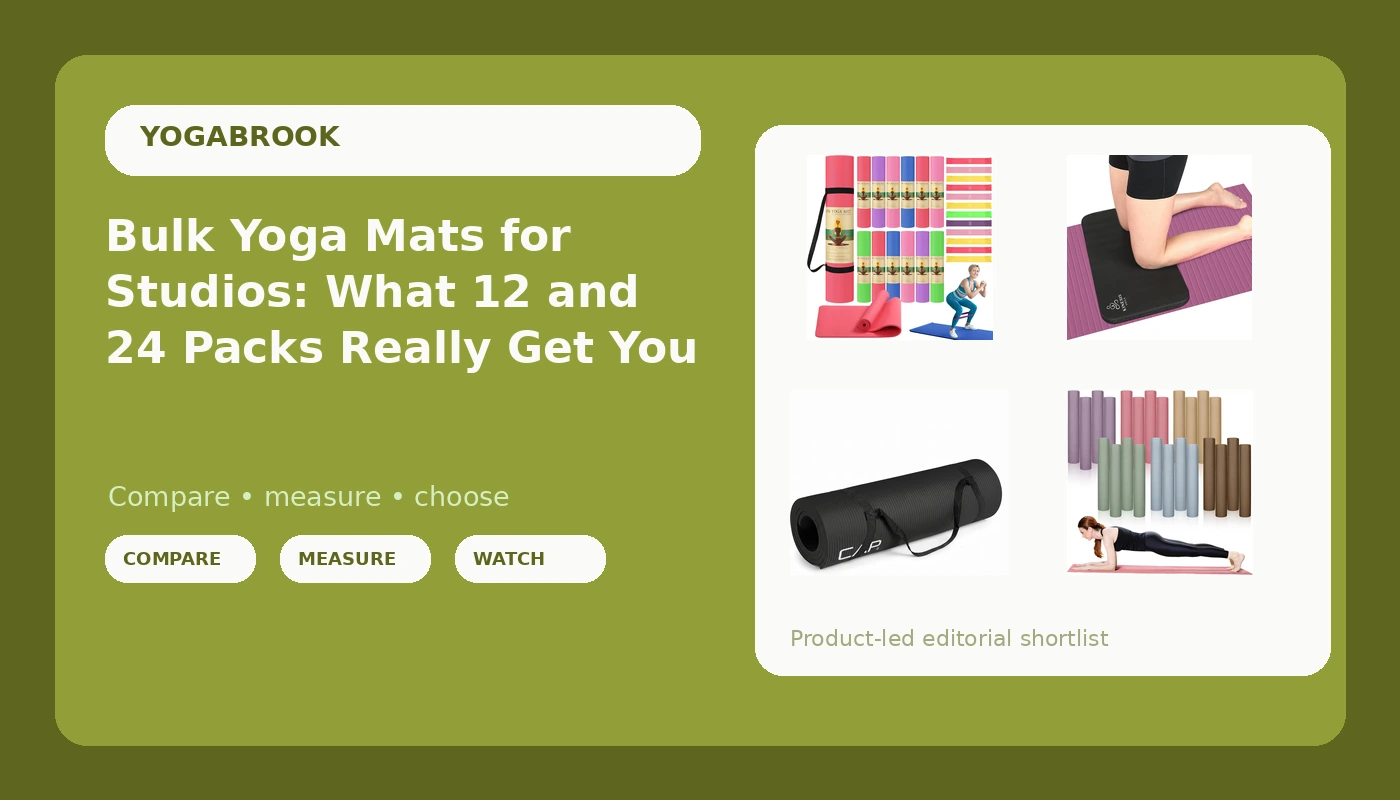
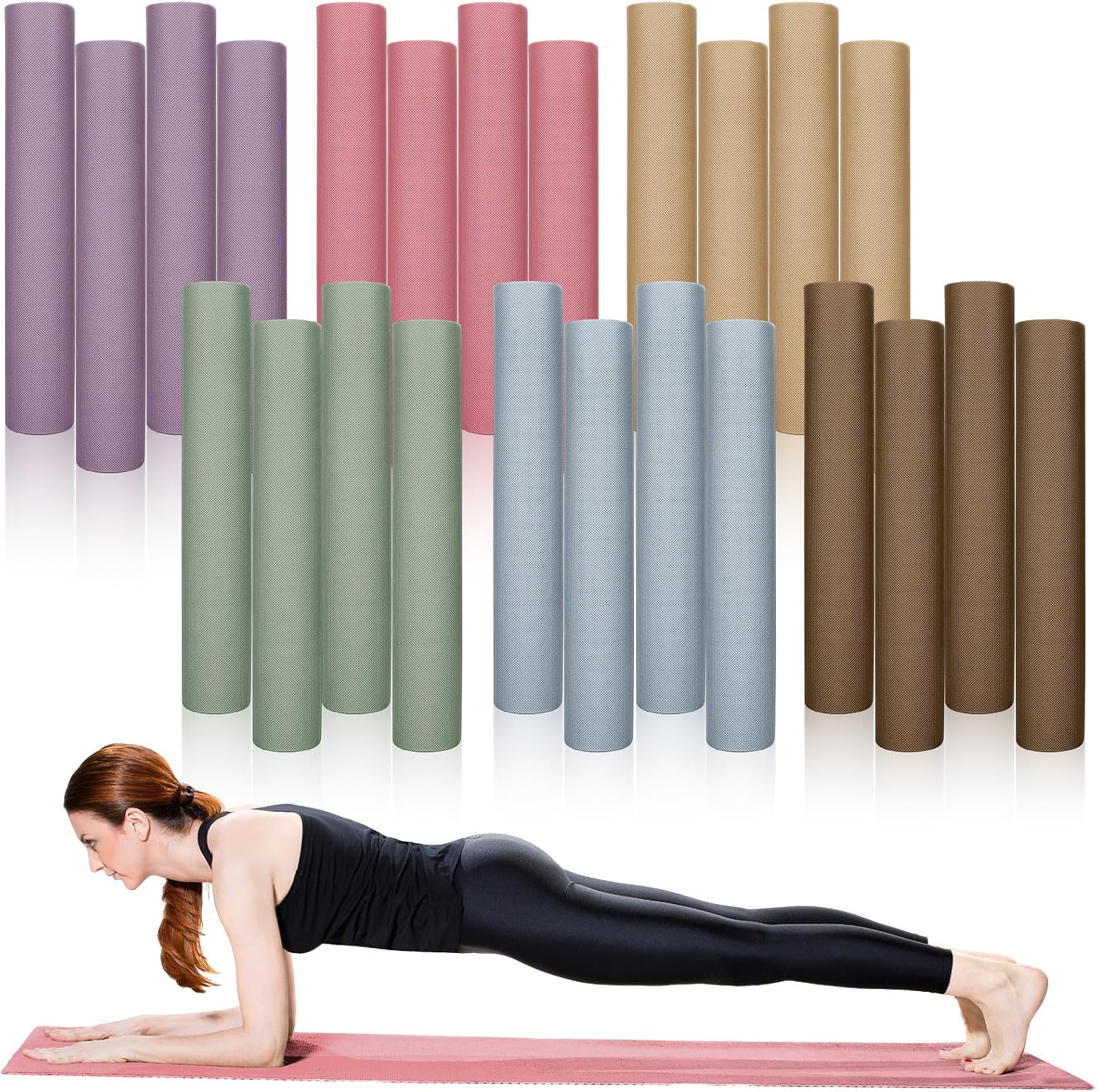
Timgle 24 Pack Yoga Mat Bulk, 4mm Thick
If I were outfitting a studio floor from scratch, this is the set I would start with. Twenty-four mats at 4mm, each 68 inches long and 24 inches wide, is enough to run two full classes back to back or one large workshop without anyone borrowing from the lost and found.
The 4mm figure is the part that matters to me. It is the thickness I would pick for a general studio floor: thick enough that a spine on hardwood is not a punishment, thin enough that a warrior two does not turn into a balance drill. Mats that run 6mm and up feel generous in child's pose and vague in every standing pose, and vagueness is what teaches beginners that they are bad at balancing when the mat is the actual problem.
The 68 inch length covers taller students, which is a bigger deal than most owners expect until they watch a six-foot-two man practice with his heels hanging off the end. The listing describes the surface as anti-slip and tear resistant. Anti-slip is the word I trust least on any yoga mat box, so treat it as a starting claim rather than a promise, and test one mat yourself before you commit a whole room to it.
Twenty-four is also the number that makes sense for a specific kind of buyer: a studio that hosts teacher trainings, a school PE department, a retreat that needs a mat per guest, or a corporate class where nobody brings their own anything. If you need fewer than a dozen, this set is more mat than you can store.
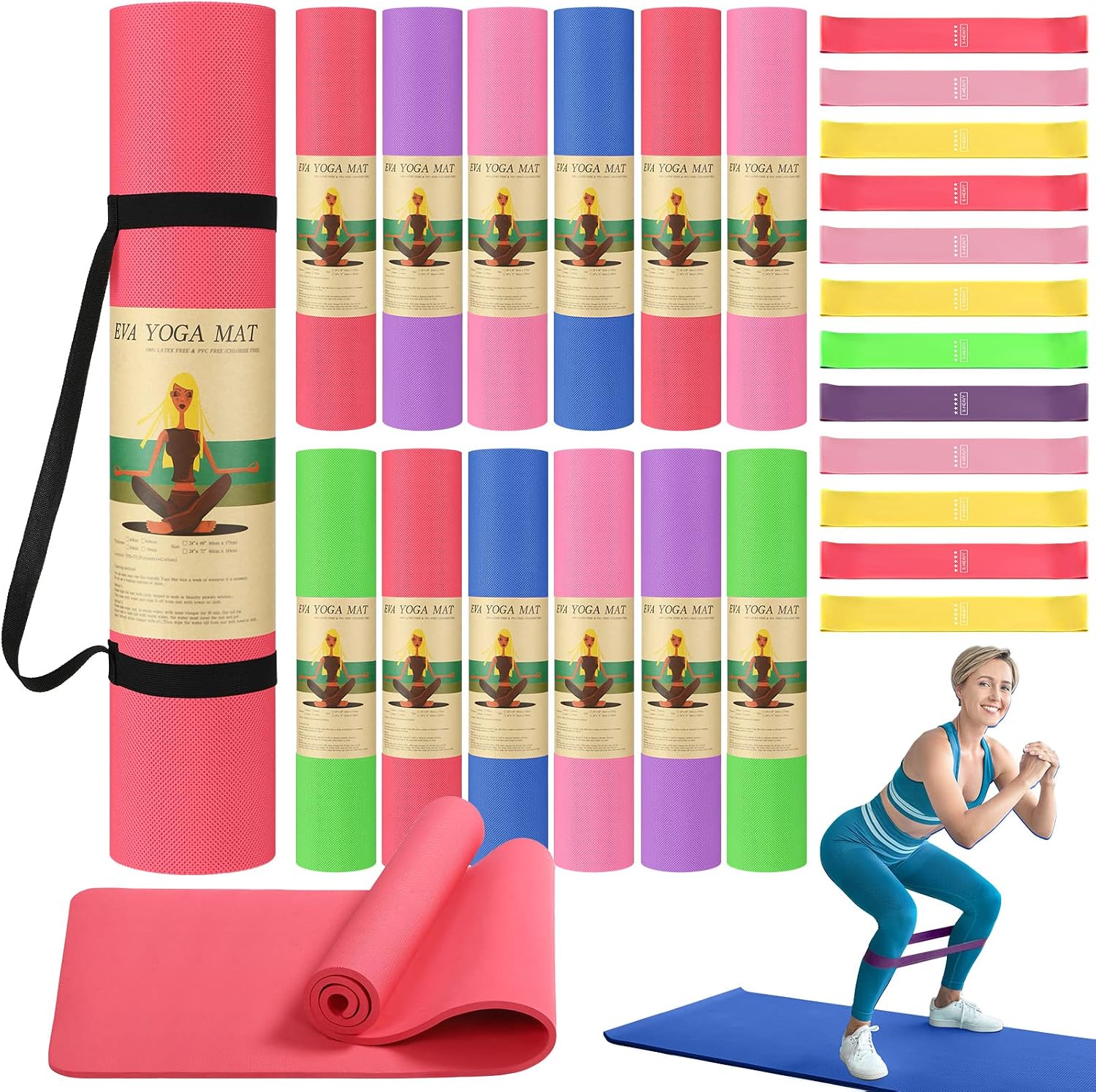
Hoolerry 36 Piece Yoga Mat Set with Bands and Straps
The Hoolerry set is twelve mats at 6mm, each 68 by 24 inches, plus twelve resistance bands and twelve carrying straps. It is a beginner program in a box, and that is not a knock. It is the most complete starting kit in this group.
The straps are the quiet win. A student who cannot reach their feet does not need a thicker mat, they need a strap, and having twelve of them in the room means the teacher stops improvising with belts. The bands extend the same twelve mats into a warm-up, a strength block, or a class for an older group where resistance work matters more than flow.
The 6mm thickness is where I would push back, gently. Six millimeters is a cushion-forward choice, and for restorative classes, yin, and students with cranky knees on a hard floor, it is genuinely kind. For standing balances, 6mm of foam under your palms is a negotiation you have to have every single time you step to the front of the mat. Beginners on 6mm often read the wobble as their own failure. If the room you are outfitting teaches a lot of standing flow, this is a consideration, not a dealbreaker.
Where this set earns its place is in community settings: a church basement class, a women's gym, a school program, a donation to a shelter, or a studio that runs a free beginner series once a month and wants to hand people something they can keep.
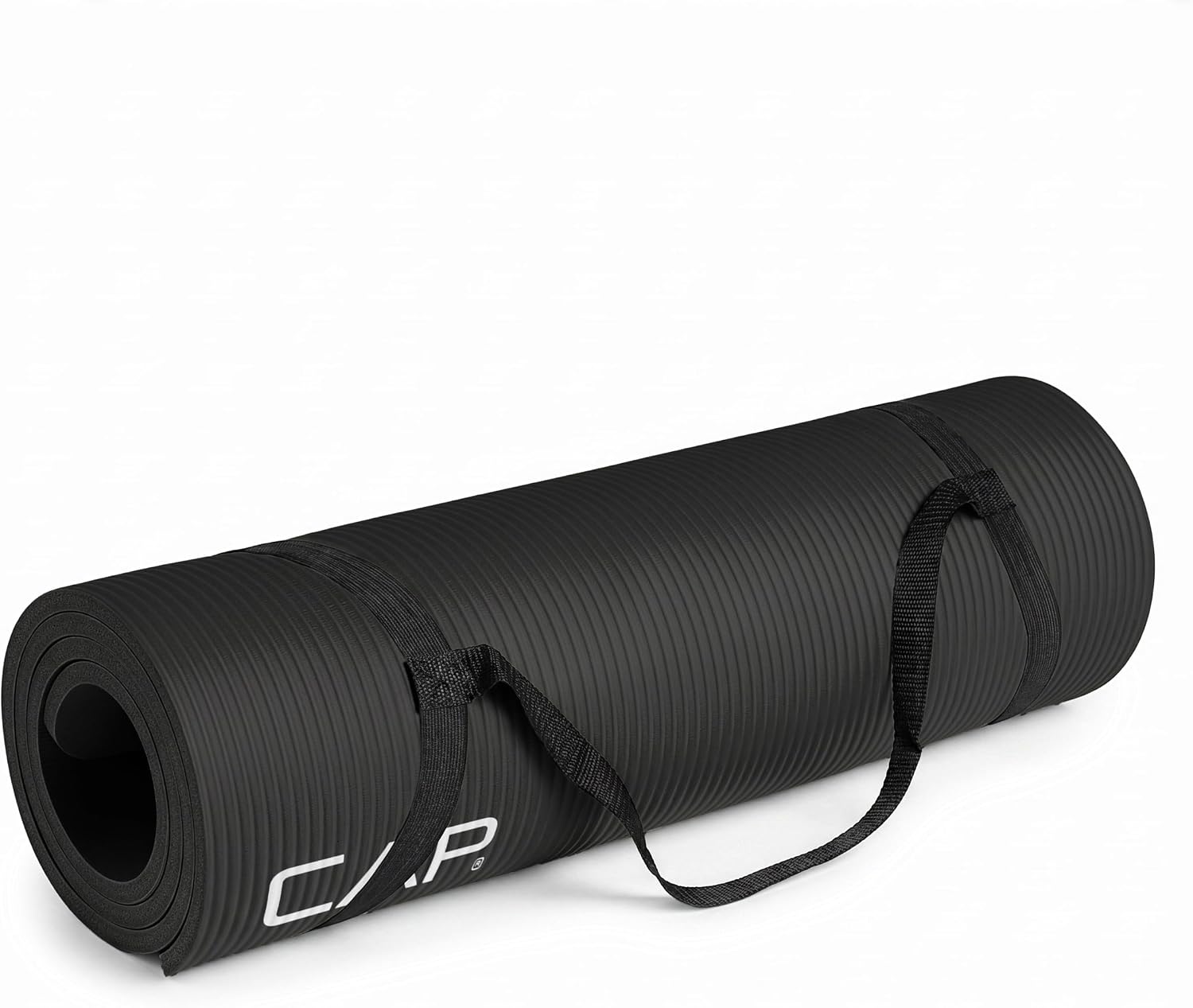
CAP Barbell 1/2-Inch High Density Exercise Yoga Mat with Strap
This is the single-mat answer in this group, and the phrase to focus on is high density. Density, not thickness, is what keeps a mat from bottoming out under a knee or a sit bone. Two mats can both claim half an inch and behave nothing alike, because one compresses to nothing and the other pushes back. High density foam is the version that pushes back.
Half an inch is a lot of cushion. That makes this a strong pick for restorative and yin practice, for floor work, for a home setup on tile or concrete, and for anyone whose knees complain in tabletop. It is not the mat I would hand someone heading into a fast vinyasa class, because half an inch of foam is soft enough to make standing balances feel vague, and I would rather see a thinner mat and a knee pad than a thick mat and a wobbly tree pose.
The included strap matters more than it sounds. A strap is what makes a heavy, dense mat portable, and a mat you can carry is a mat you actually take to class. Multiple options are available on the listing, so check the length and color you want before you order.
Kinesis Yoga Knee Pad Cushion, 15mm
This is the product I recommend most often, and it is the one people skip because it is not exciting. A 0.6 inch, 15mm knee pad solves the exact problem that thick mats create: you cannot add cushion in one spot on a mat that has to stay firm everywhere.
Put it under your knees in tabletop and camel. Put it under your wrists in plank if you have a wrist history. Put it under a hip in pigeon, under a shoulder in a long side plank, under your sit bones in a seated forward fold. A thin, firm studio mat plus this pad beats a thick, soft mat for almost every student I teach, because the mat stays honest for standing poses and the pad handles the joints.
For a studio buying in bulk, the math is different than for an individual. One pad per two mats, kept in a basket by the door, covers the students who need it without turning the whole room into a pillow. For a person with knee pain, it is the cheapest meaningful upgrade in the category, and it works on top of whatever mat you already own.
How I judge a bulk mat order
I do not rank a mat because the listing is well written. I rank it on four things I can check without trusting a marketing department.
The thickness claim. I measure at six points, including the thinnest edge, and I compare the low number to the box. If the gap is large, the mat will compress unevenly, and uneven compression is what makes a downdog feel like a wrestling match.
Grip, dry and wet. A mat that grips when dry and turns slick at minute 40 of a hot class has a slick-sweat threshold, and every mat with one eventually teaches someone a lesson. For a studio, the wet reading is the one that matters, because your room will get humid.
Corner curl and edge lift. Roll a mat out on a hard floor and watch the corners for the first ten minutes. If they lift, they will trip someone. This is the failure mode that ends a bulk set's life early, and it has nothing to do with how the mat feels on day one.
Density under a palm. Press your palm into the mat in downdog at bodyweight and watch how far it sinks. A millimeter of give is fine. Several millimeters of give means your wrists are doing work the mat should be doing.
None of these are glamorous tests. All of them are cheaper than replacing a room full of mats a year early.
Bulk yoga mat comparison table
| Product | Format | Listed thickness | Best for |
|---|---|---|---|
 Visit on Amazon → Timgle 24 Pack Yoga Mat Bulk |
24 mats, 68 x 24 in | 4mm | Studio floors, workshops, trainings, school programs |
 Visit on Amazon → Hoolerry 36 Piece Yoga Mat Set |
12 mats plus 12 bands and 12 straps, 68 x 24 in | 6mm | Beginner series, community classes, keepable gifts |
 Visit on Amazon → CAP Barbell 1/2-Inch High Density Mat |
Single mat with strap | 1/2 inch | Restorative, yin, home floors, sore knees |
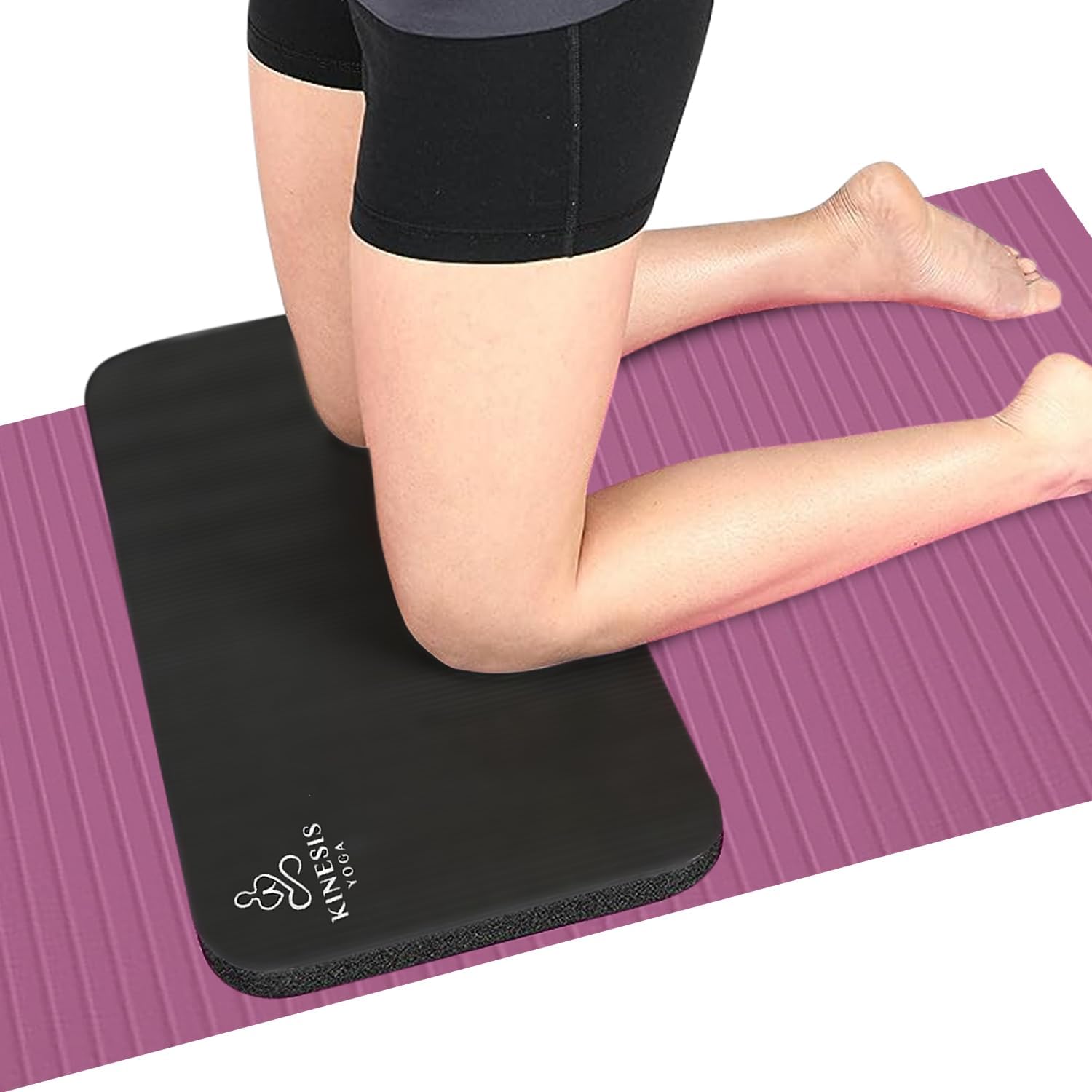 Visit on Amazon → Kinesis Yoga Knee Pad Cushion |
Single pad | 0.6 inch (15mm) | Knees, wrists, hips, adding cushion to a thin mat |
The pattern in that table is the whole guide in four rows. If you are buying for a room, you want a thin mat in volume and a stack of pads for the joints. If you are buying for one person with a knee history, you want a dense single mat and a pad.
Should you buy the Timgle 24 pack?
Yes, if you are outfitting a room and you want one order to be done. Twenty-four long, 4mm mats is the right shape for a studio floor: firm enough to keep standing poses honest, thick enough to make floor work tolerable, and long enough for the tall students everyone forgets about.
The caveat is storage and grip. Twenty-four mats take up real space, and no bulk foam mat is going to match a high-end grip surface in a hot room. Test one mat through a sweaty class before you buy the room, and keep pads by the door for the joints.
Should you buy the Hoolerry 36 piece set?
Yes, if the people using them are beginners or first-timers, and yes if you want the straps and bands included rather than bought separately. Twelve mats plus twelve straps plus twelve bands is a complete kit for a beginner series, a community class, or a program where participants take the mat home.
The trade-off is thickness. Six millimeters is generous for knees and vague for balance, so if your classes are flow-heavy and full of standing poses, this set is better as the loaner shelf than as the main floor.
Should you buy the CAP Barbell mat or the Kinesis knee pad?
Buy the CAP Barbell mat if you want one dense, cushioned mat for restorative practice, floor work, or a hard home floor, and you want a strap included so you will actually carry it. Buy the Kinesis knee pad if your knees or wrists hurt and you do not want to give up a firm mat to fix it. If you are outfitting a studio, buy both: thin mats in volume, and a basket of 15mm pads that solves the knee complaints without softening the whole floor.
That is the honest version of a bulk mat decision. A mat is a tool, and the tool that gets rolled out on a Tuesday is the one worth buying in any quantity.