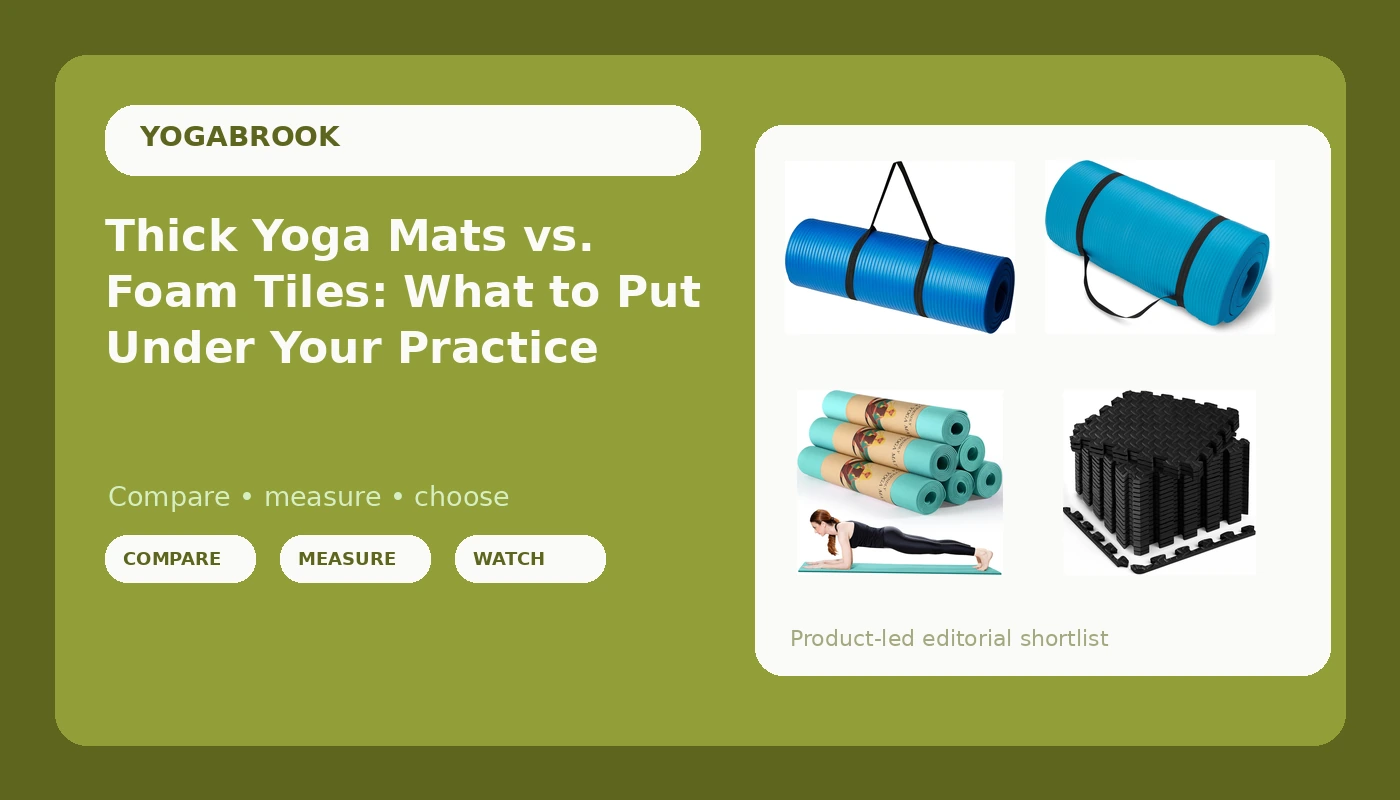
Thick yoga mats for home practice exist because most homes are not yoga studios. Studios are built on sprung wood or dense rubber, surfaces that absorb a little energy and give a mat something honest to sit on. A basement slab, a garage floor, or laminate over concrete is a different problem: it is hard, it is cold, and it sends every kneepad and forearm straight into your joints. If you have ever folded a towel under your knees in a living room, you already understand why cushioning matters.
This guide looks at four surfaces that solve that problem in different ways: a single extra-thick foam mat, a second listing of the same mat, a bulk pack of thinner mats for groups, and a set of interlocking foam floor tiles for covering a room. I teach vinyasa and a Thursday recovery class in Portland, and the question I get most from students setting up a home practice is not which mat is fanciest. It is what to put on the floor. That question has more than one right answer, and the right one depends on whether you are cushioning one body, covering a whole room, or handing a mat to every student in a class.
Related: How Thick Should a Yoga Mat Be? →
Quick answer
For one person on a hard floor, a single extra-thick foam mat is the simplest purchase. For a room, interlocking EVA foam tiles give you continuous coverage instead of a small island of cushion in the middle of a cold slab. For a class or a shared space, a bulk pack of thinner mats is the practical buy. These are three different jobs, and no single product here does all three well. If you are unsure, decide first whether you are buying cushioning for one body or coverage for a floor.
Four useful options
| Model | Best fit | What stands out |
|---|---|---|
| Amazon Basics Extra Thick Exercise Yoga Mat with Carrying Strap | One person practicing at home on a hard floor | Extra-thick foam construction and an included carrying strap |
| Amazon Basics Extra Thick Exercise Yoga Mat with Carrying Strap (second listing) | The same job, if you land on this listing instead | Same product name and format as the other Amazon Basics entry |
| Timgle 6 Pack Yoga Mats Bulk 68x24 Inches Non Slip 4 mm Thick | Teachers, studios, and shared spaces | Six mats per pack, listed at 4 mm thick and 68 by 24 inches |
| 18 Pcs EVA Foam Floor Tiles, Puzzle Exercise Mat Set for Gym | Covering a room, garage, or basement corner | Eighteen interlocking EVA foam tiles with puzzle edges |
The cushioned default: Amazon Basics Extra Thick Exercise Yoga Mat with Carrying Strap
The trade-off with a mat this thick is the one nobody puts on the box: cushion and stability pull against each other. A thicker foam layer compresses under your palms and feet, which is wonderful for knees in a low lunge and less wonderful in a standing balance pose, where every millimeter of give is another millimeter your ankle has to correct for. That is not a reason to avoid thick mats. It is a reason to know which half of your practice you are buying for. If your home floor is concrete and your knees complain, cushion wins and you learn to grip the floor with your toes in tree pose. If you practice mostly standing sequences on a forgiving wood floor, a thinner mat will feel steadier.
The carrying strap matters more than it sounds. A thick foam mat is bulky, and the mats people abandon are usually the ones that are annoying to move. If the mat lives rolled behind a door with a strap holding it closed, it gets used on a Tuesday night. If it lives in a heap in the corner, it does not.
The second Amazon Basics listing: Amazon Basics Extra Thick Exercise Yoga Mat with Carrying Strap
I am including both entries because duplicate listings are a real feature of shopping for basic gear, and pretending one of them does not exist would be unhelpful. Two listings with an identical product name usually means the same item sold through more than one offer or variation page, not two different mats. What I will not do is tell you that one is cheaper than the other or that one is a better version, because listing prices and stock move constantly and I have no verified current numbers to give you. What I can tell you is what to do about it: open both, check the size and color options each listing offers, and confirm you are buying the size you actually want before you commit. If both look identical in every option, pick either. The mat is the mat.
The practical risk with duplicate listings is not that you get a bad mat. It is that you order the wrong variant because the options differ between the two pages. Read the dropdowns, not the headline.
The class pack: Timgle 6 Pack Yoga Mats Bulk 68x24 Inches Non Slip 4 mm Thick
Four millimeters is a thin mat, and for a home practitioner with cranky knees it is the wrong purchase. For a teacher, it is often the right one. Studio floors are already built for practice, so a mat's job there is hygiene and a consistent surface, not cushioning. Thin mats stack, they dry faster after a hot class, and six of them in one order solves the "three students showed up without a mat" problem without anyone dragging a heavy roll across town.
The 68 by 24 inch footprint is worth checking against your own body and your own students. That is a common mat size, and it fits most people, but a taller practitioner will notice the length and a wider one will notice the width. Before buying six of anything, measure the person who will use them most. And note the wording the listing uses: "non slip" is a claim, and a claim is not a measurement. Grip depends on what the top layer is made of and how wet it gets, which is why a mat that holds fine in a dry morning class can get interesting in a hot room. If you are buying for a heated studio, plan on testing one mat before you commit to a second pack.
The floor underneath: 18 Pcs EVA Foam Floor Tiles, Puzzle Exercise Mat Set for Gym
This is the option people forget, and it is often the better answer. A mat cushions the space your body occupies. Tiles change the room. If you practice in a basement with a bare slab, laying a padded surface across the whole practice area means you can step off the mat without flinching, and it means the room stops being a place you avoid in winter. Eighteen tiles is enough for a generous corner or a small dedicated room, depending on tile size, and here is the honest catch: the product name does not state the tile dimensions, so the total covered area is something you need to check on the listing itself before you buy. Buy for the area you actually practice in, plus a little margin, because a surface that ends exactly at your fingertips is a surface you will curse.
One thing to know about foam tiles in general: they are a floor, not a mat. On a slick foam surface, a thin mat on top can slide. If you tile a room, plan on either practicing directly on the tiles for standing work or using a mat with a grippy underside on top of them. The combination works, but only if the two layers agree with each other.
Prices and availability may change. Product images, names, and retailer links are matched to verified listings. No current price, rating, stock status, or measured result is stated here without current evidence.
What extra thickness actually changes
Thickness is sold as comfort, and it is comfort, but it changes three other things at once. The first is compression. Foam gives under load, and under your palms in downward dog the mat gets thinner than it looks. A small amount of give protects your wrists from a hard floor. A large amount makes your hands unstable, and unstable hands travel up the arm into the shoulder. The second is balance. Every standing pose is a negotiation between your foot and the surface, and a soft surface makes your ankle do more work. People who blame their balance for wobbling in tree pose are sometimes just standing on six millimeters of sponge. The third is durability. Thick foam mats are usually closed-cell foam, which resists sweat and cleans up easily, but foam also compresses permanently over time, and the spots where you plant your hands and knees will flatten first.
That is why studios stock thin mats and homes stock thick ones. Each is optimized for the floor underneath it. The mistake is buying for the box instead of the room. Before you order anything, stand where you plan to practice and press a heel into the floor. If it is cold, hard, and unforgiving, buy cushion. If it already has some give, buy grip and stability instead.
How to choose a surface for your space
Work through these in order. Most bad purchases come from skipping to step five.
- Identify the floor. Concrete slab, tile, and laminate are the hard cases and need cushioning. Sprung wood and existing rubber flooring already absorb energy, so a thick mat there mostly adds instability.
- Decide how many bodies. One person means one mat. A household of three practicing together, or a teacher with students, means a bulk pack or a tiled area instead.
- Measure the space, not the mat. For tiles, figure out the footprint you want covered and check the actual tile dimensions on the listing, because the name alone will not tell you the total area.
- Decide where it lives when it is not in use. A mat that rolls into a strap and stands behind a door gets used. A stack of six mats needs a shelf. Tiles stay put and never need to be moved, which is their quiet advantage.
- Match the surface to the practice. Restorative and knee-heavy work rewards cushion. Standing balances, arm balances, and hot rooms reward grip and stability. If you do both, a moderate mat plus a folded blanket for kneeling is a better setup than one very thick mat.
Practical guidance for a home setup
- Air out any new foam product before you use it, ideally somewhere with moving air, because foam has a smell when it is new and it fades faster with ventilation than it does in a closed closet.
- Wipe foam with a damp cloth and mild soap rather than soaking it. Foam holds water in its cells and a soaked mat dries slowly and gets sour.
- Store mats rolled, not folded. Creases in foam become permanent weak points, and a crease is where a mat starts to tear.
- Keep a thin towel near your practice area. Sweat is what turns a grippy surface into a slippery one, and managing moisture is easier than replacing a mat.
- If you tile a room, check the seams. Puzzle edges that are not fully seated create a lip that catches a bare foot, and a lip is how people roll ankles.
Which option should you choose?
Choose the Amazon Basics Extra Thick Exercise Yoga Mat with Carrying Strap (the featured listing) when one person needs cushioning on a hard floor and wants something easy to roll up and carry. Choose the second Amazon Basics listing when you have already decided on that mat and simply need to confirm which of the two listings has the size and options you want. Choose the Timgle 6 Pack Yoga Mats Bulk 68x24 Inches Non Slip 4 mm Thick when you teach, share a space, or need mats for several people at once and the floor underneath is already suitable. Choose the 18 Pcs EVA Foam Floor Tiles, Puzzle Exercise Mat Set for Gym when the real problem is the room itself, a cold slab or a bare garage corner, and you want a surface rather than a mat.
A caveat worth stating plainly: I have described these products from their listings and from what the names and stated specifications support, not from lab results on these specific units. Thickness numbers, dimensions, and grip claims come from the listings. Verify them against the product page, especially the tile dimensions and the mat footprint, before you buy. And no mat solves a joint problem on its own. If your knees hurt in every position, that is a conversation for a professional, not a shopping cart.
The bottom line
Buy for the floor you actually have. A thick foam mat is the right first purchase for one person over a hard slab, and the Amazon Basics mat is a sensible, unglamorous version of that idea. A bulk pack of thin mats is the right purchase for a teacher or a shared space, and the Timgle pack covers six people in one order. Interlocking EVA foam tiles are the right purchase when the room itself is the problem, and eighteen tiles will change how a basement feels more than any single mat will. If you can only do one thing, do the cheap thing first: stand on your floor, press a heel down, and let the answer pick the product instead of the other way around.