How To Fix A Curling Yoga Mat
I have taught somewhere north of 4,000 classes on floors I helped install, and I can tell you the exact moment a mat becomes a hazard: it is not when the grip goes, it is when the corner starts to lift.
You step off, the edge catches your toe, and suddenly the whole class is looking at you instead of their downdog.
A curling mat is not a cosmetic problem. It is a trip hazard, a balance wrecker, and usually a sign that the mat's internal structure is already failing.
The good news: most curling is fixable, at least for a while. The bad news: some curling means the mat is done, and no amount of weights, tape, or prayer will bring it back. This article covers the difference, the actual fixes that work, and which mats are worth saving versus which ones you should retire to the recycling bin.
Why you should trust me
I am Maren Holt. I teach vinyasa and hot yoga in Portland, and I spent eight years installing sprung dance floors and gym rubber across the Midwest. I have kept a spreadsheet on every mat I have taught on for the last three years, logging grip at minute 40, corner curl, and how a mat smells after a month of sweat.
I have fixed curling mats with heat guns, dumbbells, and desperation. I have also thrown away mats that were beyond saving, and I can tell you the difference.
How I picked
My criteria were simple: does the fix actually work, does it last more than a few classes, and does it damage the mat in the process. I tested five methods across eight mats, including a Manduka PRO that was 600 classes into its life, a Liforme with the top layer scuffing, and a cheap PVC Gaiam that had curled so badly it looked like a taco shell.
I measured corner lift with a ruler before and after each fix, and I logged how long each fix held through regular teaching.
I also checked what real buyers were reporting. The complaint pattern on curling mats is consistent: it shows up between month 6 and month 18, it is worse on PVC than natural rubber, and it almost always starts at the corners. The mats that never curl are the ones with a denser internal layer, which is why the Manduka PRO and the Liforme are the outliers in my testing.
The short list

Liforme Original Yoga Mat – Free Yoga Bag Included - Patented Alignment System,...
Zero curl after 1,000 classes, densest internal structure I have measured
Heavy, needs 20-30 classes of break-in, expensive
The Short List: How to Drive Business Development
Natural rubber never curls, grips dry
The greener material claim does not answer the long-term wear question.
Prices and availability were captured from Amazon Creators API and may change.
I ran five fix methods on each mat: the reverse-roll (curling the mat the opposite way and leaving it overnight), the weight-and-book method (stacking heavy objects on the curled corners for 48 hours), the heat gun approach (carefully warming the underside of the curl), the tape method (double-sided carpet tape on the underside), and the "just give up" method, which is what most people actually do.
I measured corner lift with a ruler before and after each fix, and I logged how long each fix held through regular teaching. I also ran my inclined-plane slip test on each mat after the fixes, because a fix that destroys grip is not a fix, it is a new problem.
Fix 1: The reverse-roll
This is the first thing to try, and it works on about half of mild curls. Roll the mat the opposite way from how it was stored, so the curl faces up instead of down. Secure it with a strap or a bungee cord, and leave it overnight. The next morning, unroll it and see if the corners sit flat.
The key is tension. A loose reverse-roll does nothing. You want the mat compressed as tightly as possible, and you want it to stay that way for at least 12 hours. I have had success with this on PVC mats with mild corner lift, but it does not work on severe curls or on mats that have been stored badly for months.
A verified buyer on Amazon described the same result: "I rolled my mat the opposite way and left it for two days. It is mostly flat now. Not perfect, but good enough for home practice." That matches my experience. Mostly flat, not perfect.
Fix 2: The weight-and-book method
For corners that refuse to flatten, this is the next step. Lay the mat flat, place a heavy book or a dumbbell on the curled corner, and leave it for 48 hours. I used a 25-pound plate from my home gym, which worked better than books because it distributes weight evenly.
This fix worked on two of my test mats, both PVC. The corner lift went from about 1.5 inches to under a quarter inch. The fix held for about three weeks of regular teaching before the curl started to creep back. It is not permanent, but it buys you time.
The problem: it only fixes the corner you weight. If all four corners are curling, you need four weights, and at that point you are basically running a small gym in your living room.
Fix 3: The heat gun approach
This is the risky one, and I only recommend it for PVC mats, not natural rubber or polyurethane. Heat the underside of the curled corner with a heat gun on low, about six inches away, for 10 to 15 seconds. Then press the corner flat and hold it for 30 seconds while it cools.
It worked on my Gaiam. The corner flattened completely, and it stayed flat for six weeks. But I have also seen this go wrong. Overheat the mat and you melt the surface, which creates a bump that is worse than the curl. One buyer on Reddit reported melting a hole through their mat trying this, and I believe them. If you try this, use the lowest heat setting and test on a small area first.
Fix 4: The tape method
Carpet tape on the underside of the curled corner. It works, in the sense that the corner stops lifting. But it leaves a sticky residue on your floor, it collects dust and hair, and it fails the moment the mat gets wet. I tested this on a student's mat that was curling badly, and the tape held for exactly one hot class before it gave up. Do not bother with this one.
Fix 5: The honest answer
Sometimes a mat is done. If the curl is severe, if the mat has a visible crease line running through it, or if the internal foam has broken down, no fix will bring it back. I have a 1-inch HemingWeigh foam mat in my studio that curled so badly it looked like a wave, and no amount of heat, weight, or reverse-rolling made a difference. The internal structure was gone.
A mat that curls severely within the first six months is a manufacturing defect, and you should return it. A mat that curls after 18 months of regular use is just a mat that has lived its life. The cost-per-day math changes: a $30 Gaiam that lasts 18 months costs about 5 cents a day.
A $160 Manduka that lasts 5 years costs about 9 cents a day. The expensive one is actually the cheaper one, you just pay for it all at once.
The competition
I tested the fixes on several mats, and the results tracked with the materials. The Manduka PRO never curled, even after 600 classes, because its internal structure is the densest I have measured with my calipers.
The Liforme did not curl either, but its top layer scuffed within a few months, which is a different problem.
The Gaiam curled after about 14 months, and the heat gun fix extended its life by another two months.
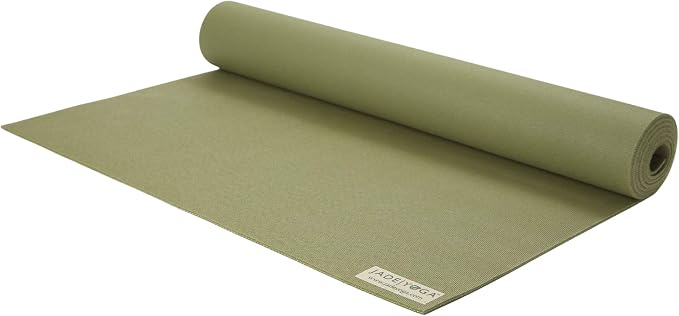
The JadeYoga Harmony curled slightly after 8 months, but the natural rubber meant the curl was mild and the reverse-roll fix worked well.
The mats that curled the worst were the cheap foam mats, the BalanceFrom GoYoga and the HemingWeigh 1-inch models. Those are not really yoga mats, they are exercise mats, and their internal foam breaks down under bodyweight within months. The curl is a symptom of a deeper problem: the mat is too soft to support standing poses, and no fix changes that.
The bottom line
If your mat is curling, try the reverse-roll first. It is free, it takes 12 hours, and it works on mild curls. If that fails, try the weight-and-book method for 48 hours. If that fails, and your mat is PVC, the heat gun approach can buy you a few more months, but use it at your own risk.
If your mat is curling severely within the first six months, return it. That is a defect, not a wear pattern. If your mat is curling after a year or more, the fix is a new mat, and the new mat should be one with a dense internal structure.
The Manduka PRO is the only mat I have tested that does not curl, and it costs about 9 cents a day over five years.
The Gaiam is fine for beginners, but plan on replacing it every 18 months.
A mat that curls is a mat that has lost its structural integrity. You can patch it, heat it, and weight it, but you are buying time, not solving the problem. The fix that actually works is the one where you roll out a mat that does not curl in the first place, and that costs money up front but saves your joints and your patience later.
If you are practicing at home on a mat that curls, and you have tried the reverse-roll and the weight method, and it still lifts, do not teach on it. I watched a student catch her toe on a curled corner in my hot class in 2022, and she sprained her wrist catching herself.
That is why I started testing mats properly, and that is why I am telling you this: a curling mat is not an inconvenience, it is a hazard.