A non-slip yoga mat is a stack of compromises, and the spec sheet is where most of them hide. Thickness, length, and the chemistry of the top layer pull against one another: the cushioned mat that protects your knees is often the one that makes standing balances wobble, and the featherweight mat you will actually carry to class is often the one that bunches under your palms in downward dog. If you have ever bought a mat because the box said 8mm and then quietly stopped rolling it out by week three, the number was not the problem. The missing piece was an explanation of what the number does.
Two things before we start. The links in this article are affiliate links, so I earn a commission if you buy through them, and I would rather say that in the first paragraph than bury it in a footer. And this is an explainer, not a ranking. Four mats, four different jobs, and the reasoning you need to choose between them.
Related: Yoga Mat Thickness: What 5mm and 8mm Actually Change →
Quick answer
Match the mat to your body, your joints, and the floor you practice on, not to the marketing. A thicker mat buys cushioning for knees, wrists, and hard floors at the cost of stability in standing poses. A moderate mat puts you closer to the ground, which most people find steadier for balance work. Length matters more than beginners expect: a 72-inch mat fits taller practitioners who otherwise hang off the end, while a 68-inch mat is the standard studio footprint. Material decides feel, odor, and how the surface behaves once you start sweating. There is no single mat that wins here, only the mat that fits how and where you actually practice.
Four useful options
| Model | Best fit | What stands out |
|---|---|---|
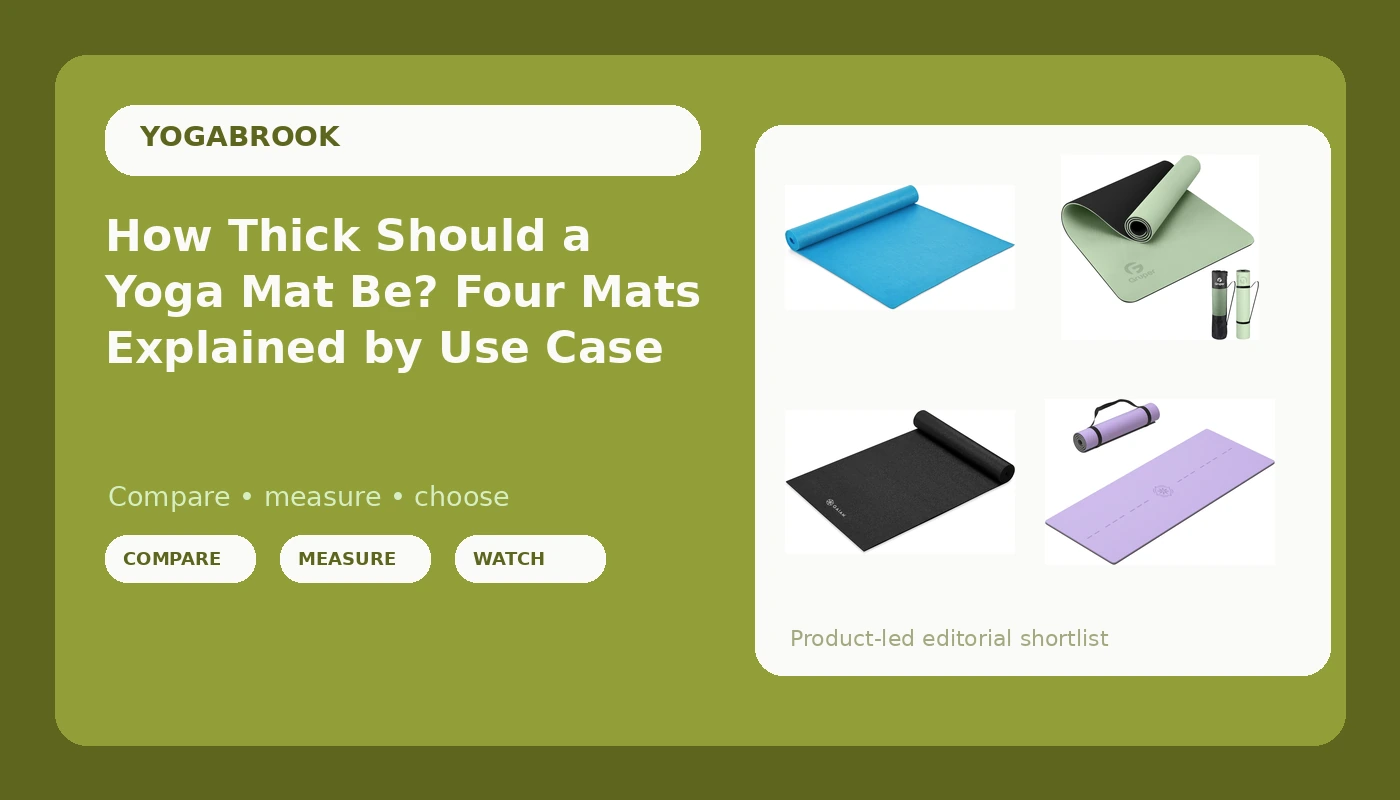
| TPE Yoga Mats 72" x 24", 8mm Non-Slip Exercise Mat with Carry Strap | Taller practitioners and anyone who wants more cushion under knees and wrists | 72-inch length, 8mm thickness, TPE construction, carry strap included |
| CAP Non-Slip Yoga Mat for Home Workout & Pilates, Lightweight Exercise Fitness Mat with Textured Grip Surface, Portable Roll-Up Yoga Mat for Women & Men | A first mat, a travel mat, or a second mat for home workouts | Lightweight roll-up build with a textured grip surface |
| Gruper Yoga Mat Non Slip, Eco Friendly Exercise Mat with Carrying Strap | Home practice where a strap and an eco-labeled build matter to you | Eco-friendly positioning and a carrying strap in the box |
| Gaiam Yoga Mat - Premium 5mm Solid Thick Non Slip Exercise & Fitness Mat for All Types of Yoga, Pilates & Floor Workouts (68" x 24" x 5mm) | The middle of the road: standard size, moderate cushion | 68 by 24 inch footprint at 5mm, the mainstream studio dimensions |
The long, cushioned option: TPE Yoga Mats 72" x 24", 8mm Non-Slip Exercise Mat with Carry Strap
Here is the trade-off you are buying into. Eight millimeters is a lot of foam, and foam compresses. Under your palms in downward dog or plank, a deep mat can let your hands sink, which pushes the wrist into a sharper angle than a firmer surface would. In standing poses, the same softness means your foot has to work harder to find the floor, so balance poses feel less planted. Where that cushion earns its keep is kneeling, seated poses, and any practice on tile, concrete, or a thin apartment carpet over slab. If your knees and wrists are the limiting factor, more thickness helps. If your problem is wobbling in warrior two, it does not.
The lightest way in: CAP Non-Slip Yoga Mat for Home Workout & Pilates
Lightweight is a promise and a warning in the same word. Less material usually means less density, and a less dense mat compresses further under bodyweight, so it feels softer than its nominal thickness suggests. For a beginner testing whether a home practice sticks, that is a completely reasonable place to start, and it is also a sensible second mat to keep in a bag or a car. What it is not is a mat built for a hot room and a daily vinyasa habit; light foam wears faster under repeated loading, and a thin-feeling surface gets less forgiving as it ages.
The eco-labeled middle: Gruper Yoga Mat Non Slip, Eco Friendly Exercise Mat with Carrying Strap
Treat "eco friendly" as a claim to investigate, not a material specification. The two words cover a wide range, from a mat that genuinely uses a plant-based or recycled content top layer to a standard PVC mat with a leaf printed on the box. Before you buy any mat on that promise, look for the actual material named somewhere in the listing: TPE, natural rubber, cork, or a recycled blend. A strap is a small thing, but it matters more than people admit, because a mat that travels easily is a mat that gets used. If the material claim is not spelled out, buy this one for the surface and the strap, not for the word.
The mainstream default: Gaiam Yoga Mat - Premium 5mm Solid Thick Non Slip
Five millimeters at 68 by 24 inches is the shape most yoga classes are designed around, and there is real value in that: mats of this size line up in a studio row, fit standard cubbies, and behave predictably underfoot. Five millimeters is enough cushion to take the edge off a hard floor without the deep sink that makes standing balances vague. The honest limitation of this category is grip over time. A surface that holds when your hands are dry can get noticeably slicker once you are sweating and the top layer has absorbed a season of lotion and body oil, which is why cleaning matters more than any spec on the box.
Prices and availability may change. Product images, names, and retailer links are matched to verified listings. No current price, rating, stock status, or measured result is stated here without current evidence.
How thickness changes what happens under your hands
Mat thickness is measured on the box as a nominal number, and nominal means it describes the intended build rather than a precise gauge at every point. What matters to your body is not the number but how far the material compresses under load. Think of it as three zones. Up to about 5mm, you get enough padding for a hard floor while keeping your palms and feet close to the ground, which is why moderate mats dominate balance-heavy practices. From 6mm to 8mm, cushioning improves and stability starts to slip away, because the foam under your hand deforms before your arm does. Past that, you are into the thick foam mats sold for bad knees and floor workouts, where the surface is comfortable to kneel on and genuinely difficult to balance on.
There is also a length calculation that has nothing to do with thickness. A 68-inch mat suits most people under roughly 5 foot 10 for a full-length lie-down. Above that, your head or heels start to hang off the end, which throws off supine poses and any sequence where you slide back in a lunge. A 72-inch mat solves that problem, and it also means the mat is heavier and bulkier to carry. If you are tall and you practice at home, take the length. If you are tall and you carry your mat six blocks to a studio, weigh how much that extra length is worth to you.
Grip, material, and what "non-slip" actually means
Almost every mat claims to be non-slip, and almost none of those claims specify the condition. A surface can be perfectly grippy when your hands are dry and dangerously slick at minute forty of a heated class. Texture helps with dust and dry skin, but sweat is a chemistry problem. The top layer material decides whether moisture makes the surface tackier or turns it into glass.
The three families you will meet in this price range behave differently. PVC is the cheapest and most common: durable, widely available, and dependent on a surface treatment that wears down over years of use. TPE is lighter, lower in odor out of the box, and generally softer, which makes it pleasant for home practice and less resilient under daily heavy loading. Natural rubber has the best reputation for wet grip, and it also has the strongest smell and the shortest tolerance for being left in a hot car. Whatever the material, the same maintenance rules apply, and they matter more than the marketing copy.
- Measure your height against the mat length before anything else, since a 68-inch mat and a 72-inch mat fit different bodies.
- Decide thickness by your joints and your floor: more cushion for tile and bad knees, less for balance work and stability.
- Match the material to how much you sweat and how sensitive you are to odor, because a mat you dislike the smell of is a mat you will avoid.
- Decide where the mat lives. A mat that stays rolled out at home can be heavy; a mat that travels needs to be light and easy to strap.
- Buy for the practice you have now, not the practice you imagine. A cheap mat used five days a week beats an expensive one used twice.
Practical guidance for keeping grip alive
- Wipe the surface with a damp cloth and a drop of mild soap after sweaty sessions, then let it air dry fully before rolling it up.
- Keep a small towel next to the mat for your hands during hot or long practices, and use it before your palms start sliding.
- Skip lotion on your hands and feet before practice, since oils sit on the top layer and are the most common cause of a mat that suddenly feels slick.
- Unroll a new mat and let it air out for a day or two somewhere ventilated, especially if it arrives with a strong plastic or rubber smell.
- Store the mat rolled, not folded, and keep it out of direct sun and hot cars, both of which break down foam and surface treatments faster than use does.
- Test the mat on the floor you actually practice on, because a surface that grips on carpet can slide on a smooth studio floor.
Which option should you choose?
Choose the TPE Yoga Mats 72" x 24", 8mm Non-Slip Exercise Mat with Carry Strap when you are tall, you practice at home on a hard floor, and your knees or wrists want more cushion than a standard mat provides. Choose the CAP Non-Slip Yoga Mat for Home Workout & Pilates when you want a light, inexpensive mat for home workouts, Pilates, or a bag you keep in the car, and you are not yet asking it to survive a daily hot class. Choose the Gruper Yoga Mat Non Slip, Eco Friendly Exercise Mat with Carrying Strap when you want a strap included and you are willing to verify the material claim rather than take the label at face value. Choose the Gaiam Yoga Mat - Premium 5mm Solid Thick Non Slip when you want the standard studio size and a moderate cushion that keeps you close to the floor for balance work.
One caveat worth stating plainly: thickness figures here are the manufacturers' nominal specs, and grip depends on your sweat chemistry, your floor, and how well you clean the mat. None of that is a measurement I can make for your body in your living room. Use these as decision criteria, not as a promise about how any mat will feel under your hands at minute forty.
The bottom line
Thickness is a budget you spend on cushioning or on stability, and you cannot buy both at once. Length is a fit question that taller practitioners should settle first. Material is the part that decides whether the surface keeps holding once you are warm and wet, and maintenance decides whether it keeps holding a year from now. Pick the mat that matches your height, your floor, and how often you honestly roll it out, and treat every non-slip claim on a box as an unfinished sentence until you know the conditions it was written for.